The volcanic heartbeat of American crime cinema — from Michael Corleone's cold ascent to Tony Montana's operatic downfall. The actor who turned intensity into an art form and made every scene feel like the last one.
Portrait · Al Pacino
Born Alfredo James Pacino on April 25, 1940, in the East Harlem neighborhood of Manhattan, he was raised largely by his Sicilian-immigrant grandparents after his parents divorced when he was two. He dropped out of the High School of Performing Arts at seventeen, working as a building superintendent, messenger, and theatre usher to fund his studies at the HB Studio and then the Actors Studio under Lee Strasberg.
His first major film, The Panic in Needle Park (1971), demonstrated a frightening commitment to inhabited realism — the performance that made Francis Ford Coppola cast him against studio opposition as Michael Corleone in The Godfather (1972). The studio wanted someone with a face you couldn't look away from. Coppola understood that Pacino's face was the face of someone becoming something he would not be able to stop.
The 1970s were a run of sustained brilliance almost without parallel in American cinema: The Godfather Part II, Serpico, Dog Day Afternoon, ...And Justice for All — five films that earned him five consecutive Oscar nominations and established the template for American screen acting for a generation. He was nominated five years running between 1973 and 1975 without winning, and did not win until Scent of a Woman in 1993.
Two Tony Awards for Does a Tiger Wear a Necktie? (1969) and The Basic Training of Pavlo Hummel (1977) confirmed that his intensity was as effective in the theatre as on screen — a fact he has continued to demonstrate in stage work across six decades.
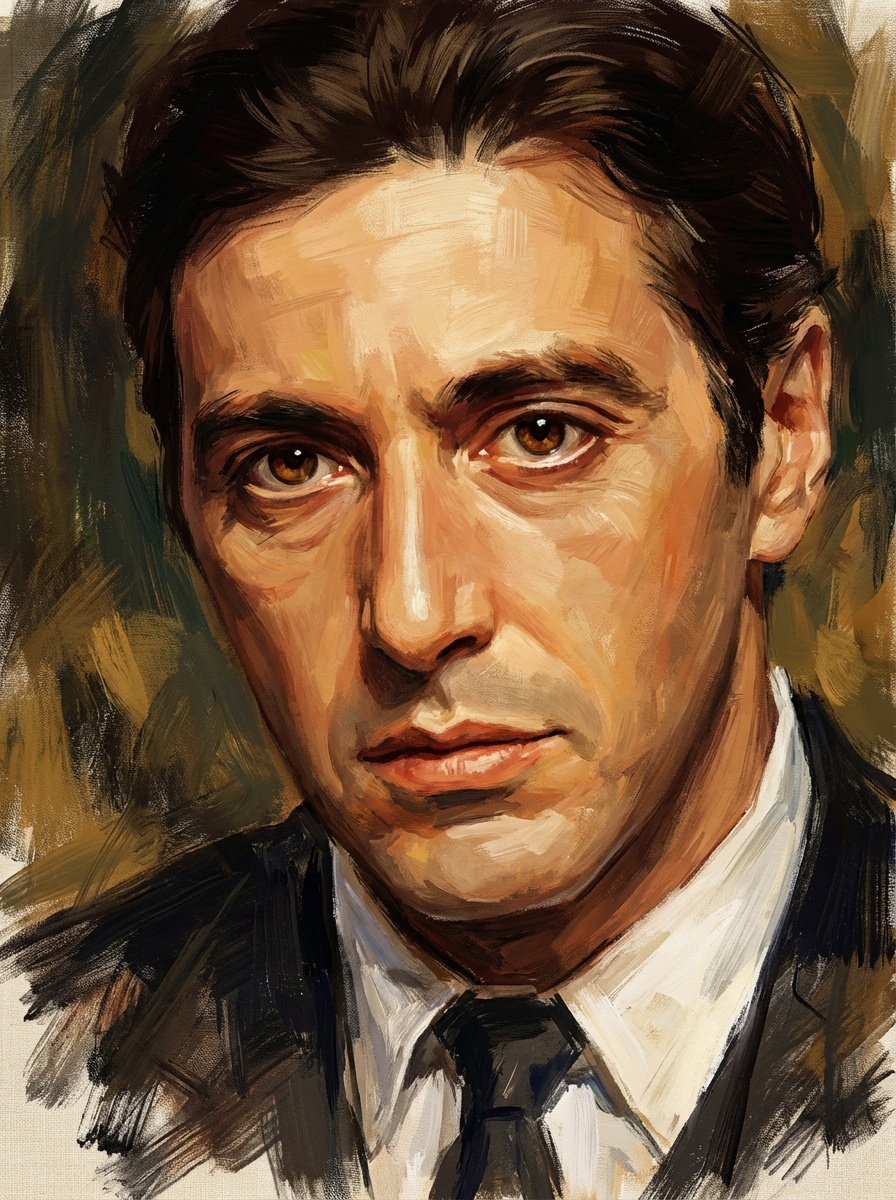
Michael Corleone's transformation from civilian to patriarch is the greatest arc in American cinema, and Pacino performs it with ice-cold precision. The restaurant scene — Michael's first murder — is a study in controlled terror. Every choice is irrevocable, and he knows it.
Where The Godfather showed Pacino's capacity for cold control, Dog Day Afternoon showed what happened when he let everything out. Sonny's cry of "Attica! Attica!" to the crowd outside is pure instinct made performance. The man is genuinely funny here, and that makes everything else hit harder.
Pacino inhabits Serpico's hippie-cop isolation with total conviction — the beard, the beret, the creeping paranoia are all worked from the inside out. His finest sustained realistic performance: no operatics, just a man trying to stay honest in a system designed to punish him for it.
Tony Montana is not subtle, and that's the point — he is appetite made flesh, American ambition stripped of every polite fiction. Pacino's performance operates at a pitch most actors are afraid to attempt. Say hello to my little friend is not acting — it's mythology. The film became a cultural text, and he became its prophet.
The diner scene — Pacino and De Niro sharing a table for the first and only time — is one of cinema's great encounters: two forces of nature in the same frame, perfectly calibrated. Pacino plays Hanna as a man so devoted to the hunt that everything else has already been destroyed. He understands De Niro's McCauley because he has become the same thing on the other side of the law.
The camera has a love affair with certain people. When the camera sees them, it just falls in love.
Al Pacino is to American crime cinema what Cary Grant was to screwball comedy — the form's perfect instrument. His face in 1972, in the doorway of a garden in Sicily, registers the decision that makes Michael Corleone, and the door that closes forever behind him is the door that defines a genre. Everything that followed — Scarface, Heat, Donnie Brasco, The Irishman — exists in the space that performance opened.
The intensity that sometimes tipped into excess in his later career was always, at its best, the honest expression of a performer who didn't know how to take the easy road. He cared too much, always, and that caring — which could be exhausting and magnificent in the same moment — is what made him irreplaceable.