Seven-time Mr. Olympia. The biggest action star of the 1980s. Governor of California. A man who arrived from a small Austrian village and became — through an act of sheer, documented will — an American institution.
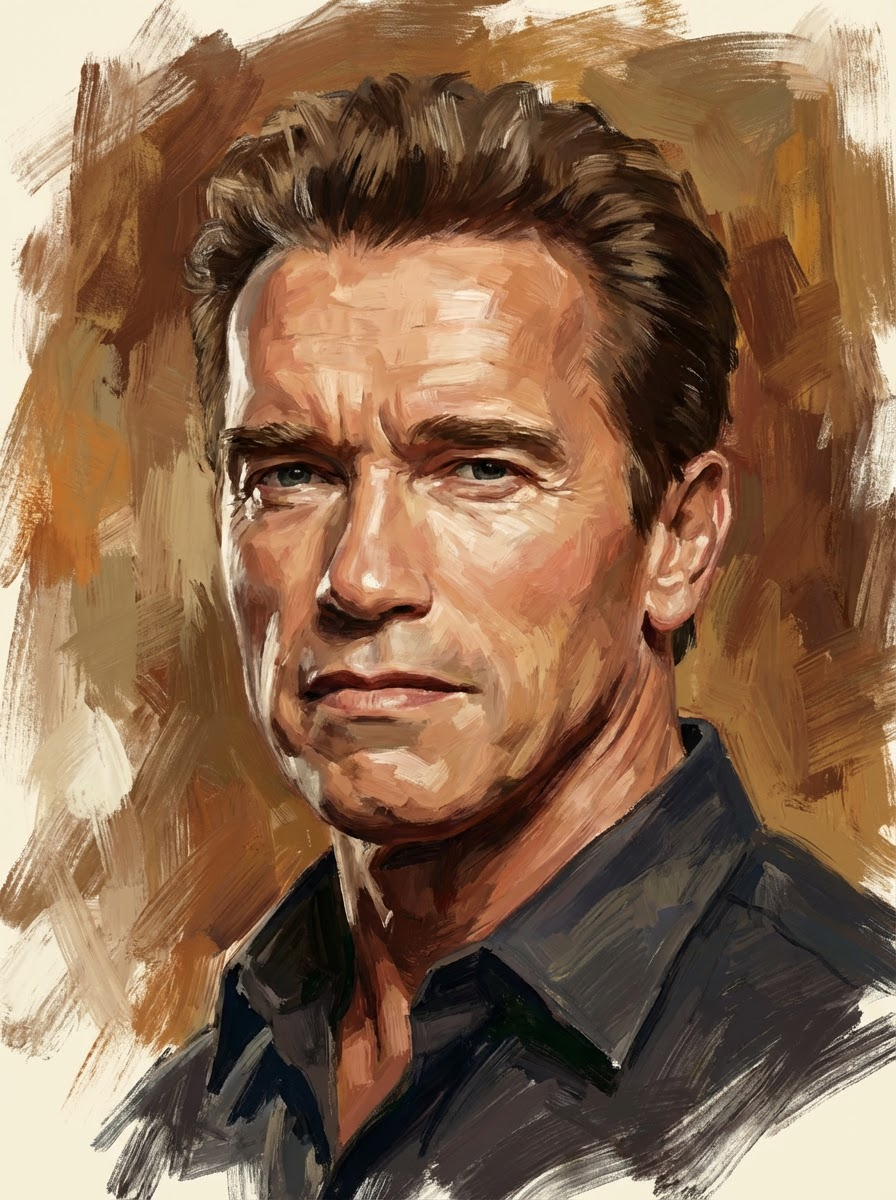
Portrait · Arnold Schwarzenegger
Born Arnold Alois Schwarzenegger on July 30, 1947, in Thal, Styria, Austria — a small village outside Graz — to a police chief father and a homemaker mother, he decided at age fourteen that he would become a bodybuilding champion and then go to America. He treated this as a plan, not a dream. By fifteen he was training seriously. By twenty he was Mr. Universe.
He won the Mr. Olympia title seven times between 1970 and 1980, dominating the sport so completely that the 1977 documentary Pumping Iron turned him into a mainstream celebrity. The film revealed not just a physique but a personality — charismatic, psychologically acute, darkly funny — that would prove perfectly adapted to the screen.
The role of The Terminator in James Cameron's 1984 film was his definitive creation — a performance of pure physical cinema in which his limitations as a naturalistic actor became precisely the right qualities for an emotionless machine. His delivery of "I'll be back" became the most quoted line in action cinema history, and the franchise continued for four decades.
Elected Governor of California as a Republican in the 2003 recall election, he served two terms until 2011 — a political career that, whatever its outcomes, was structurally another iteration of the same immigrant-makes-it story that his entire life had been telling. He was the first foreign-born governor of California since 1862.
What looked like a casting shortcut — give the big Austrian the part that requires no warmth — turned out to be perfect cinema. Schwarzenegger's stillness, his economy of expression, his reading of "I'll be back" as pure declarative fact: all of it is exactly right. He understood that the machine doesn't perform — it simply is.
The film works because Schwarzenegger plays Dutch as genuinely afraid, not just physically endangered — a man who meets something he cannot out-muscle and must out-think. The mud sequence remains one of action cinema's most purely satisfying moments of improvised ingenuity.
Verhoeven pushed Schwarzenegger into comedic and paranoid registers he hadn't accessed before, and the film is richer for it. The question of what is real is never fully resolved. His performance as a man who cannot be sure of his own identity is his most intellectually interesting work.
The thumb-up in the final descent into molten steel landed because Schwarzenegger had earned it — he spent the film building a relationship with a child that audiences believed. The machine learning to be human turned out to be the most human story he ever told.
His willingness to be the butt of the joke — to play perfectly straight against DeVito's chaos — revealed a comedic intelligence that his action roles rarely required. It remains his most charming performance, and one of the shrewdest career pivots of the 1980s.
I'll Be Back.
Arnold Schwarzenegger is a phenomenon that Hollywood could not have manufactured because it required a life, not a career plan. His bodybuilding titles, his film career, his governorship, his continued public presence in his seventies — each chapter has been lived with the same focused ambition that he described, with unusual self-awareness, as the engine of everything.
The Terminator franchise he anchored remains one of cinema's most durable, precisely because the central image — a machine that cannot be stopped, that keeps getting up, that says what it means — was not a metaphor for Schwarzenegger. It was a description. "I'll be back" is the most honest line he ever delivered, and he has been making good on it ever since.