Singer. Actress. Director. Producer. A voice that bent popular music to its will, and a talent that conquered every stage, screen, and studio it touched across six decades.
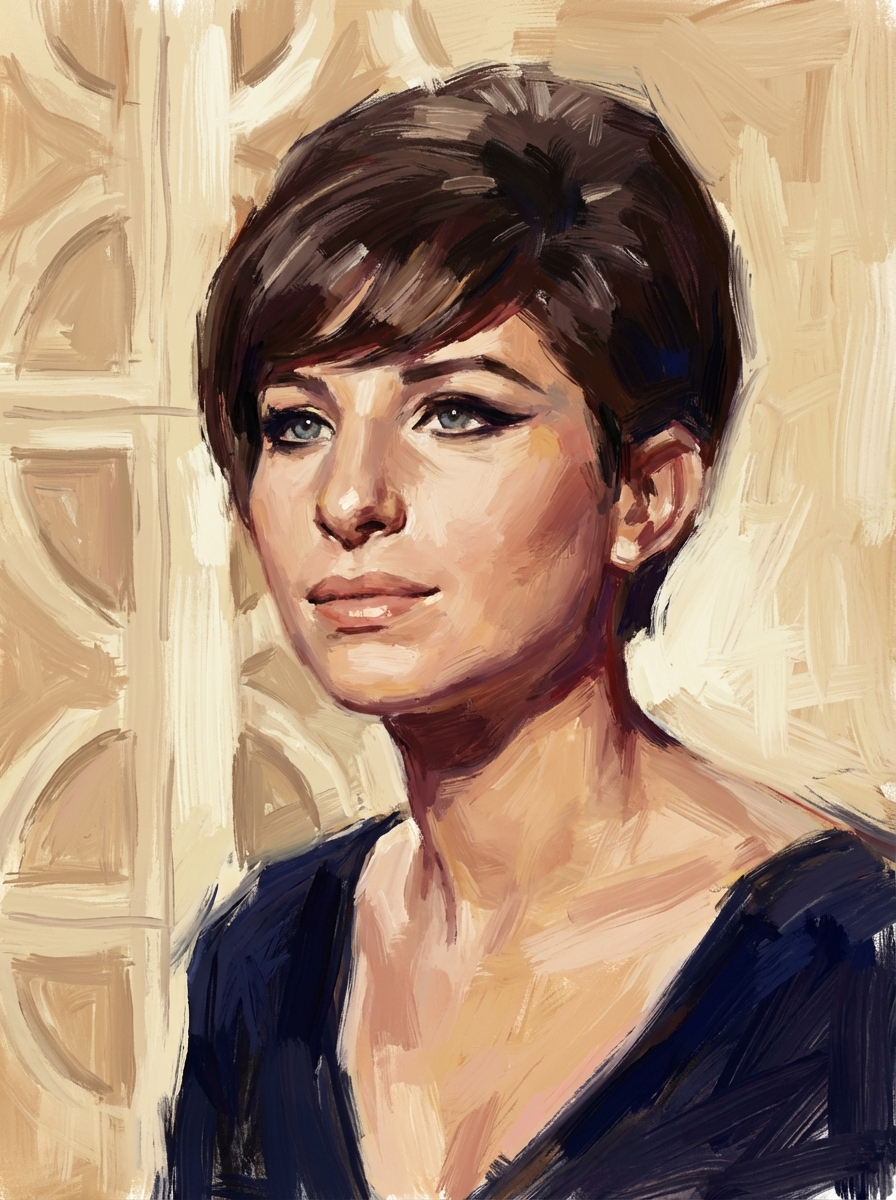
Portrait · Barbra Streisand
Born on April 24, 1942, in Brooklyn, New York, Barbara Joan Streisand grew up in a modest household shaped by the early death of her father. She taught herself to sing by listening to records, and at eighteen she was performing in Greenwich Village clubs, dropping the second "a" from her name to seem more distinctive. Manhattan took notice fast.
Her 1962 Broadway debut in I Can Get It for You Wholesale earned her a Tony nomination at nineteen. Two years later, Funny Girl made her the most talked-about performer in New York — a physical comedian, a dramatic actress, and a vocalist of staggering range all at once. The London transfer and subsequent film cemented her as a global star.
In Hollywood, Streisand moved with unusual autonomy. She negotiated creative control early, producing her own films before it was fashionable for actresses to do so. Her 1983 directorial debut Yentl — which she also wrote, produced, and starred in — remains one of the most personal studio films of the decade, and she became the first woman to win the Golden Globe for Best Director.
As a recording artist, she charted in six consecutive decades — a feat matched by no other solo performer. Her voice, described as a perfect instrument of emotional intelligence, shaped American popular song from the Brill Building era through arena pop.
Director William Wyler's adaptation showcased Streisand as an electrifying comedic and dramatic force. "People" and "Don't Rain on My Parade" became instant standards. She tied Katharine Hepburn for Best Actress — the only tie in Oscar history.
Opposite Robert Redford, Streisand delivered one of cinema's most emotionally intelligent performances — nominated for Best Actress, with Marvin Hamlisch's title theme becoming one of the most recognizable in film history. The nostalgia it generated was inescapable.
Co-produced by Streisand herself, the film was the highest-grossing of 1976. "Evergreen" — which she co-wrote — won the Academy Award for Best Original Song, adding a second Oscar to her collection and cementing her cross-genre dominance.
Streisand became the first woman to win the Golden Globe for Best Director for this film. The Michel Legrand score won two Academy Awards. A passion project of extraordinary personal conviction.
Among the most dramatically demanding of Streisand's performances, pitting her against Richard Dreyfuss in a chamber film of controlled fury. She also produced, demonstrating her continued insistence on creative authority.
I arrived in Hollywood without having my nose fixed, my teeth capped, or my name changed. That was quite a revolution.
Barbra Streisand is one of the best-selling music artists of all time, with estimated sales exceeding 150 million records worldwide — a figure that puts her in the company of Elvis, The Beatles, and Michael Jackson. More remarkably, she has had charting albums in six consecutive decades.
As a filmmaker, she remains one of only a handful of women to direct a film that grossed over $100 million worldwide. Her complete command of multiple art forms simultaneously — voice, screen acting, directing, producing, songwriting — has no real equivalent in American entertainment history.
The term EGOT (Emmy, Grammy, Oscar, Tony) was partly coined with artists like her in mind. She holds all four, plus the Presidential Medal of Freedom, the Kennedy Center Honor, and the American Film Institute Lifetime Achievement Award.