The actress who sued Warner Bros. and lost, then won by winning every argument that mattered. Two Oscars, ten nominations, and a career that refused to end on anyone else's terms — conducted with a ferocity that the industry had never seen from a woman and spent decades trying to categorise.
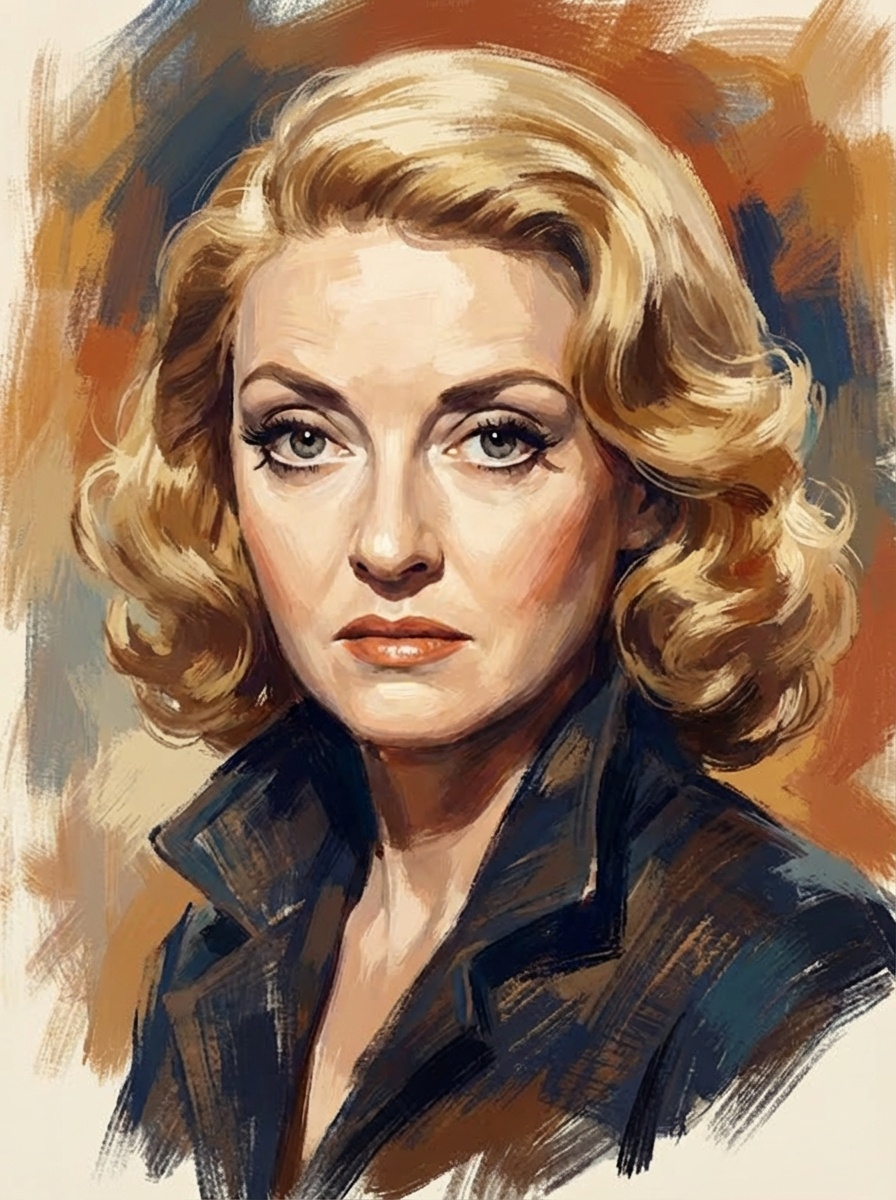
Portrait · Bette Davis
Born Ruth Elizabeth Davis on April 5, 1908, in Lowell, Massachusetts — the elder of two daughters of a divorcing marriage, she was raised by her mother and grew up in relative poverty after her father left. She studied acting at John Murray Anderson's School for the Theatre in New York, was rejected by Eva Le Gallienne's Civic Repertory Theatre, and arrived at Universal in 1930 still unknown enough that a studio representative reportedly failed to find anyone who looked like a movie star in the group he met at the train station.
By 1935 she had won her first Academy Award for Dangerous, and by 1938 her second for Jezebel. In 1936 she sued Warner Bros. to escape a studio contract she considered slavery — citing an English case, she lost in an English court — but the moral victory established her as an actress of unusual conviction, and Warner's responded by giving her better material.
Her performance as Margo Channing in All About Eve (1950) is the summit of her career and arguably the finest performance by any actress in Hollywood's sound era. The film, directed by Joseph L. Mankiewicz, gave Davis dialogue of extraordinary wit and venom, and she delivered it with the precision and attack of someone who had been waiting her whole career for the role.
In her sixties she found a second wind in horror — What Ever Happened to Baby Jane? (1962), paired with her long-time enemy Joan Crawford, became a cultural event and earned her tenth Oscar nomination, making her the most-nominated actress in Academy history at that point. She spent her last decade still working, still formidable, still the most electric presence in any room she entered.
"Fasten your seatbelts — it's going to be a bumpy night." Davis delivers the line as a declaration of war, a self-assessment, and a preview of the next two hours simultaneously. Her Margo Channing is the greatest performance in American cinema, and the film knows it, and so does she.
The film's famous closing line — "Oh, Jerry, don't let's ask for the moon. We have the stars" — lands because Davis has earned it across two hours of authentic transformation. Her Charlotte is not a makeover but a rebirth, and Bette Davis plays the interior work that makes it credible.
Davis and Wyler's working relationship was legendarily difficult and legendarily productive — he made her do take after take until the performance shed every trace of performance and became something else. The red dress scene is one of studio Hollywood's great moments of pure dramatic charge.
Davis prepared for Jane by eating almost nothing, wearing thick stage makeup, and performing at a pitch that should have been absurd and is instead terrifying. The fact that she did this opposite her genuine enemy Joan Crawford added a layer of reality that no director could have written. Her tenth Oscar nomination, for the most extreme performance of a fearless career.
Regina Giddens is one of American drama's great villains, and Davis plays her without mitigation — no softening backstory, no redeeming gesture, no wasted sympathy. She is the bad thing at the centre of the world the film describes, and she knows it, and she doesn't care.
Fasten your seatbelts. It's going to be a bumpy night.
Bette Davis' legacy is structural as much as artistic. She was the first woman to fight a studio publicly over creative control and force the system to reckon with the concept that actresses had artistic agency. Every actress who has negotiated creative rights since 1936 did so in a landscape she altered by losing a lawsuit that she effectively won.
As an artist, she is the origin point of a tradition — the actress who plays difficult women without softening them, who treats her audience as adults capable of being interested in people who don't deserve their sympathy. From Margo Channing to Meryl Streep's Miranda Priestly, from Baby Jane to Glenn Close's Alex Forrest, the lineage runs through Davis. She invented the mode; everyone else is working in her tradition.