Former circus acrobat turned Oscar winner — the most physically spectacular and intellectually curious actor of his generation. The man who convinced Hollywood that a body could be an instrument of art.
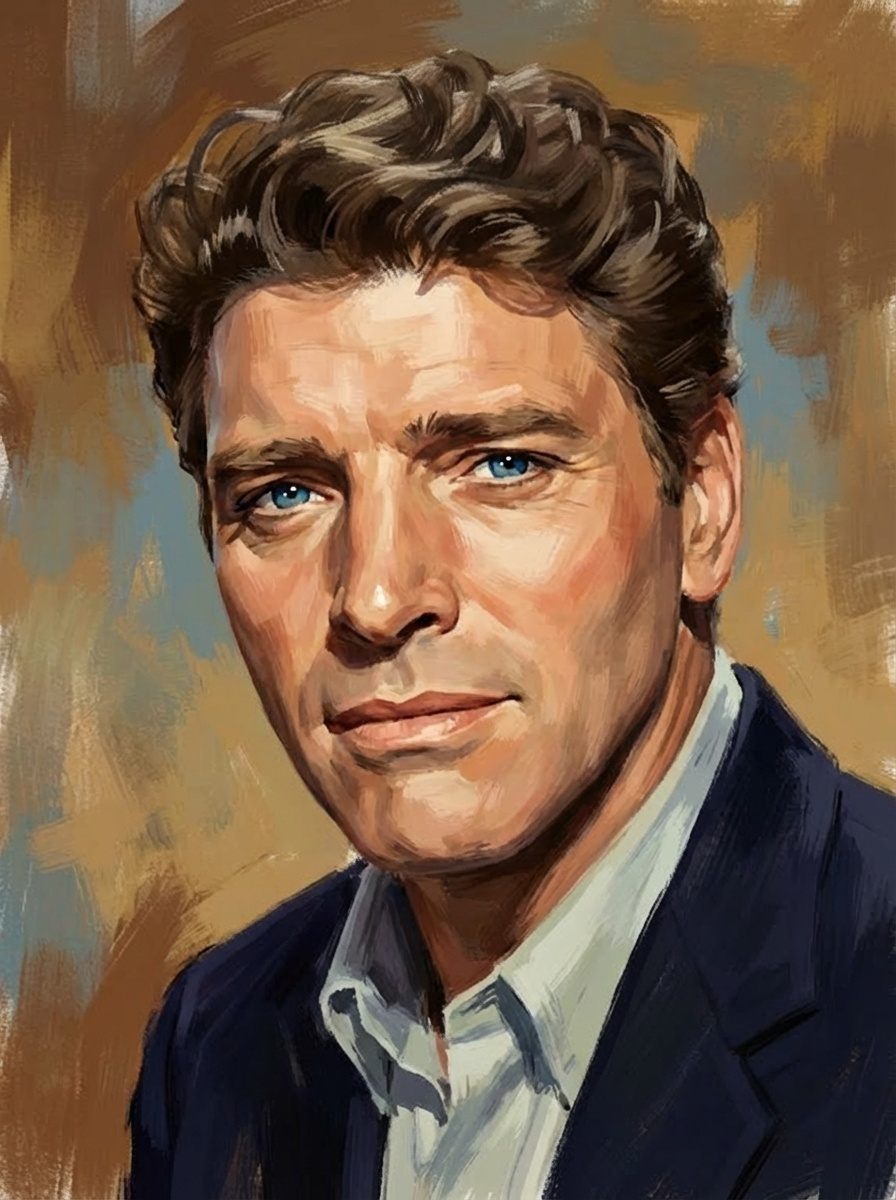
Portrait · Burt Lancaster
Born Burton Stephen Lancaster on November 2, 1913, in the East Harlem neighbourhood of Manhattan — the same neighbourhood that would produce Al Pacino twenty-seven years later — he grew up in a working-class family and was performing as an acrobat with the Kay Brothers Circus by his early twenties. Service in World War II interrupted the circus career, and on returning he was discovered by a talent agent at a party and cast in his first film with no prior acting experience.
His debut in The Killers (1946), adapted from Hemingway, established the template immediately: a body like a weapon, a stillness that read as either menace or strength depending on context, and an emotional directness that most trained actors took years to develop. He was twenty-eight years old and had never acted professionally before.
One of the first actors to form his own production company, Hecht-Lancaster, he produced films of unusual ambition — including Marty (1955), which won the Palme d'Or and the Best Picture Oscar. His Oscar came for Elmer Gantry (1960), Richard Brooks' scorching portrait of an evangelical con man — a performance of terrifying, charming, unstoppable force.
Luchino Visconti cast him as the aging Prince in The Leopard (1963) — a daring choice that paid off in one of cinema's most unexpectedly interior performances: Lancaster's aristocrat watching his world dissolve with a grandeur that is entirely earned. In his final decade, Louis Malle's Atlantic City (1980) gave him his last masterwork — an old man's late, tender, impossible romance.
There has never been quite a performance like Elmer Gantry in American cinema — a man who believes every word he's saying while meaning none of it, a hypocrite so complete he has passed through hypocrisy to something almost like sincerity. Lancaster plays it at full volume and full depth simultaneously.
The beach kiss with Deborah Kerr — waves washing over two intertwined bodies — entered the cultural vocabulary permanently. But the film's real achievement is Lancaster's performance of military honor alongside personal desire, holding both without flinching. His Warden is one of Hollywood's great studies in controlled feeling.
Visconti's choice of the American action star for the Sicilian aristocrat was widely derided before filming began. The result silenced every critic. Lancaster's Prince carries a lifetime of privilege and its discontents in every gesture — the ballroom sequence is forty-seven minutes long and seems shorter than any action scene he ever filmed. His greatest performance.
At sixty-seven, Lancaster found a register no one had asked him for before — tender, faded, tenderly self-deluded — and made it the most moving performance of his career. The scene in which he watches Susan Sarandon rub herself with lemon juice through her window is one of cinema's most perfectly observed acts of quiet longing.
In a film of spectacular performances — Tracy, Clift, Garland, Schell — Lancaster's central performance is the most quietly devastating. Janning barely speaks for the first half of the film, and when he finally does, the effect is extraordinary. His long silence is the film's moral argument.
I always tried to make films about something — about ideas. The physicality was never the point. The point was always the person inside it.
Burt Lancaster represents a path in American cinema that was not widely taken and is now essentially unavailable: the major commercial star who also demanded to be taken seriously as an artist, backed that demand with his own production capital, and made it stick. He produced Marty, which won Best Picture. He hired Luchino Visconti. He worked with Louis Malle at sixty-seven. The consistency of ambition across fifty years is remarkable.
His physicality — the acrobat's precision, the chest, the smile that was somehow simultaneously warm and predatory — was always in the service of something more than itself. He refused to be decorative. Even when the films were genre products, he brought a seriousness of purpose that elevated them, and when the films were works of art, he met them fully prepared. He is the rare case where the physical and the intellectual were genuinely and equally extraordinary.