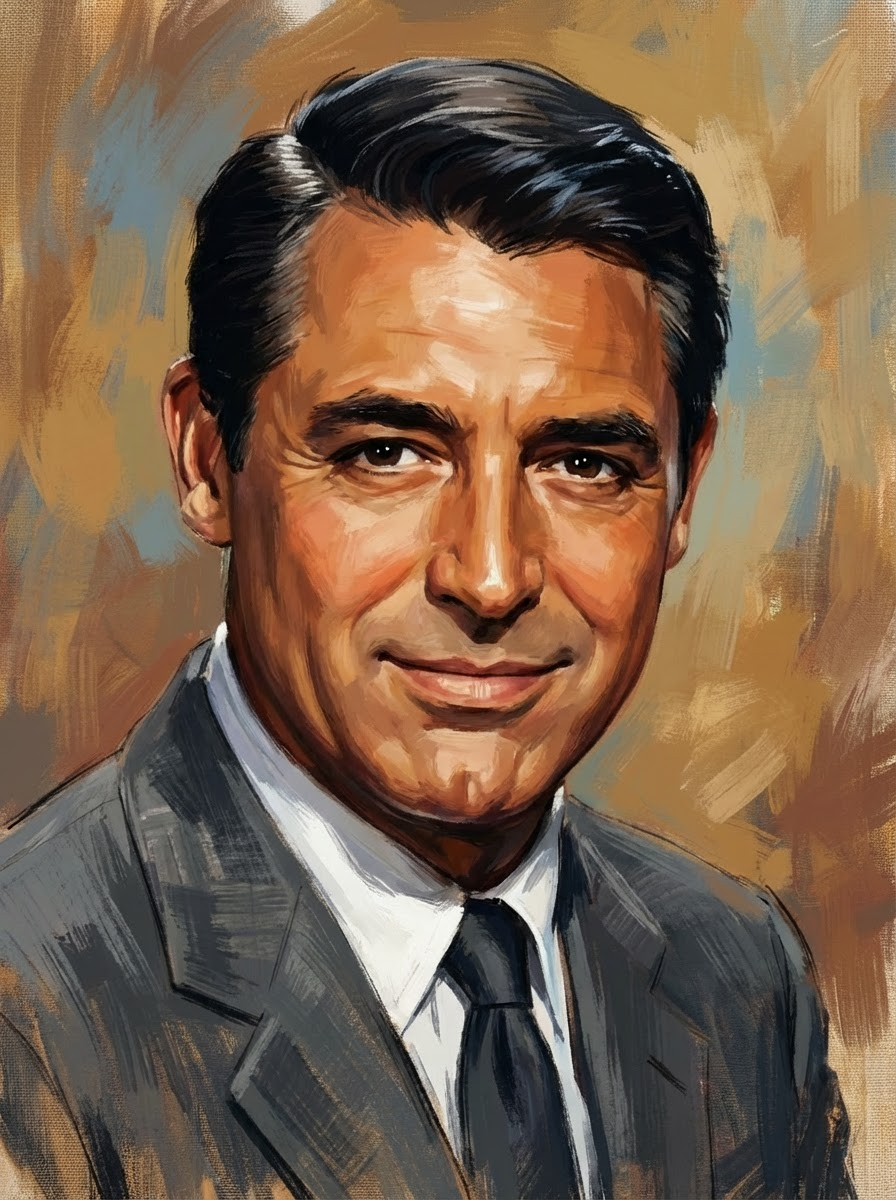
The unreachable standard. Four Oscar nominations, zero wins — because the Academy never quite figured out how to give a prize to a man who made the hardest thing in acting look like no effort at all. The most imitated, least duplicated movie star who ever lived.
Portrait · Cary Grant
Born Archibald Alec Leach on January 18, 1904, in Horfield, Bristol — a working-class childhood marked by his mother's sudden, unexplained disappearance into a psychiatric institution when he was nine. He was told she had died. He would not discover she was alive until he was thirty. He left school at fourteen to join the Bob Pender acrobatic troupe, came to America with them in 1920, and never went back.
He arrived in Hollywood in 1931, adopted the name Cary Grant, and within two years was appearing opposite Marlene Dietrich, Mae West, and Katharine Hepburn. He had no formal training and apparently no technique visible from the outside — which was itself a technique of extraordinary sophistication. Directors spent their careers trying to understand what he was doing and generally concluded that he wasn't doing anything you could teach.
His mastery of screwball comedy — in Bringing Up Baby (1938) and His Girl Friday (1940) — came from a physical precision inherited from his acrobat training: he could time a double-take to the fraction of a second, and his pratfalls had the beauty of planned gymnastics. His dramatic range, on display in Notorious (1946) and None But the Lonely Heart (1944), was rarely deployed but always present.
He retired from acting in 1966, aged sixty-two, at the absolute peak of his popularity — the only major star to retire voluntarily while still a box office draw — and never returned. He received an Honorary Oscar in 1970. He died of a stroke in Davenport, Iowa, in 1986, before a one-man show he had been giving for decades.
Grant and Rosalind Russell overlap each other's dialogue so completely that the film seems to operate at a different tempo than real life — a hothouse of pure verbal energy in which Grant's timing, even when being interrupted, is exact. His Walter Burns is one of cinema's great comic performances hiding as something else entirely.
Devlin's love for Alicia is inseparable from his willingness to destroy her, and Grant holds that paradox without explaining it. The long kiss that Hitchcock staged around censorship restrictions is the most erotic sequence in his filmography — and Grant's stillness in the face of Bergman's desire is the film's engine.
Grant at fifty-five, in a grey flannel suit, fleeing across a cornfield from a crop duster — and he makes you believe every second of it. The genius of North by Northwest is that it requires its star to be ridiculous and magnificent simultaneously, and Grant is the only person it could have worked for. The film is pure cinema, and he is its perfect instrument.
The tortoiseshell glasses, the rising panic, the pratfalls delivered with the precision of a trained acrobat — Grant's Dr. Huxley is the perfect reactive comedian, which is the hardest kind. A film that failed on release and is now considered one of the greatest comedies ever made.
At fifty-nine, Grant was so self-aware about the absurdity of the romantic lead age gap that he insisted the film acknowledge it — and the acknowledgment made it charming rather than uncomfortable. His final great film, and the most relaxed he ever seemed on screen.
Everyone wants to be Cary Grant. Even I want to be Cary Grant.
Cary Grant is the standard. Not one of the standards — the standard. When critics, directors, and fellow actors reach for a benchmark for screen presence, comedy, romantic leading, or the quality of making hard things look easy, they reach for Grant. He was nominated for two Oscars and never won, which says more about the Academy than about him.
The famous quote — "Everyone wants to be Cary Grant; even I want to be Cary Grant" — contains the whole mystery. He understood that his persona was a creation, was slightly bewildered by how completely it had succeeded, and took it seriously anyway. He turned Archibald Leach into Cary Grant, and then Cary Grant into the definition of something that had no name before him and still doesn't have a better one.