Paris, France · 1903 – 1996

Claudette Colbert

Born in Paris, raised in New York, crowned in Hollywood — the most technically accomplished comic actress of the screwball era and the only woman to match Clark Gable line for line, glance for glance, and come out ahead.

1
Academy Award
Won
3
Oscar
Nominations
60+
Film
Credits
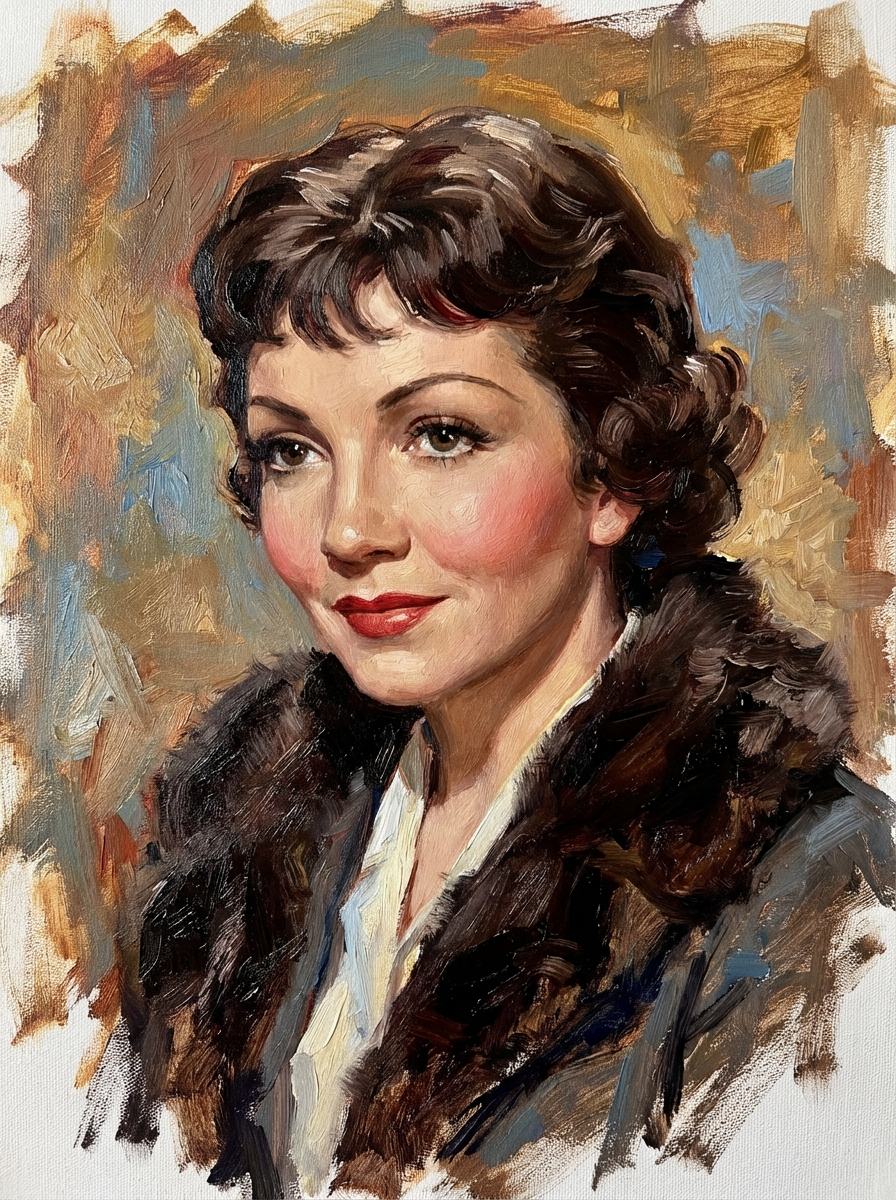
Claudette Colbert — painted portrait Portrait · Claudette Colbert

From Paris to Hollywood — the Long Way Round

Born Émilie Claudette Chauchoin on September 13, 1903, in Saint-Mandé, Paris — her family emigrated to New York when she was six, and she grew up bilingual in lower Manhattan. She studied fashion design before drifting into theatre in the mid-1920s, landing on Broadway under her adopted name and quickly establishing herself as an actress of unusual wit and precision.

Paramount signed her in 1929. She proved equally capable of Cecil B. DeMille spectacle — Cleopatra (1934), in which she reputedly bathed in asses' milk — and intimate comedy. Her Oscar came for It Happened One Night (1934), opposite Clark Gable, though she accepted the award at a train station before boarding a cross-country trip, having been told she hadn't won. She was brought back and the ceremony waited.

Her partnership with director Preston Sturges produced two of the finest screwball comedies ever made: The Palm Beach Story (1942) and the earlier Remember the Night (1940). Sturges understood her particular genius — an intelligence so quick it registered as lightness, a warmth that could turn frosty without warning — and built films around it. Her Gerry Jeffers in The Palm Beach Story is a masterclass in getting what you want while pretending you're not sure what you want.

She retired from films in the early 1960s, moving to Barbados, where she lived for the rest of her long life, making occasional stage and television appearances into her eighties. She died in 1996, aged ninety-two — the longest life of any major Hollywood star of the classic era.
1903
Born in Saint-Mandé, Paris; emigrates to New York at six
1920s
Broadway debut; Paramount contract signed 1929
1934
Oscar won — It Happened One Night; collected at train station
1934
Cleopatra — DeMille; the milk bath; spectacle acting
1942
The Palm Beach Story — Sturges; screwball peak
1944
Since You Went Away — Oscar nom; wartime drama
1996
Dies in Barbados, aged 92

From It Happened One Night to The Palm Beach Story

1934Screwball Comedy · Romance
It Happened One Night
Capra's road-trip masterpiece — Colbert as Ellie Andrews, the runaway heiress whose initially combative journey with Clark Gable's reporter becomes the defining screwball romance. She didn't want the part, didn't want Gable, and swept the Oscars anyway.
Oscar Win

Colbert accepted the role only after her fee demands were met and then determined to hate every moment of it. What the camera caught instead was a performer at the height of her powers — the hitchhiking scene, the Walls of Jericho, the finale — all executed with a precision that looked like spontaneity. The best trick of her career was making it look like Gable's film while ensuring it was hers.

1942Screwball Comedy · Satire
The Palm Beach Story
Preston Sturges' anarchic comedy of remarriage — Colbert as Gerry Jeffers, who leaves her impractical husband to find a richer one in Florida, only to complicate matters in every direction. Her finest performance — speed, wit, and feeling in perfect proportion.

The film opens with a prologue that raises more questions than it answers and never explains itself — Sturges trusted Colbert to carry the contradiction, and she does. Her Gerry is the most modern of screwball heroines: she knows exactly what she's doing, and does it anyway, with full knowledge of the irony. The Ale and Quail Club sequence is the funniest single scene in 1940s comedy.

1934Epic · Historical
Cleopatra
Cecil B. DeMille's spectacular Egyptian epic — Colbert as Cleopatra, navigating Caesar and Antony across two hours of gilded extravagance and political intrigue. An Oscar nomination and the role that proved she could do spectacle as well as intimate comedy.
Oscar Nom

DeMille's Cleopatra requires its actress to be at once regal, sensual, politically ruthless, and ultimately tragic — a range that most actresses of the era would have distributed across several films. Colbert does it in one, with the milk bath and the barge and the asp, and makes none of it ridiculous. She is the best Cleopatra the screen has produced, and she did it twenty-nine years before Elizabeth Taylor.

1944Drama · Wartime
Since You Went Away
John Cromwell's wartime home-front drama — Colbert as Anne Hilton, the wife and mother holding a family together while her husband is overseas. Her third Oscar nomination, for her most restrained and most genuinely affecting performance.
Oscar Nom

The comedy had always been rooted in intelligence; here the intelligence is rooted in love, and the result is a performance of sustained emotional dignity that surprised everyone who knew her only from the screwball films. Anne Hilton's grace under the accumulating pressures of wartime absence is one of Hollywood's finest portraits of practical courage.

"

I have always liked the opposite of what I was supposed to like, which has made my life very interesting and my directors very nervous.

— Claudette Colbert

One Oscar Collected at a Train Station

Academy Award — Best Actress
1935
It Happened One Night
Collected at a train station before boarding a cross-country trip — she had been told she hadn't won
Oscar Won
Academy Award — Nominations
1935 · 1935 · 1945
It Happened · Private Worlds · Since You Went Away
Three nominations — comedy and drama both recognized
3 Nominations
AFI Female Screen Legend
1999
12th Greatest Female Legend
American Film Institute ranked among the greatest female screen legends of all time
AFI Legend
Kennedy Center Honors
1989
Lifetime Achievement
Honored for her contribution to American performing arts — at eighty-six, still vital
Kennedy Center

Intelligence Disguised as Lightness

The Left Profile
She famously refused to be photographed from the right — a vanity that drove directors to distraction and produced, as a side effect, a consistent visual intimacy with the camera that gave her close-ups an unusual quality of directness.
Speed
Her delivery was the fastest in Hollywood — she could process and respond to a line before the audience had finished hearing it, which created the effect of a mind running slightly ahead of the scene. Sturges built his films around this quality deliberately.
Parisienne Roots
Her French birth and bilingual childhood gave her a detachment from American social conventions that read on screen as sophistication — she could play the ingénue and the sophisticate because she genuinely understood both, and found both slightly ridiculous.
The Long Life
She died at ninety-two — the longest life of any major Hollywood star of the classic era — having retired to Barbados and simply lived well, making occasional returns to the stage when the material interested her. She outlasted her era by a generation.

The Woman Who Made It Happen One Night

Claudette Colbert is the finest comic actress of the screwball era and one of the most technically accomplished performers Hollywood has produced — a woman whose intelligence was so fast it registered as effortlessness, and whose effortlessness concealed a precision that directors only fully appreciated when they tried to replicate it with someone else. Nobody could.

The hitchhiking scene in It Happened One Night — in which she lifts her skirt to stop traffic where Gable's thumb has failed — is the defining image of her career and one of Hollywood's great unscripted moments. It was her idea. Of course it was.

Academy Award
Collected at a train station, 1935
1
Oscar Nominations
Three across two genres
3
Age at Death
Longest-lived major Hollywood star
92
AFI Female Legend Rank
Among the greatest ever
#12