San Francisco, California · Born 1930

Clint Eastwood

The Man with No Name. Dirty Harry. William Munny. Walt Kowalski. An actor who invented himself twice — first as the laconic gunfighter of Leone's spaghetti Westerns, then as one of America's finest directors. Still working at ninety-four.

4
Academy Awards
as Director
40+
Films
Directed
60+
Acting
Credits
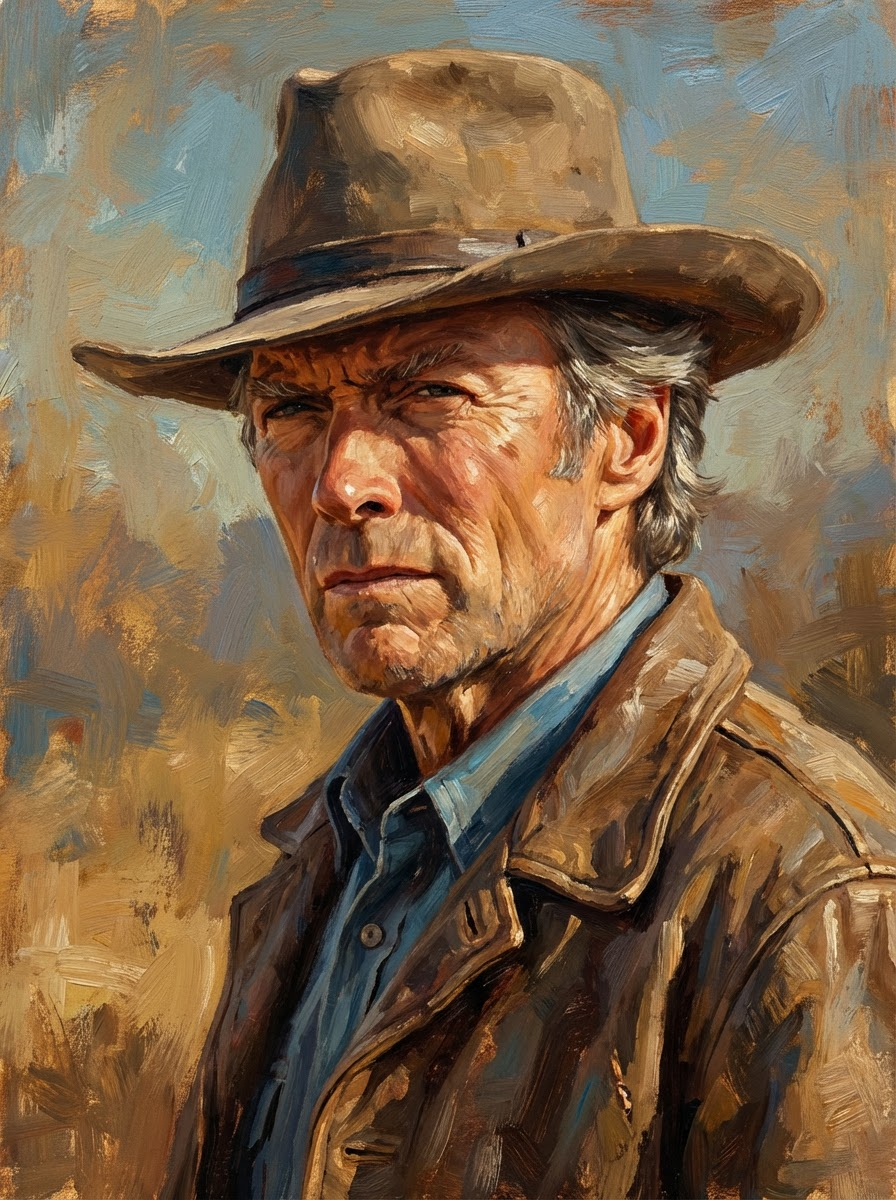
Clint Eastwood — painted portrait Portrait · Clint Eastwood

From TV Cowboy to Spaghetti Immortality

Born Clinton Eastwood Jr. on May 31, 1930, in San Francisco — the son of a steel worker and a factory worker who moved the family repeatedly during the Depression. He drifted into acting after military service, arrived at Universal on a stock contract, and spent years in bit parts before landing the role of Rowdy Yates in the television series Rawhide (1959–1965). The show made him recognisable. Sergio Leone made him legendary.

Leone cast him in A Fistful of Dollars (1964) — the first of the Dollars Trilogy — and the collaboration produced one of cinema's great icons: the Man with No Name, the poncho, the cheroot, the squint, the unhurried menace. Leone understood that Eastwood's economy of expression was not a limitation but a technique, and built a visual grammar around it. By The Good, the Bad and the Ugly (1966), the trilogy had redefined the Western genre globally.

Dirty Harry (1971) transferred the laconic authority to the urban crime film — Harry Callahan's "Do you feel lucky?" speech is as recognisable as any line from the Leone films. But it was Eastwood's transition to directing — beginning with Play Misty for Me (1971) and maturing through Bird (1988), Unforgiven (1992), and Million Dollar Baby (2004) — that revealed his deepest ambitions.

Unforgiven (1992), in which he played an aging gunfighter emerging from retirement for one last job, won four Academy Awards including Best Picture and Best Director — a film that was simultaneously the culmination of everything Leone had built and the film's own obituary for the myth it celebrated. He has continued directing into his nineties with undiminished craft.
1930
Born in San Francisco, California
1959
Rawhide TV series — national recognition begins
1964
A Fistful of Dollars — Leone; the Man with No Name born
1966
The Good, the Bad and the Ugly — Leone; trilogy peak
1971
Dirty Harry — Callahan; urban icon; directorial debut
1993
2 Oscars — Best Picture · Best Director, Unforgiven
2005
2 more Oscars — Million Dollar Baby; back-to-back greatness

From The Dollars Trilogy to Unforgiven

1966Spaghetti Western · Epic
The Good, the Bad and the Ugly
Leone's masterwork — Eastwood as Blondie, the Man with No Name completing a three-way hunt for Confederate gold. The longest, most ambitious, and most cinematically overwhelming film of the Dollars Trilogy, ending in one of cinema's great standoffs.

Leone and Eastwood developed a shared language across three films that was entirely visual — the extreme close-up of eyes, the wide shot of landscape, the silence before violence. Blondie barely speaks; the film barely needs him to. The three-way standoff at Sad Hill Cemetery is the most formally beautiful sequence in Western cinema.

1992Western · Deconstruction
Unforgiven
Eastwood's directing and acting masterwork — as William Munny, the reformed killer who takes one last job, and in doing so becomes the thing he'd spent years trying not to be. Four Academy Awards. The Western's greatest self-examination.
Oscars Won

Unforgiven is simultaneously the film that uses everything Leone taught Eastwood and the film that systematically dismantles every myth those lessons built. William Munny's final rampage in the saloon is not cathartic — it is horrifying, and he makes it so deliberately. The greatest actor-director double performance in American cinema history.

1971Crime · Thriller · Police
Dirty Harry
Don Siegel's San Francisco crime thriller — Eastwood as Inspector Harry Callahan, the outside-the-rules detective whose .44 Magnum speech became one of cinema's most quoted moments. A film that transferred the Leone laconic authority to the American city.

"Do you feel lucky? Well, do ya, punk?" Harry Callahan delivers the line twice — once for effect, once for real — and Eastwood understands the difference. His Callahan is not the fascist vigilante critics claimed: he is a man deeply uncomfortable with the rules he keeps breaking, which is more interesting. The squint found its urban context.

2008Drama · Redemption
Gran Torino
Eastwood's autumnal acting-directing valediction — as Walt Kowalski, the Korean War veteran and widower who befriends his Hmong immigrant neighbours and performs a final act of self-sacrifice that redeems everything he has been. His finest screen performance.

Walt Kowalski is the sum of every hard-bitten Eastwood character, finally given something to do that costs him everything and earns him the only thing that matters. The final scene is the most moving thing Eastwood has ever put on film, as actor or director. The film that makes the case that all those Westerns were always about this: what a man does when the moment actually comes.

"

Do You Feel Lucky? Well, Do Ya, Punk?

— Clint Eastwood as Harry Callahan · Dirty Harry, 1971

Four Oscars, One of Cinema's Great Double Careers

Academy Awards — Director · Picture
1993
Unforgiven
Best Director and Best Picture — two Oscars for the Western's greatest self-examination
2 Oscars Won
Academy Awards — Director · Picture
2005
Million Dollar Baby
Best Director and Best Picture — back-to-back double with Unforgiven; rare in film history
2 More Oscars
AFI Lifetime Achievement
1996
Career Achievement
American Film Institute — 24th Lifetime Achievement Award, for contributions as actor and director
AFI Lifetime
Irving G. Thalberg Award
1995
Producer Achievement
Academy honorary award for consistently high quality of production — a third dimension to an already remarkable career
Thalberg Award

Silence as Moral Language

The Squint
Leone taught Eastwood to communicate entirely through the face — the narrowed eyes, the almost-smile, the barely-there contempt. This economy, which looked like limitation to Hollywood producers who initially passed on him, was in fact the most efficient acting technique the Western genre ever found.
The Director's Eye
His transition to directing was not lateral but vertical — he brought to it an actor's understanding of where emotion lives in a scene, and built a visual style (economical, unshowy, music-led) that was recognizably his own from the first film and has only deepened since.
The Myth Examined
Unforgiven and Gran Torino are both films about the violence in the myths Eastwood had spent his career embodying. He was among the first major action stars to systematically interrogate his own iconography, and the interrogation produced the best work of his career.
Longevity
Still directing and occasionally acting in his nineties — a creative longevity that has no precedent among action stars of his generation. The quality has not declined. Sully (2016), Richard Jewell (2019), Cry Macho (2021) — he does not coast.

The Man with No Name Who Made His Name Twice

Clint Eastwood is the only major Hollywood star of his generation to have two fully distinct careers of equal stature — as a screen actor whose persona defined a decade of cinema, and as a director of consistent quality whose best films are among the finest American movies ever made. Unforgiven alone would place him among cinema's immortals; Gran Torino adds a postscript that deepens everything that came before it.

The Man with No Name has no name because he doesn't need one — he is defined entirely by action, by silence, by what he does rather than what he says. That aesthetic — which Leone discovered and Eastwood inhabited — became, over fifty years, a moral philosophy: that character is performance, that what you do under pressure is what you are, and that the Western was always a parable about this, waiting to be taken seriously. Eastwood took it seriously. Unforgiven is the proof.

Academy Awards
Best Director × 2 · Best Picture × 2
4
Films Directed
1971 to present — over five decades
40+
Age of First Leone Film
A Fistful of Dollars, 1964
34
Age at Unforgiven
His first directing Oscar, 1993
62