The man America watched run for four years. His Dr. Richard Kimble — hunted, haunted, perpetually one step ahead of capture — became one of television's defining figures, his quietly anguished face the medium's most inhabited mask of permanent exhaustion and undefeated hope.
Portrait · David Janssen
Born David Harold Meyer on March 27, 1931, in Naponee, Nebraska — his mother was a former Ziegfeld Follies showgirl who remarried a man named Eugene Janssen, whose surname David took. The family moved to Los Angeles when he was young, and he appeared in his first film at fifteen. He served in the Army and returned to Hollywood in the early 1950s, working steadily in films and television without breaking through.
The breakthrough came when The Fugitive premiered on ABC on September 17, 1963. The series — created by Roy Huggins — cast Janssen as Dr. Richard Kimble, a physician wrongly convicted of his wife's murder, perpetually on the run from Lieutenant Gerard (Barry Morse) while searching for the one-armed man who actually committed the crime. The premise was simple; what Janssen did with it was not.
He brought to Kimble a quality of inhabited exhaustion that television had never quite seen before — not performed fatigue but the specific weariness of a man who has been running for so long that hope and despair have become indistinguishable. His face in close-up did more work than any other actor on American television. The show ran four seasons and its finale, broadcast August 29, 1967, drew an estimated 72 million viewers — the largest single audience in American television history to that point, a record that stood for eleven years until the first broadcast of Roots.
His film work — Warning Shot (1967), The Green Berets (1968), Marooned (1969) — showed range that his television fame made easy to overlook. He died of a heart attack on February 13, 1980, aged forty-eight, widely mourned and insufficiently celebrated.
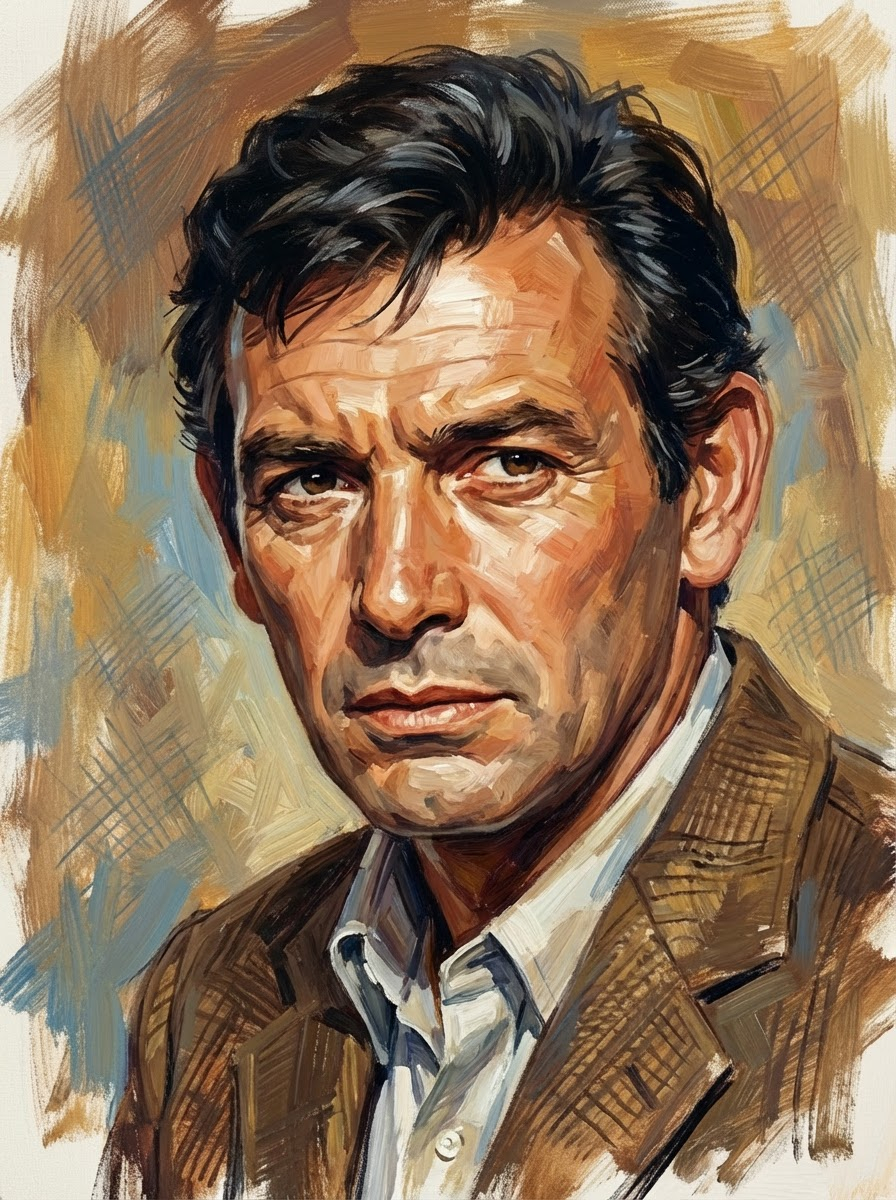
Kimble is defined entirely by what he cannot do — cannot stop, cannot rest, cannot explain himself to most of the people who help him. Janssen plays the role from inside the constraint: every kindness he receives deepens the sadness because he cannot stay to return it. The quietly anguished face — the most inhabited mask of permanent exhaustion in television history — did more work than any monologue could.
Where Kimble was innocent and hunted, Valens may or may not be guilty and is his own pursuer — the inversion was clearly deliberate, and Janssen navigates the moral ambiguity with the same interior complexity he brought to the TV series. The film demonstrates that his range extended well beyond the hunted-man archetype.
The role required Janssen to convey authority and helplessness simultaneously — a man who controls everything except the thing that matters — and he does it with the same economy that made Kimble so compelling. The film won the Oscar for Best Visual Effects; Janssen won the scenes.
The series was professionally accomplished and popular without being memorable — which tells you something about how specific the conditions of The Fugitive were. Kimble worked because he was running; O'Hara pursued. The melancholy in Janssen's face needed something to run from in order to be fully activated.
Richard Kimble is every man who has ever been unjustly accused — and every man who has ever been guilty and gotten away with it. The audience didn't know which one they were watching. Neither did I, sometimes.
David Janssen's legacy is inseparable from Richard Kimble, and Richard Kimble's legacy is inseparable from the specific quality Janssen brought to him: a face that registered the ongoing cost of being innocent in a world that has decided otherwise. No other actor could have played Kimble, because no other actor of the era had the specific combination of physical handsomeness and melancholy interiority that the role required.
The 72 million viewers who watched the series finale were watching, in the end, one man's face as he finally got to stop running — and Janssen gave them something in that moment that justified four years of pursuit. He was not a tragic figure; he was a great artist working in the right medium at the right moment, doing the thing he was born to do. The fact that it was television and not film is the industry's oversight, not his.