The girl who learned to dance in three months to keep up with Gene Kelly and Frank Sinatra — then spent sixty years proving that energy, talent, and refusal to quit are a more durable combination than any studio could manufacture.
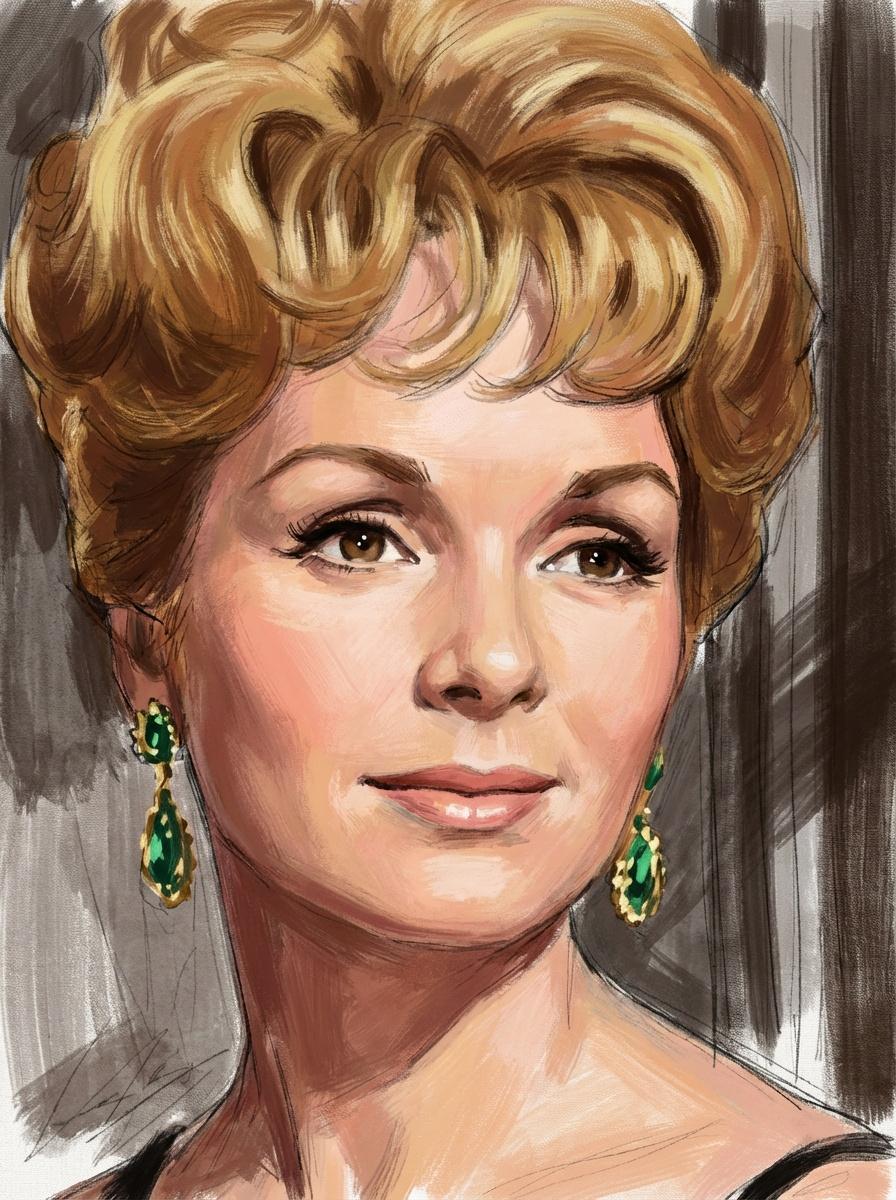
Portrait · Debbie Reynolds
Born Mary Frances Reynolds on April 1, 1932, in El Paso, Texas — her father a carpenter, her family working-class, her childhood spent in Burbank after a cross-country move. She won a beauty contest at sixteen that landed her a contract with Warner Bros., was transferred to MGM, and at nineteen was cast alongside Gene Kelly and Donald O'Connor in Singin' in the Rain (1952).
The casting was considered a gamble — Reynolds had virtually no dance training. She spent three months working eighteen-hour days to prepare for a role opposite Hollywood's finest dancers. Kelly was notoriously demanding, and Reynolds later said she cried under a piano one afternoon from exhaustion; Fred Astaire found her there and encouraged her to continue. The film became one of the most celebrated musicals ever made, and her performance in it earned her a place in Hollywood history before her twentieth birthday.
Her Oscar nomination came for The Unsinkable Molly Brown (1964) — a role whose title described its actress as much as its character. Through three failed marriages (including the devastatingly public departure of Eddie Fisher for Elizabeth Taylor), a near-bankruptcy, and the death of her daughter Carrie Fisher on December 28, 2016, Reynolds maintained a performing career of almost supernatural continuity. She died the following day, December 29, 2016, aged eighty-four — one day after Carrie.
Her later career included a celebrated Las Vegas residency, a Tony nomination for Irene on Broadway, and a Screen Actors Guild Lifetime Achievement Award in 2015 — presented to her by her daughter, one year before they both died within twenty-four hours of each other.
Kelly was notoriously hard on Reynolds during production — she had to match his technique through sheer application of will rather than training. What the camera captured was not a dancer approximating Kelly's level but a performer of such natural vitality that the gap became irrelevant. Her "Would You?" number is one of the musical's great moments of pure joy in motion.
Molly Brown is the role that fits Reynolds most perfectly — a woman whose determination to survive and thrive is so total that obstacles become mere interruptions. The title described the actress. Her Molly is not a symbol but a person: specific, funny, touchingly naive, and completely indestructible.
Reynolds found in Beatrice the kind of complexity her career had rarely given her — a woman who is simultaneously loving and oblivious, whose relationship with her son is a study in the ways families fail each other without malice. The Golden Globe nomination confirmed what her colleagues had always known: she could do more than the musicals asked of her.
How the West Was Won asked Reynolds to age believably across several decades, a task she accomplished with a naturalism that the musical work had not needed to demonstrate. Lilith Prescott is the film's emotional spine — the one character whose journey justifies the Cinerama spectacle surrounding her.
I was the girl next door — until they moved me next to Gene Kelly.
Debbie Reynolds' legacy rests on a film she made at nineteen with no dance training — and on sixty years of subsequent work that proved the Singin' in the Rain performance was not luck but character. She was the last of the MGM musical stars, and she kept the tradition alive not by imitating what it had been but by embodying the quality that had always defined it: the refusal to be defeated by what the work demands.
The image of her receiving the SAG Lifetime Achievement Award from Carrie Fisher in 2015 — two women who had spent decades negotiating the particular difficulty of being a daughter and a mother in public — is the human document that explains both of them. She died one day after Carrie. Of course she did. She would never have left willingly while there was still something to do.