New York City · 1909 – 2000

Douglas Fairbanks Jr.

The son of the most famous man in silent cinema — who grew up largely without his father, built a career in his shadow, then surpassed the shadow entirely through a second act of decorated military service, diplomacy, and a dignity that owed nothing to inheritance.

5
US Naval
Decorations
6
Allied Nations'
Military Awards
75+
Film & TV
Credits
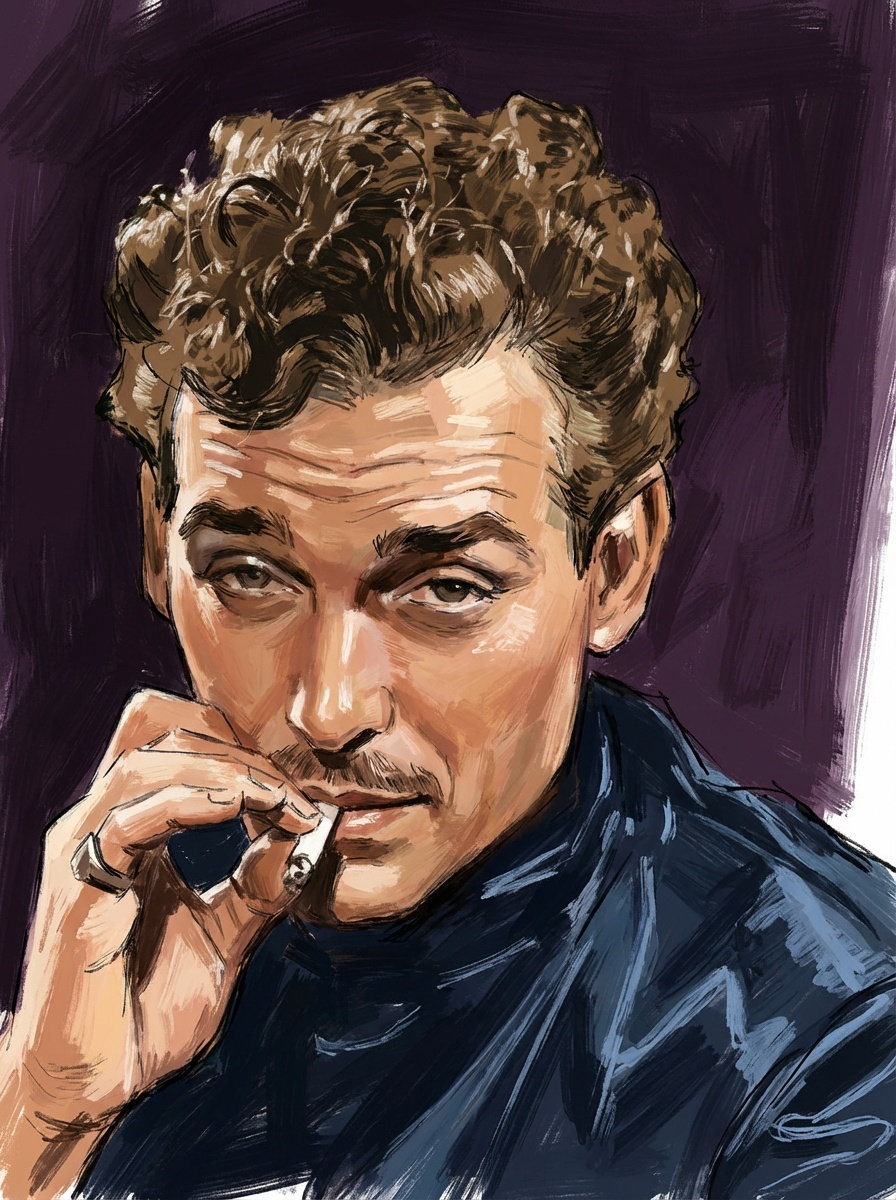
Douglas Fairbanks Jr. — painted portrait Portrait · Douglas Fairbanks Jr.

From His Father's Shadow to His Own Distinction

Born Douglas Elton Fairbanks Jr. on December 9, 1909, in New York City — the only child of Douglas Fairbanks Sr. and Anna Beth Sully. His parents divorced when he was nine; he was raised primarily by his mother, seeing his father infrequently and living largely outside the Hollywood world that had made his name famous. He appeared in his first film at thirteen, not because of family connections but in spite of the ambivalence with which his father regarded his career ambitions.

He married Joan Crawford in 1929 — a union that lasted until 1933, moved him socially into the Hollywood elite, and gave both parties something the other needed. His career through the 1930s was steady rather than spectacular: leading roles in adventure films and melodramas, a genuine charm and a physical ease that recalled his father without reproducing him.

The transformation came with the Second World War. Fairbanks had been an early and vocal interventionist before Pearl Harbor, and when America entered the war he enlisted in the Navy Reserve, eventually rising to the rank of Captain. He served in the Atlantic, the Pacific, and the Mediterranean, participating in several major deceptive operations including helping to plan the Sicily invasion's cover story. He received the Legion of Merit, the Croix de Guerre, the Order of the British Empire, and decorations from Norway, France, and Italy — six nations in total.

After the war he became an unofficial cultural ambassador — hosting television programmes, producing films in Britain, maintaining a position in the Anglo-American cultural establishment that was entirely of his own making. He was knighted by the British government in 1949 — an honour received by very few Americans — and spent his final decades in a position of genuine distinction that his father's fame could not have predicted or provided.
1909
Born in New York City; parents divorce at age 9
1922
Film debut at age 13 — career begun against father's wishes
1929
Marries Joan Crawford; Hollywood social peak
1939
Gunga Din — Ballantyne; adventure peak; vocal interventionist
1941
Enlists in Navy Reserve; commando and deception operations
1949
Knighted by the British government — KBE
2000
Dies in New York City, age 90

From The Prisoner of Zenda to Gunga Din

1939Adventure · War · Classic
Gunga Din
George Stevens' Kipling adventure — Fairbanks as Sergeant Tommy Ballantyne, one of three British soldiers navigating cult warfare in colonial India. The film's ensemble sparkles, but Fairbanks' easy physical grace and comedic timing anchor its human warmth.

The film requires Fairbanks to be simultaneously funny, courageous, romantic, and cynical — a range that his decade of experience had made second nature. His partnership with Cary Grant and Victor McLaglen produced one of Hollywood's finest adventure ensembles. He holds his own against Grant, which is the highest praise available in this context.

1937Adventure · Romance · Swashbuckler
The Prisoner of Zenda
John Cromwell's Ruritanian romance — Fairbanks as Rupert of Hentzau, the film's charming villain, who steals the film from its hero with a combination of elegance, wit, and genuine menace. One of the finest swashbuckling villain performances of the studio era.

Rupert of Hentzau is one of those villain roles where the audience hopes the villain wins, and Fairbanks plays him with the full knowledge of this dynamic — he gives Rupert exactly enough charm to make his villainy a genuine alternative rather than a mere obstacle. Ronald Colman is the nominal star; Fairbanks is what you remember.

1947Adventure · Fantasy · Swashbuckler
Sinbad the Sailor
Richard Wallace's Arabian fantasy — Fairbanks as Sinbad, the legendary sailor on his eighth voyage in search of Alexander the Great's lost treasure. His first major post-war film, demonstrating that the naval Captain and the swashbuckling hero occupied the same body.

Post-war Fairbanks brought something to Sinbad that the pre-war version would not have had: a man who had actually been tested, who knew the difference between performed heroism and the real thing. The ease is the same; the authority behind it is deeper.

1931Drama · Underworld · Pre-Code
Little Caesar
Mervyn LeRoy's landmark gangster film — Fairbanks as Joe Massara, the dancer-turned-gangster whose ambivalence about his criminal life provides the film's moral counterweight to Edward G. Robinson's ferocious Rico. A pre-Code performance of genuine dramatic weight.

Fairbanks' Joe is the film's conscience — the man who knows what Rico is and chooses proximity anyway, until proximity becomes impossible. His final scene, watching the consequences of his choices, is the performance that showed he was capable of more than adventure films usually asked. Robinson took the notices; Fairbanks did the harder work.

"

I had the name before I earned it. The only question was whether I would earn it, or let it simply be a label.

— Douglas Fairbanks Jr.

Knighted, Decorated, Distinguished — Entirely on His Own Terms

Knight Commander of the British Empire
1949
KBE — Honorary Knighthood
Knighted by George VI — one of very few Americans ever to receive the honour; for wartime service and Anglo-American relations
KBE
US Naval Decorations
1942–45
Legion of Merit · Silver Star
Five US decorations including Legion of Merit and Silver Star — for commando and deception operations in the Atlantic and Mediterranean
5 US Decorations
Allied Nations — Military Honors
1942–45
Croix de Guerre and More
Decorated by France, Norway, Italy, and Britain — six nations in total recognised his wartime service
6 Nations
Screen Actors Guild · Emmy
Career
Television Legacy
Emmy nomination for The Douglas Fairbanks Jr. Presents anthology series — a second career in television production and hosting
Emmy Nom

The Name Carried as a Challenge

The Name
No actor in Hollywood history carried a heavier inherited name into his own career. He refused both to exploit it and to discard it — he made it mean something different by making himself mean something different. The Jr. became a distinction, not a diminishment.
The Villain Turn
Rupert of Hentzau in The Prisoner of Zenda is his finest screen achievement — a villain of such charm that the film is unbalanced in his favour, and the casting of the hero's son as the villain is a joke that only works if the villain is more compelling than the hero. He was.
The War
His WWII service was not a public relations exercise but an authentic commitment — he was an early interventionist, had been close to British political and cultural circles for years, and brought genuine operational intelligence to the deception work that contributed to major Allied operations.
The Second Life
The post-war career — television host, film producer, diplomat, social figure, honorary knight — was the one nobody could have predicted from the first. It was also the most distinctly his own. He lived until 2000, and the knighthood was the last thing his father's name had nothing to do with.

The Man Who Made the Name His Own

Douglas Fairbanks Jr.'s legacy is the refusal of a particular fate. He could have coasted on his name, coasted on his charm, coasted on the Hollywood social position his marriage to Crawford temporarily provided. He chose instead to be tested — first by war, then by the harder demands of a post-war career built on something other than inherited glamour. The six military decorations are the record of that choice.

His knighthood was the honour that meant most to him — an acknowledgment by a country not his own that the person inside the famous name was worth recognising separately. Douglas Fairbanks Sr. was never a knight. Douglas Fairbanks Jr. was. The distinction is the story.

US Military Decorations
Including Legion of Merit and Silver Star
5
Allied Nations' Decorations
France, Norway, Italy, Britain
6
KBE
One of very few Americans ever knighted
1949
Career Span
1922 to final television work
75yr