The Brooklyn kid who studied at the Actors Studio, turned down Maggio in From Here to Eternity to do a Tennessee Williams play on Broadway, then spent sixty years building the most varied character career in Hollywood — including the most entertaining performance in the greatest Western ever made.
Portrait · Eli Wallach
Born Eli Herschel Wallach on December 7, 1915, in Red Hook, Brooklyn — the son of Polish Jewish immigrants who ran a candy store. He studied at the University of Texas and the City College of New York, served in WWII, and on his return enrolled at the Actors Studio, where he became one of Lee Strasberg's most accomplished students alongside Marlon Brando and James Dean.
His film debut was delayed by a principled choice: when offered the role of Maggio in From Here to Eternity (1953) — the role that revived Frank Sinatra's career — Wallach turned it down to honour a commitment to Tennessee Williams' Camino Real on Broadway. He received the first Tony Award ever given for a debut performance. His integrity cost him a major film role; his word cost him nothing.
Sergio Leone cast him as Tuco Benedicto Pacífico Juan María Ramírez — known as the Ugly — in The Good, the Bad and the Ugly (1966). The performance is the most comprehensive comic-menacing double act in Western cinema: Tuco is simultaneously terrifying and absurd, a man who survives by wit and luck and animal energy. Wallach was fifty when he made it; he rode horses, performed his own stunts, and nearly died three times during production.
He worked continuously into his nineties — The Holiday (2006), Wall Street: Money Never Sleeps (2010), The Ghost Writer (2010) — with undiminished energy and the perpetual delight in the work that had defined him from his first Broadway rehearsal. He died on June 24, 2014, aged ninety-eight, as his wife Anne Jackson — his partner of sixty-six years — held his hand.
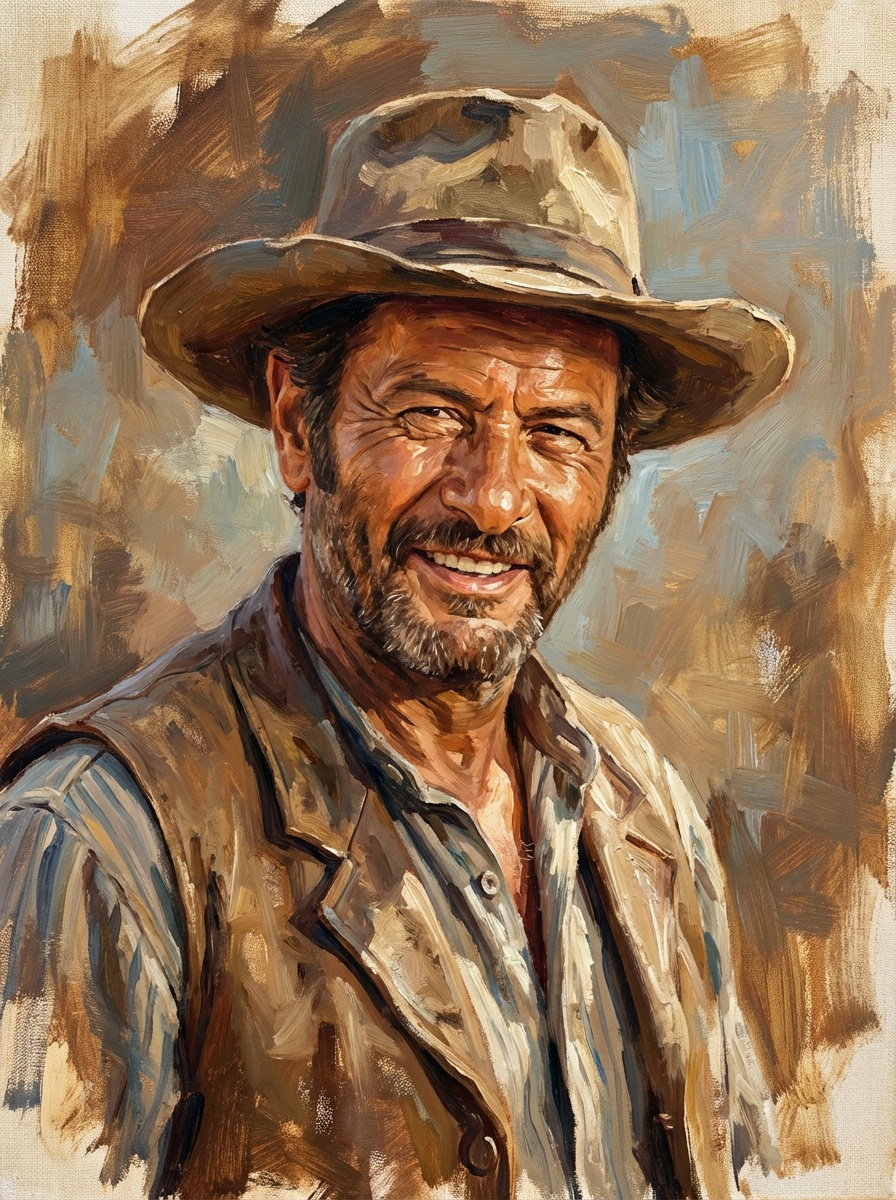
Tuco is the film's heart because he is the film's most human character — he wants to live, to eat, to not be hanged, to find the gold. His motives are comprehensible in a film where the other two characters are moral abstractions. The train sequence, where Wallach nearly loses his head to a passing railway car, was real — unplanned, accidental, and captured on camera.
Calvera is the film's most interesting character — the man with a coherent philosophy of banditry who cannot understand why the seven chose to return after he let them go. His bewilderment at genuine altruism is the film's moral centre, and Wallach plays it with complete seriousness. His death scene — "You came back — for a place like this? Why?" — is the film's finest moment.
Baby Doll was condemned by Cardinal Spellman and became one of the most controversial American films of its decade — Wallach's Vaccaro is both the cause and the film's most sophisticated element. The scene on the swing — Vaccaro extracting a confession by the precise application of charm — is Actors Studio technique deployed for maximum dramatic effect.
The brief appearance says everything about what Wallach had become: an actor so completely in command of his instrument that a three-minute scene carries the weight of a career. At ninety-four, still more interesting to watch than most actors at forty.
There are three kinds of men. The ones that learn by readin'. The few who learn by observation. The rest of them have to pee on the electric fence for themselves.
Eli Wallach's legacy is Tuco and everything that isn't Tuco — the Brooklyn Method actor who turned down Sinatra's career-making role to honour a stage commitment, then spent six decades building the most varied character career in Hollywood from that single principled choice. The Tony Award he won for his debut is the emblem of his values; the Honorary Oscar he received at ninety-four is the industry's belated acknowledgment of his worth.
Tuco is immortal — the performance that turns The Good, the Bad and the Ugly from a great film into an irresistible one. But Calvera's bewilderment at the Seven's return, Baby Doll's Vaccaro on the swing, the elderly man on Martha's Vineyard in The Ghost Writer — these are all the same actor, finding in each role something new to be delighted by. He was delighted for ninety-eight years. The camera always caught it.