Helena, Montana · 1901 – 1961

Gary Cooper

The Montana ranch hand who walked into silent pictures and invented the American screen archetype — the man who does what must be done without announcing it, whose refusal of heroic posture is itself the heroism. Hemingway said Cooper was the only actor he ever watched who didn't remind him of acting.

2
Academy Awards
Won
5
Oscar
Nominations
100+
Film
Credits
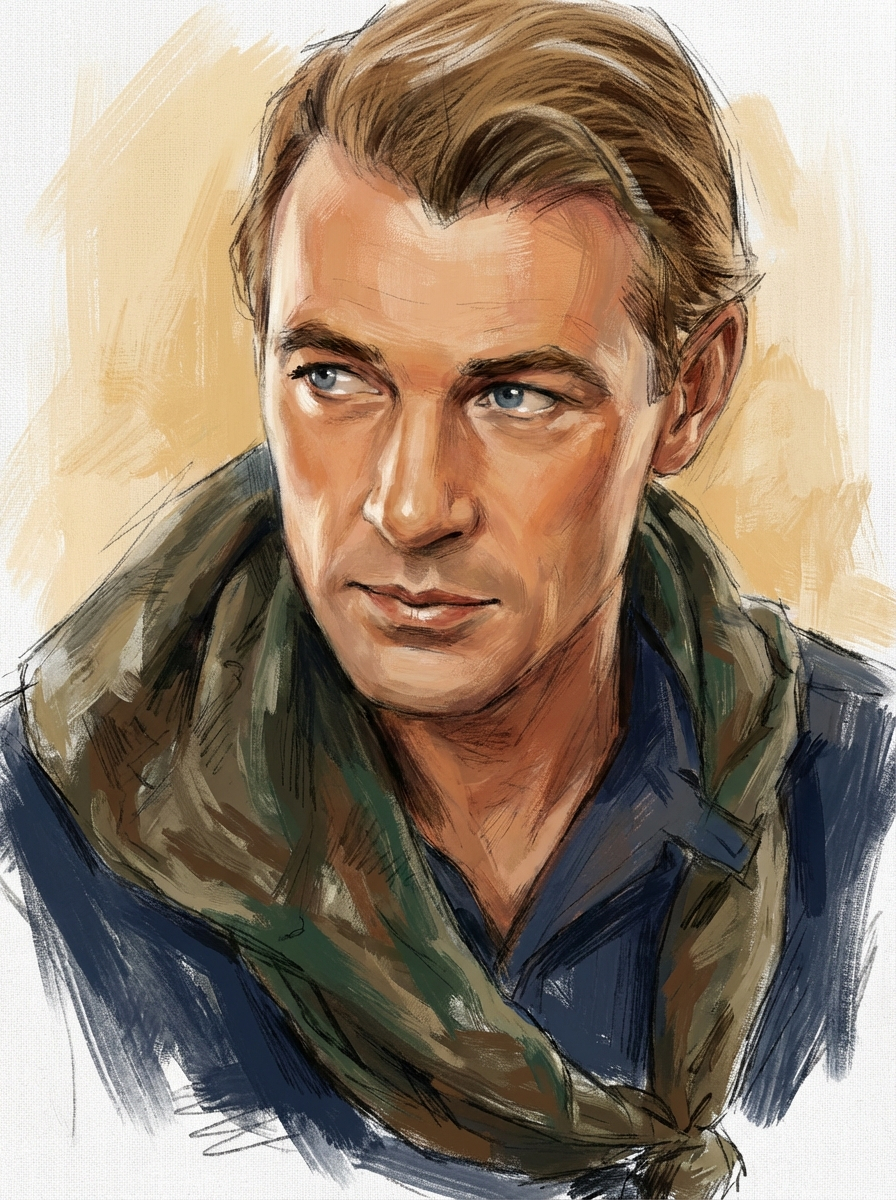
Gary Cooper — painted portrait Portrait · Gary Cooper

From Montana to High Noon

Born Frank James Cooper on May 7, 1901, in Helena, Montana — the son of a Montana Supreme Court justice, raised partly in England, partly on his family's ranch in the Flathead Valley. He attended Grinnell College in Iowa, dropped out, drove to Los Angeles, worked as a newspaper cartoonist and a cowboy extra, changed his name to Gary at his agent's suggestion, and arrived in speaking pictures in the late 1920s as a man who had actually been the thing he was asked to play.

His career through the 1930s — A Farewell to Arms (1932), Design for Living (1933), Mr. Deeds Goes to Town (1936) — established the archetype: the decent American whose decency is not weakness but a form of strength so absolute it requires no declaration. Frank Capra understood what Cooper was and built Mr. Deeds around it; Hemingway, who befriended Cooper personally, said he was the only actor he ever watched without thinking about acting.

His first Academy Award came for Sergeant York (1941) — the biographical film about the World War I conscientious objector who became its most decorated soldier. Howard Hawks directed; Cooper played York as a man whose reluctance is genuine and whose courage is merely what his conscience requires. His second came for High Noon (1952) — Will Kane, the marshal who faces a returning killer alone while the town watches — a performance of such sustained physical and psychological stillness that it remains the definitive statement of what Cooper's particular brand of American heroism looked like from the inside.

He received an Honorary Oscar in 1960, presented by James Stewart, who wept delivering it. Cooper died on May 13, 1961, one month after receiving it, of prostate cancer. He was fifty-nine.
1901
Born in Helena, Montana; raised partly in England
1925
Hollywood extra; cowboy roles; became Gary Cooper
1929
Sound films; the voice matches the silences
1936
Mr. Deeds Goes to Town — Capra; Oscar nom; the archetype codified
1942
Oscar won — Sergeant York; the reluctant hero
1953
Oscar won — High Noon; Will Kane; alone at noon
1961
Honorary Oscar; dies one month later, age 59

From Mr. Deeds to High Noon

1952Western · Drama · Fred Zinnemann
High Noon
Fred Zinnemann's Western in real time — Cooper as Marshal Will Kane, who faces a returning killer alone while the town he has served refuses to help. His second Oscar: a performance of sustained physical and psychological stillness that remains the definitive statement of his particular heroism.
Oscar Win

High Noon's real-time structure places its entire dramatic weight on Cooper's face — the camera returns to him again and again as the clock advances, and what he shows is not fear but the acknowledgment of fear alongside the refusal to act on it. It is the most technically demanding thing he ever did because it is the most internal. Pauline Kael called it the definitive Cooper performance because it has nowhere to hide.

1941Biography · War · Howard Hawks
Sergeant York
Howard Hawks' biography of Alvin York — Cooper as the Tennessee marksman and conscientious objector who became WWI's most decorated American soldier. His first Academy Award: a performance that understood the character's religiosity and reluctance without condescending to either.
Oscar Win

York's religious faith is the film's most delicate element — a lesser performance would have patronised it or satirised it or simply ignored it. Cooper plays it as the literal truth of a man who means what he says, which is the only approach that makes the character's arc comprehensible. Hawks said Cooper was the only actor he ever worked with who needed no direction for this role — he simply understood York from the inside.

1936Comedy · Drama · Frank Capra
Mr. Deeds Goes to Town
Frank Capra's populist comedy-drama — Cooper as Longfellow Deeds, the tuba-playing greeting-card poet who inherits a fortune and brings his small-town decency to New York's cynics. His first Oscar nomination and the film that codified the Capraesque hero.
Oscar Nom

Capra built the film around the specific quality that made Cooper unmistakable: the ability to be genuinely good without being naïve, to meet cynicism with intelligence rather than confusion. Deeds is not stupid; he is simply more honest than the world he has entered. The courtroom scene — his eventual response to the commitment hearing — shows Cooper's range at its most unexpected.

1942Drama · Sports · Sam Wood
The Pride of the Yankees
Sam Wood's biography of Lou Gehrig — Cooper as the Yankees' Iron Horse, from his college days to his farewell speech at Yankee Stadium. His third Oscar nomination: a performance of quiet, sustained dignity that made Gehrig's physical decline a genuinely moving rather than merely sentimental event.
Oscar Nom

Cooper was not a natural baseball player and worked for months to develop the left-handed Gehrig's stance and swing — the dedication is visible, and it matters, because the film's credibility depends on the audience's belief in its subject. His delivery of the farewell speech — "I consider myself the luckiest man on the face of the earth" — is the most famous moment of his career and was filmed in a single take.

"

I make pictures for people, not for critics. I know what they want, and I try to give it to them — nothing fancy, nothing tricky. Just the truth of the man in the situation.

— Gary Cooper

Two Oscars, Five Nominations — A Career of Complete Integrity

Academy Award — Best Actor
1942
Sergeant York
First Oscar — York's religious faith and reluctant heroism played without condescension or irony; the Academy's recognition of a performance that could have been patronising and wasn't
Oscar Won
Academy Award — Best Actor
1953
High Noon
Second Oscar — Will Kane's sustained internal courage across real time; the definitive statement of the Cooper archetype at its most demanding
Oscar Won
Honorary Academy Award
1960
Career Achievement
Honorary Oscar presented by James Stewart, who wept delivering it. Cooper died one month later. The career it recognised spanned thirty-five years without a single dishonest performance.
Honorary Oscar
Oscar Nominations
1937 · 1942 · 1943 · 1953
Five Nominations
Five nominations across two decades — Mr. Deeds, Sergeant York, Pride of the Yankees, For Whom the Bell Tolls, and High Noon
5 Nominations

The Refusal of Heroic Posture as Heroism

The Montana Man
Cooper had actually worked cattle, actually ridden horses, actually lived the outdoor life that the Westerns asked him to perform. This is not incidental: the ease with which he inhabited physical space came from having inhabited it. Hemingway noticed it immediately; so did every director who worked with him.
The Yup and Nope
His economy of expression — the minimal reply, the look that contains the speech he's not going to make, the way a scene's emotional content gets communicated through what he doesn't do — was widely imitated and never equalled. He understood that the camera sees everything you think, which made thinking the performance.
The Reluctant Hero
Every major Cooper role is a variation on the same theme: a man who doesn't want to be a hero and is one anyway because his conscience won't allow the alternative. York doesn't want to fight. Kane doesn't want to fight. Deeds doesn't want to fight. The wanting is irrelevant; the conscience is everything.
The Hemingway Connection
Ernest Hemingway and Cooper were close friends for decades — they hunted together, fished together, and Hemingway entrusted Cooper with the film adaptation of For Whom the Bell Tolls. The friendship was the recognition of a shared aesthetic: the man who shows nothing and means everything.

The American Archetype — Original and Unequalled

Gary Cooper's legacy is the American screen archetype he invented and no one has since surpassed — the man whose decency is a form of strength, whose silence contains everything the performance needs, whose refusal of heroic posture is itself the heroism. From High Noon's Will Kane to Sergeant York to Longfellow Deeds, he made the same argument across thirty-five years: that integrity is not passive but active, and that its finest expression is the choice to stand alone when standing alone is required.

James Stewart wept presenting his Honorary Oscar. Hemingway, who had no patience for actors, called him the only one who disappeared into a role completely. The camera agreed: a hundred films, two Oscars, five nominations, and never once, in any of them, the feeling of watching someone perform.

Academy Awards Won
Sergeant York · High Noon
2
Oscar Nominations
Across three decades
5
AFI Male Screen Legend Rank
11th Greatest Male Screen Legend
#11
Career Span
1925 to High Noon and beyond
36yr