Sainte-Christine, Quebec · 1916 – 2006

Glenn Ford

The Canadian-born actor whose naturalness was so complete that critics spent forty years underestimating it as simplicity. His best films — Gilda, The Big Heat, 3:10 to Yuma — are studies in the pressure a quiet man can exert simply by refusing to be the thing the situation wants him to be.

80+
Film
Credits
1958
Top Box Office
Star, That Year
4
Years US
Marine Service
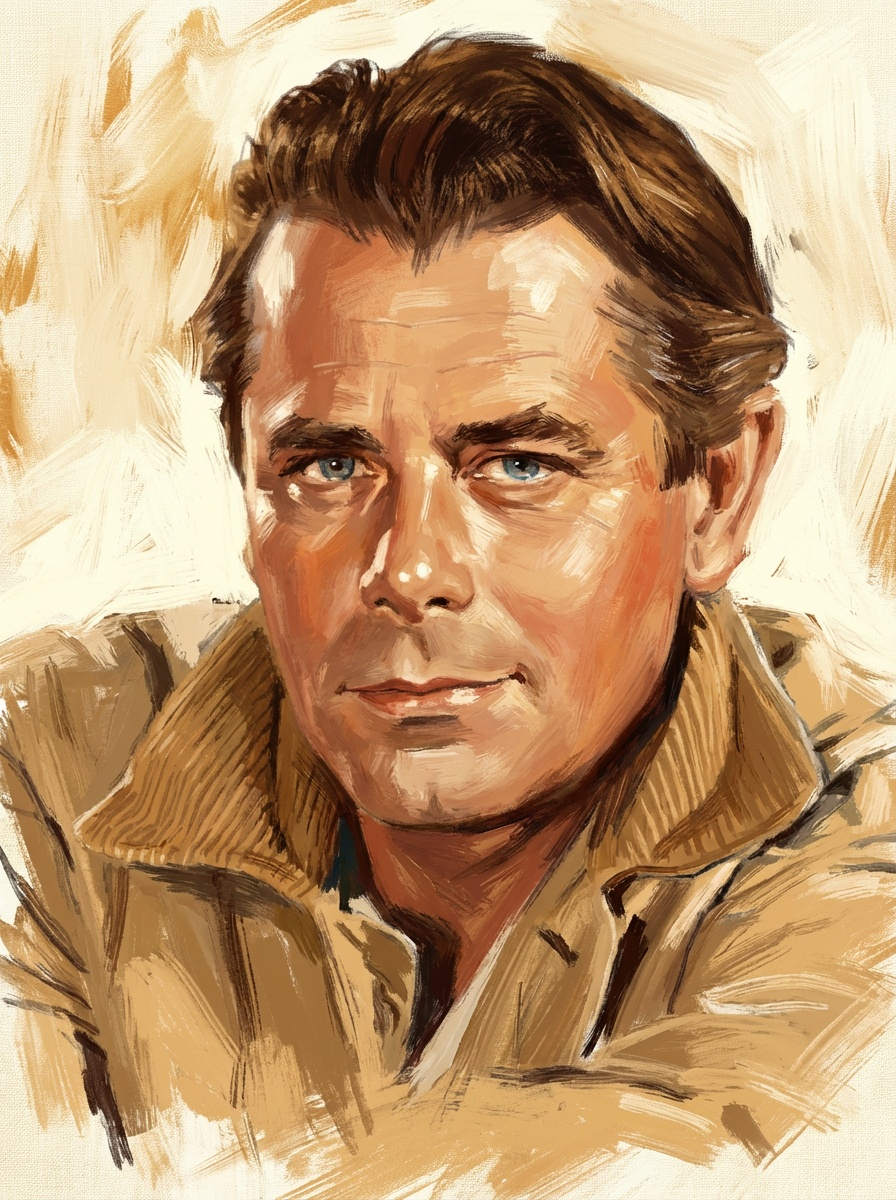
Glenn Ford — painted portrait Portrait · Glenn Ford

From Quebec to Gilda's Dressing Room

Born Gwyllyn Samuel Newton Ford on May 1, 1916, in Sainte-Christine, Quebec — the son of a railway executive. The family moved to Santa Monica when he was eight, and Glenn grew up in California, worked in theatre from his teens, and signed with Columbia Pictures in 1939 at twenty-three. His early films were unremarkable vehicles, and his career was interrupted by four years of service with the Marine Corps Reserve during the war.

His return to Columbia and the casting opposite Rita Hayworth in Charles Vidor's Gilda (1946) transformed both his career and American cinema's understanding of sexual tension. Johnny Farrell's relationship with Gilda — the complex of desire, resentment, and love that the film's Production Code restrictions forced underground — gave Ford the opportunity to communicate everything through what he withheld. His naturalistic stillness against Hayworth's incandescence was not passivity but controlled pressure, and the combination produced one of Hollywood's great screen partnerships.

Fritz Lang's The Big Heat (1953) gave him Dave Bannion — the honest cop whose wife is killed by a mob car bomb, driving him across the line he had always believed he would not cross. The film is one of cinema's finest noirs, and Ford's performance is its anchor: the restraint that precedes violence, the decency that doesn't survive what decency encounters.

Delmer Daves' 3:10 to Yuma (1957) cast him against type as outlaw Ben Wade opposite Van Heflin's struggling rancher — the most charming man in any room he enters, the most dangerous, and the most morally complex. By 1958 he was Hollywood's number one box office draw. He served again with the Navy Reserve during the Vietnam era, attaining the rank of Captain. He died on August 30, 2006, in Beverly Hills, aged ninety.
1916
Born in Sainte-Christine, Quebec; family moves to California
1939
Columbia Pictures contract; early career begins
1942
Marine Corps Reserve; four years of WWII service
1946
Gilda — Hayworth; the screen partnership; the career made
1953
The Big Heat — Bannion; Lang; noir at its most moral
1958
Number one box office star in Hollywood; 3:10 to Yuma
2006
Dies in Beverly Hills, age 90; nine decades of living

From Gilda to 3:10 to Yuma

1946Noir · Romance · Rita Hayworth
Gilda
Charles Vidor's noir — Ford as Johnny Farrell, the gambler whose history with Gilda (Rita Hayworth) underlies every scene they share. His naturalistic restraint against her incandescence was not passivity but controlled pressure — one of Hollywood's great screen partnerships, built on everything the Production Code wouldn't let them say directly.

The film's erotic charge runs entirely through what Ford withholds — the desire that is expressed as contempt, the love that is expressed as cruelty, the history that is expressed as silence. His Johnny Farrell communicates everything through what he doesn't do, which made him one of cinema's first truly modern screen actors. The hat-pin scene — the most coded moment in studio-era Hollywood — only works because Ford's response is entirely internal.

1953Noir · Crime · Fritz Lang
The Big Heat
Fritz Lang's classic noir — Ford as Detective Dave Bannion, whose wife is killed by a mob car bomb, pushing him across the line between legitimate law enforcement and something darker. One of cinema's finest studies in the cost of crossing a moral threshold you believed you never would.

Bannion's transformation — from decent cop to something more dangerous — is the film's moral argument, and Ford plays it without the protective distance of genre. The restraint that defines him becomes something more threatening as the film progresses, because the audience understands that what is being suppressed is not weakness but fury. Lang said Ford was the most naturally cinematic actor he ever directed.

1957Western · Delmer Daves · Two-Hander
3:10 to Yuma
Delmer Daves' Western — Ford against type as outlaw Ben Wade, the charming, dangerous, morally complex criminal that Van Heflin's struggling rancher must deliver to justice. His finest characterisation: a man who could buy his way out of any situation and is obscurely pleased when he cannot.

Wade is the most complicated role Ford ever played — a man whose intelligence and charm make him more dangerous than his criminality, and whose obscure respect for Heflin's Dan Evans is the film's most intriguing element. His final choice — to board the train he could have avoided — is left ambiguous, which is the film's most sophisticated decision.

1955Drama · Education · Richard Brooks
Blackboard Jungle
Richard Brooks' controversial school drama — Ford as Richard Dadier, the idealistic teacher confronting violence and indifference in an inner-city school. The film that introduced rock and roll to mainstream American cinema via Bill Haley's opening credits, and proved Ford could anchor social-realist drama with complete conviction.

Dadier's refusal to be broken — his insistence on the possibility of teaching even in a classroom that is doing everything possible to prove him wrong — is Ford at his most quietly stubborn, which is Ford at his most characteristic. The film's contemporary controversy over its depiction of urban school violence obscured a central performance of considerable force.

"

I never play heroes. I play men who are put in situations where they have to decide what they're worth. That's different.

— Glenn Ford

Hollywood's Number One Star — The Year They Noticed

Box Office Champion
1958
Hollywood's #1 Star
The number one box office draw in Hollywood in 1958 — the industry's commercial confirmation of what critics had been slow to articulate: that his naturalness was not the absence of technique but its highest expression.
#1 Box Office
Military Service
1942 · 1960s
Marine Corps · Naval Reserve
Four years of WWII service with the Marine Corps Reserve; subsequent service with the Naval Reserve during the Vietnam era, attaining the rank of Captain
Captain, USN Reserve
The Rita Hayworth Partnership
1946
Gilda · Three Films Together
Three films with Rita Hayworth — Gilda, The Loves of Carmen, Affair in Trinidad — producing one of Hollywood's most charged screen partnerships, built on contrasting instruments that the camera loved equally
3 Films Together
Hollywood Walk of Fame
1960
Star — Hollywood Boulevard
Star on the Hollywood Walk of Fame for a career that had already produced Gilda, The Big Heat, Blackboard Jungle, and 3:10 to Yuma — and was not yet half over
Walk of Fame

The Naturalness That Was Never Simple

The Withholding
Ford's method — never announced, never theorised, simply practised — was the communication of emotional complexity through physical restraint. The desire becomes contempt, the love becomes anger, the history becomes silence. Everything the Production Code wouldn't allow him to say directly he said through what he didn't do.
Gilda's Partner
His screen partnership with Rita Hayworth is one of Hollywood's most charged — not because they were similar but because they were opposite. Her incandescence required his stillness to have a surface to burn against. The films work because the contrast is itself the drama.
The Moral Line
His characteristic role — in The Big Heat, in 3:10 to Yuma, in countless Westerns — is the decent man placed in a situation that tests whether decency can survive contact with the world's actual conditions. Ford always played the moment of decision without signalling in advance which way it would go.
The Underrated Career
His reputation has not kept pace with his achievement — the fate of naturalistic actors in eras that mistake obviousness for significance. The Big Heat and 3:10 to Yuma are among the finest films of the 1950s, and his performances in both are central to why. The critical reclamation continues, slowly and correctly.

Eighty Films — Never Once a False Note

Glenn Ford's legacy is the naturalness that critics kept mistaking for simplicity — the technique so complete it was invisible, the instrument so well-tuned it never called attention to itself. Gilda, The Big Heat, 3:10 to Yuma, and Blackboard Jungle are four films from eleven years, each in a different genre, each with the same quality of absolute conviction.

His number one box office ranking in 1958 was Hollywood's commercial acknowledgment of what was genuinely there; the critical reassessment that has followed his death has caught up with what the audience always understood. He was ninety when he died, and had made more than eighty films, and in none of them was he anything less than completely present.

Feature Films
1937 to final work
80+
Box Office Rank
Hollywood's #1 star, 1958
#1
Films with Rita Hayworth
Hollywood's great screen partnership
3
Age at Death
August 30, 2006
90