The Los Angeles actress whose combination of vulnerable sensuality and genuine intelligence made her the definitive femme fatale of 1950s Hollywood noir — the woman you believed could get a man killed and felt sorry for while she was doing it. Her best performances are more honest than the genre she worked in deserved.
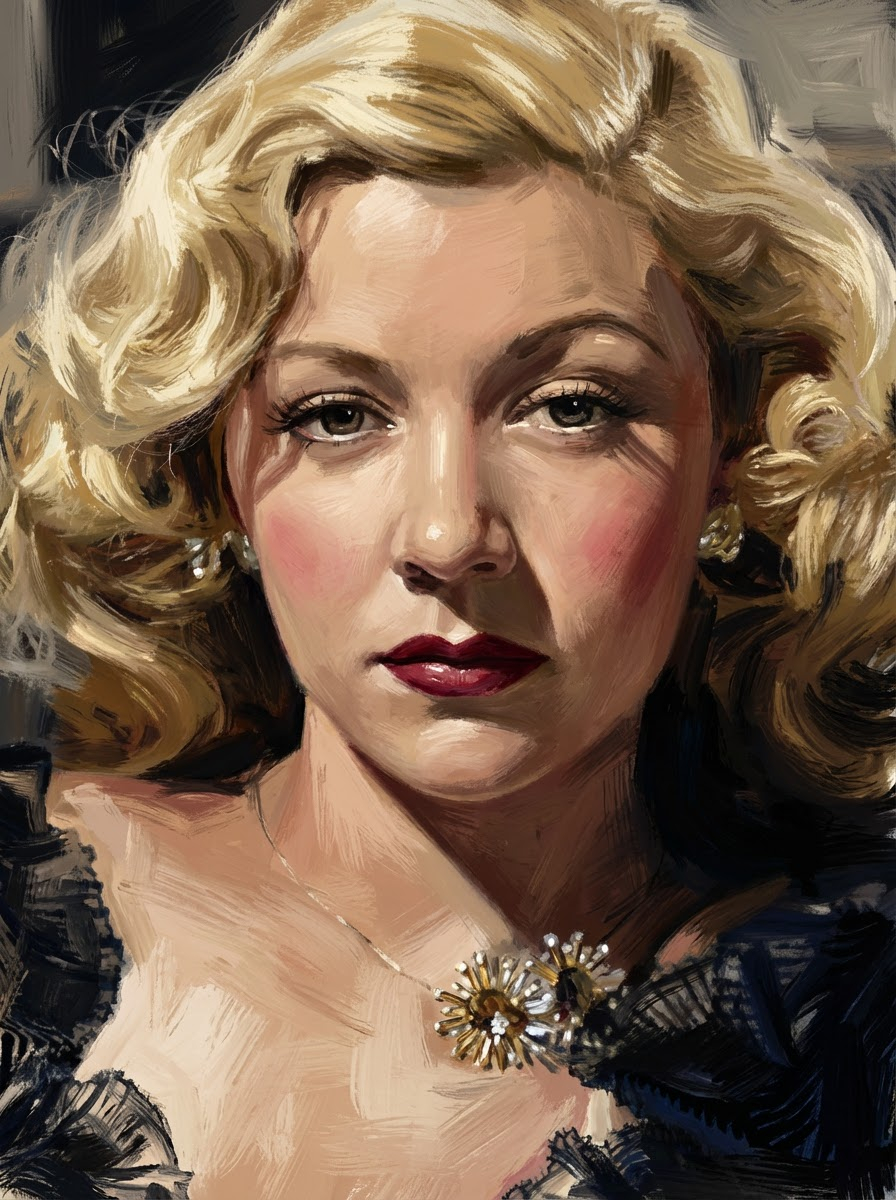
Portrait · Gloria Grahame
Born Gloria Hallward on November 28, 1923, in Los Angeles — the daughter of a mechanical engineer and an English drama teacher who had herself performed on the London stage. She studied at the Pasadena Playhouse and the Hollywood Studio Club, changed her name to Grahame, and arrived in Hollywood features in 1944 as a blonde with an unusual quality: a sensuality that seemed genuinely unpremeditated, as if the camera had caught her thinking about something else and found something more interesting than what she would have chosen to show.
Her early MGM roles were minor, but Frank Capra cast her in It's a Wonderful Life (1946) — Violet Bick, the town flirt, played with a warmth that complicated the character's conventional function — and the notices were immediate. Humphrey Bogart requested her for Nicholas Ray's In a Lonely Place (1950), in which she plays Laurel Gray, the neighbour who falls in love with a violent screenwriter. The film is one of Hollywood's great studies in the simultaneous attraction and fear that a dangerous man produces in a woman who knows better, and Grahame's performance is its emotional centre.
Vincente Minnelli's The Bad and the Beautiful (1952) won her the Academy Award for Best Supporting Actress for a role that amounts to perhaps fifteen minutes of screen time — the Southern actress wife of a failed writer, undone by her husband's infidelity and her own fragility. Fritz Lang's The Big Heat (1953) gave her Debby Marsh, the gangster's moll whose face is scarred by boiling coffee in the film's most shocking scene, and who returns to take her revenge. The two performances together constitute the fullest argument for her intelligence as an actress — she could play women destroyed by men and women who destroyed men, and in each case she found the wound beneath the surface.
She died on October 5, 1981, in New York, aged fifty-seven, of peritonitis following cancer surgery she had delayed for two years. She was performing in a regional theatre production in England and refused to stop working.
Laurel's progression — from attraction to love to the fear she cannot suppress — is the film's moral structure, and Grahame sustains it with a psychological precision that the noir genre rarely allowed its female characters. Her final scene — refusing to answer when Bogart calls her name — is the most quietly devastating ending in 1950s American cinema.
Rosemary is on screen briefly, and the performance has no room for error — every moment must count, and every moment does. Grahame's gift for communicating damaged vulnerability without self-pity is here at its most distilled. Her scene after discovering her husband's infidelity — the hysterical car ride into the darkness — is the performance that won the Oscar and the one that most fully demonstrates what she could do when given the space to do it.
Debby's arc — from complicit accessory to the film's agent of justice — is Grahame's most complete characterisation: a woman whose superficiality is revealed as a survival mechanism, and whose capacity for action is revealed by the violence done to her. Her scene returning the coffee to its source — wearing a disfigured face with complete calm — is the most satisfying moment of revenge in 1950s noir.
Ado Annie is the proof that Grahame's qualities — the unpremeditated sensuality, the apparent transparency — were as useful for comedy as for danger. The character's helplessness before her own desires is played with genuine warmth rather than condescension, which is a difficult balance in a musical role that could easily become a caricature. She was nominated for the Oscar and lost, which was not the first or last time the Academy underestimated her range.
I was never a femme fatale. I was just a woman who kept getting into situations where fate was fatal to the men around me. That's different.
Gloria Grahame's legacy is the intelligence that noir kept misidentifying as decoration. In a Lonely Place and The Big Heat are two of the finest American films of the 1950s, and her performances in both are central to why — not because she is decorative but because she is the films' moral intelligence, the character whose understanding of what is happening is more complete than anyone else's.
She died at fifty-seven, still working, refusing to let illness end what she had not chosen to end. The Oscar for fifteen minutes in The Bad and the Beautiful is the industry's most accurate acknowledgment of her gifts: she could fill any amount of screen time with complete conviction, and the amount was irrelevant.