Stockholm, Sweden · 1905 – 1990

Greta Garbo

The Stockholm actress who became Hollywood's supreme enigma — who survived the transition from silent films to talkies and then, at thirty-six, in the middle of a career at its zenith, walked away completely and never returned. The retirement lasted forty-nine years. She said she wanted to be alone. She was.

4
Oscar
Nominations
36
Age at
Retirement
49
Years of
Retirement
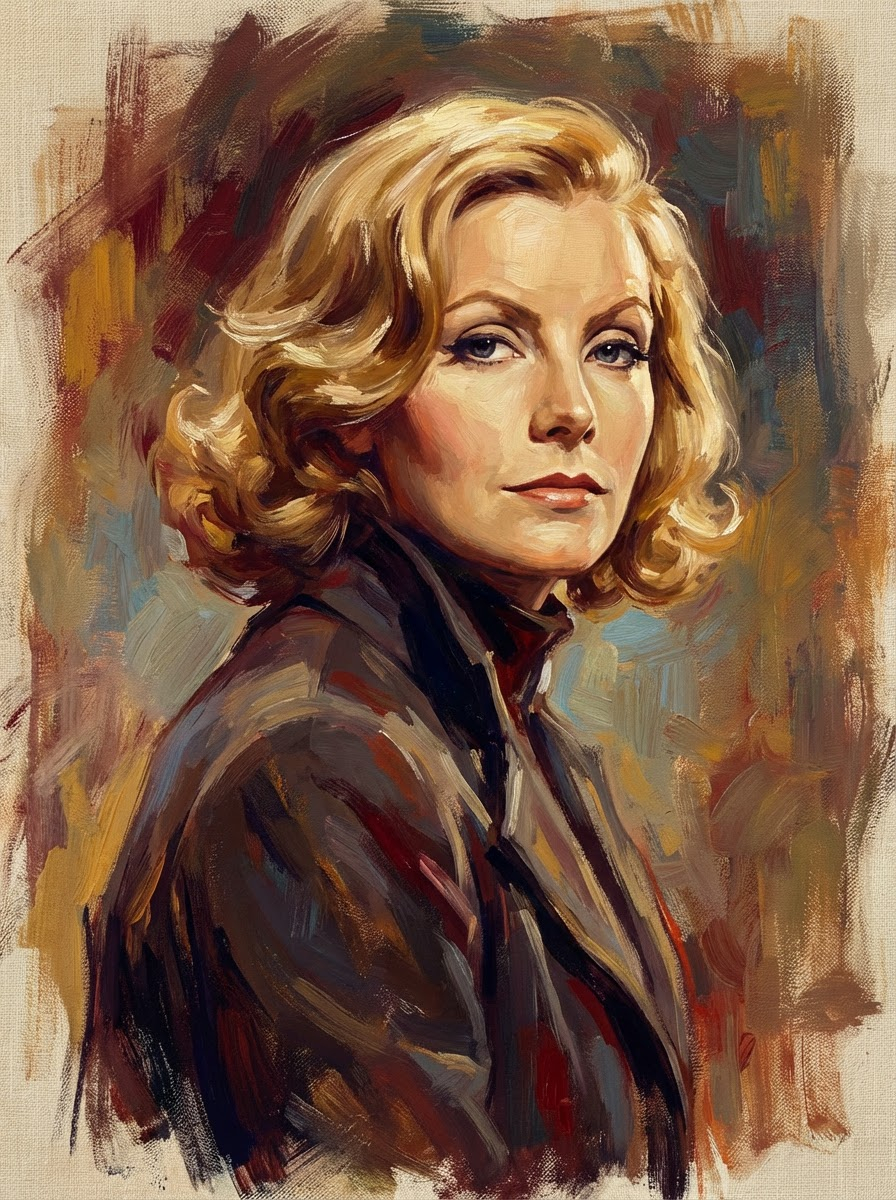
Greta Garbo — painted portrait Portrait · Greta Garbo

From Södermalm to Ninotchka's Smile

Born Greta Lovisa Gustafsson on September 18, 1905, in Södermalm, Stockholm — a working-class district. Her father died of influenza when she was thirteen; she left school to work in a hat shop and then as a model for department store catalogues, which led to minor roles in Swedish films and to the attention of director Mauritz Stiller. Stiller changed her name to Garbo, directed her in The Saga of Gösta Berlings (1924), and brought her to Hollywood when MGM signed him in 1925. She was twenty. She spoke almost no English.

Her transition from the Swedish cinema to MGM — from Stiller's direction to a Hollywood studio system she distrusted on arrival and never stopped distrusting — produced a series of silent films of increasing distinction. The transition to sound, which destroyed many silent careers, confirmed rather than diminished hers: MGM marketed her first talkie, Anna Christie (1930), with the tagline "Garbo Talks!" and the film confirmed that the voice was as compelling as the face had been.

Ernst Lubitsch's Ninotchka (1939) — "Garbo Laughs!" was the campaign — was the most unexpected demonstration of her range: a Soviet emissary whose ideological severity is gradually dissolved by Paris and by Melvyn Douglas. The comedy showed what the tragic roles had suppressed, and the performance is one of cinema's finest comic characterisations. George Cukor's Camille (1936) and Clarence Brown's Anna Karenina (1935) had confirmed that her capacity for tragedy was equally complete.

In 1941, at thirty-six, after the commercial failure of Two-Faced Woman, she announced a temporary retirement. She never made another film. The retirement lasted forty-nine years, until her death on April 15, 1990, in New York City. She received an honorary Academy Award in 1954 for "her unforgettable screen performances."
1905
Born in Södermalm, Stockholm; working-class childhood
1918
Father dies; leaves school; department store model; films begin
1924
Mauritz Stiller; name becomes Garbo; Gösta Berlings
1925
MGM; Hollywood; twenty years old; speaks no English
1930
"Garbo Talks!" — Anna Christie; the voice as compelling as the face
1939
"Garbo Laughs!" — Ninotchka; Lubitsch; the range complete
1941
Retires at thirty-six; never returns; forty-nine years of silence

From Anna Christie to Ninotchka

1939Comedy · Ernst Lubitsch · "Garbo Laughs!"
Ninotchka
Ernst Lubitsch's comedy of ideological erosion — Garbo as Ninotchka, the Soviet trade representative whose Marxist severity is gradually dissolved by Paris, champagne, and Melvyn Douglas. The most unexpected demonstration of her range, the most sustained comedy she ever played, and one of cinema's finest performances in either mode.
Oscar Nom

Ninotchka's transformation — from stiff ideologue to laughing woman — is the film's comic argument about what human nature resists and what it cannot, and Garbo plays both ends of the spectrum with equal conviction. The famous laugh scene works because what precedes it has been played completely straight: the comedy requires the severity. The campaign tagline "Garbo Laughs!" suggests how unexpected this was; the performance suggests they had not previously understood what they had.

1936Romance · George Cukor · Alexandre Dumas fils
Camille
George Cukor's adaptation of Dumas — Garbo as Marguerite Gautier, the Parisian courtesan who falls genuinely in love for the first time and is destroyed by it. Her finest sustained tragic performance: a woman who has built a life around not feeling things, undone by feeling them completely.
Oscar Nom

Marguerite's death scene — she is dying of tuberculosis, and Armand arrives too late — is the performance's culmination, but what makes it devastating is what precedes it: the careful establishment of a woman whose sophistication is a form of self-protection, and whose love for Armand removes that protection entirely. Cukor said directing Garbo was the most extraordinary professional experience of his life — she knew things about the camera he had not known before.

1935Drama · Clarence Brown · Leo Tolstoy
Anna Karenina
Clarence Brown's Tolstoy adaptation — Garbo as Anna, the St. Petersburg society woman whose love affair with Vronsky destroys her position, her family, and finally her life. The role that comes closest to demanding everything she had, in a performance that demonstrates the camera's ability to record interior states that performance alone cannot express.

Anna Karenina is the role that most completely demonstrates why Garbo's face was the camera's greatest subject — the interior life visible in the stillness between expressions, the emotions communicated not through what she does but through what the lens captures when she is doing nothing. It is the purest argument for cinema as a medium distinct from theatre: what she does would be invisible on stage.

1930Drama · Sound Era Debut · Eugene O'Neill
Anna Christie
Clarence Brown's Eugene O'Neill adaptation — Garbo's first sound film, marketed with "Garbo Talks!" The gravelly Swedish-accented voice proved as compelling as the silent image; the Academy nomination confirmed it. The transition that destroyed other silent careers confirmed hers.
Oscar Nom

The MGM marketing machine understood that the voice was a risk — that audiences who loved the silent Garbo might not accept the sound Garbo — and met the risk directly with the campaign. The gamble worked. The voice was low, accented, specific in a way that the idealized silent image had not been, and the specificity was more compelling than the idealization. She simultaneously filmed a German-language version of the same film, with a German cast — confirming the practical intelligence beneath the mystique.

"

I want to be alone.

— Ninotchka · Greta Garbo · Ernst Lubitsch, 1939

Four Nominations — One Honorary Oscar — Forty-Nine Years of Absence

Honorary Academy Award
1954
Lifetime Achievement
Awarded for "her unforgettable screen performances" — thirteen years after her retirement. She did not attend the ceremony. The award was accepted in absentia by a representative, which was as much presence as she was willing to offer the industry.
Honorary Oscar
Four Oscar Nominations
1930 · 1930 · 1937 · 1940
Career Nominations
Anna Christie, Romance, Camille, Ninotchka — four nominations spanning ten years, each for a performance in a different mode: the sound debut, the romantic tragedy, and the comedy that surprised everyone including her studio
4 Nominations
The Retirement
1941 — 1990
Forty-Nine Years
At thirty-six, at the apex of her career, after the commercial failure of Two-Faced Woman — she stopped. She received many offers over the following decades. She refused them all. The retirement was total and permanent, and lasted until her death in 1990.
Complete Retirement
New York Walks
1941–1990
The Private Life
She lived in New York, walked the city daily in flat shoes and a hat, refused interviews, avoided photographs, never discussed the retirement. The enigma that the publicity machine had manufactured became, in retirement, entirely authentic.
New York, 1941–90

The Face That the Camera Loved Most

The Camera's Subject
Garbo's specific gift — what Roland Barthes called "a face that belongs to no region of the world" — was a capacity for interior life legible to the camera that went beyond what acting technique could account for. Directors learned to let the camera rest on her face rather than require action from it; the stillness was more eloquent than the gesture.
The Sound Transition
The transition to sound that destroyed Norma Desmond and many actual silent careers confirmed Garbo's rather than ending it. The voice — low, Swedish-accented, specific — was as compelling as the image had been, and for a different reason: where the silent Garbo was idealized, the sound Garbo was particular, and the particularity was more interesting.
The Enigma
The privacy that the MGM publicity machine cultivated as a marketing strategy became, in retirement, entirely genuine — the woman who said she wanted to be alone actually wanted to be alone, and spent forty-nine years demonstrating it. The manufactured enigma and the real one were indistinguishable, which is perhaps the most interesting thing about her.
The Retirement
Her retirement at thirty-six — complete, permanent, unexplained — is the most radical act in Hollywood history. She gave no reason; she returned no calls; she made no film. The industry spent decades assuming she would return, making offers, waiting. The waiting was the answer. She had said she wanted to be alone; she was, for forty-nine years.

The Sphinx Who Kept the Secret

Greta Garbo's legacy is the face and the retirement — and the understanding that both are arguments for the same thing: that the relationship between a great performer and the camera is not a professional transaction but something more intimate, more complete, and ultimately more private than the industry she worked in could accommodate. She gave the camera everything it wanted from her. She gave the industry nothing it wasn't contractually owed.

The honorary Oscar in 1954 she accepted in absentia. The four nominations for four genuinely different kinds of performance confirm a range that Ninotchka alone would have established. The retirement at thirty-six, maintained for forty-nine years until her death, is the statement: that the work was complete, that the life was her own, and that she had said everything she intended to say.

Oscar Nominations
1930 · 1930 · 1937 · 1940
4
Age at Retirement
1941 — never returned
36
Years of Retirement
Until death in 1990
49
Age at Death
April 15, 1990, New York
84