New York City · 1890 – 1977

Groucho Marx

The verbal machine gun of the Marx Brothers — from vaudeville to Broadway to Hollywood, and then, when Hollywood was finished with him, to television, where he reinvented himself at sixty as the host of You Bet Your Life and proved that wit is more durable than youth, or fame, or the movie business.

13
Marx Brothers
Films
11
Years of
You Bet Your Life
87
Years
of Living
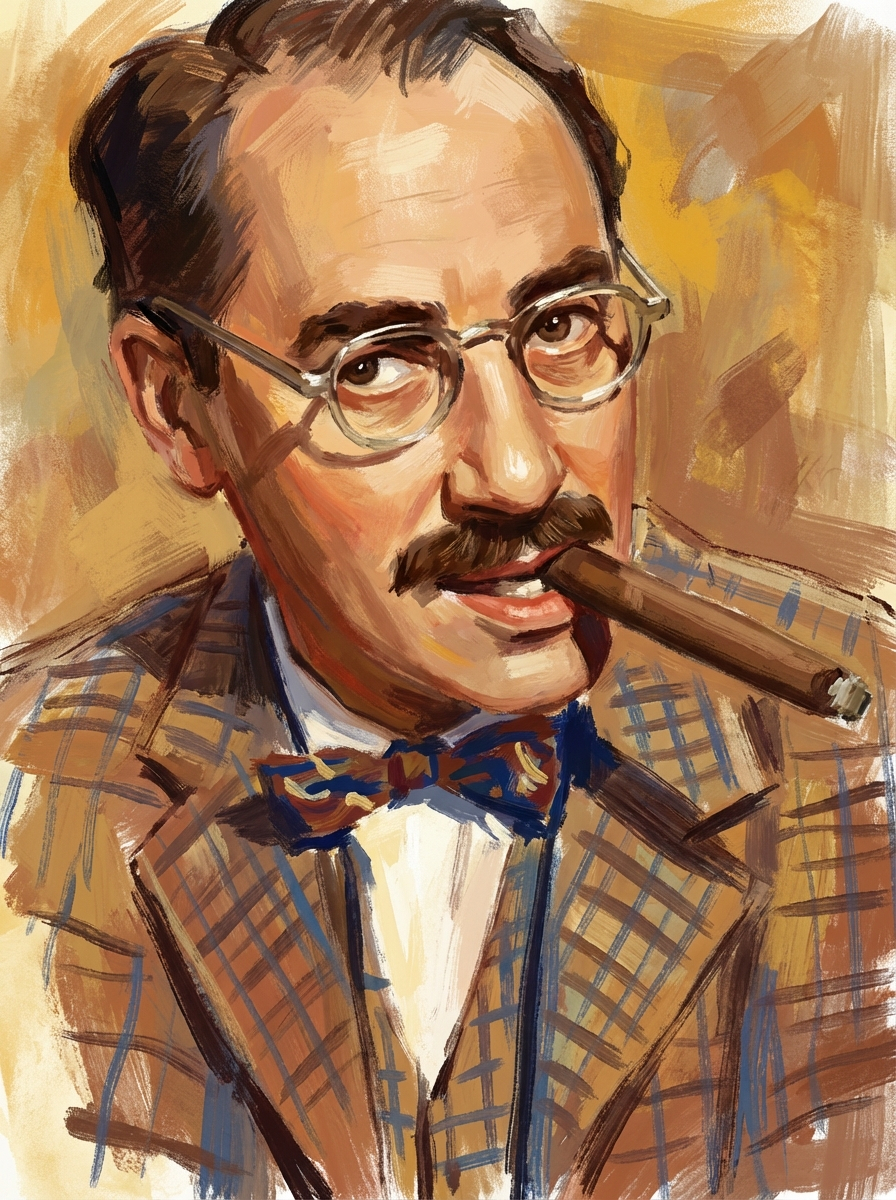
Groucho Marx — painted portrait Portrait · Groucho Marx

From Yorkville Vaudeville to Duck Soup's State of Freedonia

Born Julius Henry Marx on October 2, 1890, in Yorkville, Manhattan — the third of five brothers raised by Minnie and Sam Marx, whose mother Minnie pushed her sons into vaudeville as soon as they were old enough to perform. The stage names came from a 1914 poker game: a monologist named Art Fisher assigned each brother a nickname based on character. Julius became Groucho — the sourpuss. The mustache, the cigar, the loping walk and the machine-gun delivery were vaudeville constructions, refined over fifteen years before Broadway and Hollywood saw them.

The Marx Brothers reached Broadway in I'll Say She Is (1924), The Cocoanuts (1925), and Animal Crackers (1928) — three productions that confirmed they were unlike anything that had preceded them on the American stage: a comedy of anarchic velocity, verbal density, and systemic contempt for the social structures that framed their material. Paramount filmed both stage shows and then gave them original scripts. Duck Soup (1933), directed by Leo McCarey, is their masterpiece — a satire of nationalism, political leadership, and war whose contempt for its own subject is so complete that it is simultaneously the funniest and the most politically serious film the Marx Brothers made.

Their move to MGM and producer Irving Thalberg produced A Night at the Opera (1935) and A Day at the Races (1937) — more polished, more commercially successful, and slightly less anarchic. By the early 1940s the team had dissolved and Groucho's solo film career was modest. In 1947 he became the host of the radio quiz show You Bet Your Life — transferred to television in 1950 — and for eleven years demonstrated that his conversational wit was even more formidable than his scripted comedy. He died on August 19, 1977, in West Hollywood, aged eighty-seven.

T. S. Eliot exchanged a long and affectionate correspondence with him; S. J. Perelman wrote for him; Woody Allen cited him as his primary influence. The cigar was usually unlit. The walk was adopted as a stage character and then abandoned; in private life he walked normally.
1890
Born Julius Henry Marx in Yorkville, Manhattan; mother Minnie schemes
1914
Poker game assigns stage names; Julius becomes Groucho
1924
Broadway — I'll Say She Is; the arrival; critics stunned
1929
Paramount films begin; The Cocoanuts; Hollywood conquered
1933
Duck Soup — McCarey; Freedonia; the masterpiece
1950
You Bet Your Life — television; eleven years; the reinvention
1977
Dies in West Hollywood, age 87; T. S. Eliot was his pen pal

From Duck Soup to A Night at the Opera

1933Comedy · Leo McCarey · Satire
Duck Soup
Leo McCarey's Marx Brothers masterpiece — Groucho as Rufus T. Firefly, the appointed leader of Freedonia, who declares war on a neighbouring state for reasons that include insult, incompetence, and inattention. A satire of nationalism and political leadership so complete in its contempt that it is simultaneously the funniest and most politically serious thing they made.

Duck Soup's war begins because Firefly is insulted at a party and could not be persuaded not to be. The film presents this as structurally indistinguishable from how actual wars begin, which is the most serious observation any Hollywood film of the 1930s made about international politics. It was a commercial failure on release — audiences found it too anarchic; the Marx Brothers' Paramount contract was not renewed — and has since been recognized as the finest political satire in American film comedy.

1935Comedy · Sam Wood · MGM
A Night at the Opera
Sam Wood's MGM Marx Brothers film — their most commercially successful, their most polished, and the one that demonstrated what Thalberg's production philosophy added and what it cost. The stateroom scene is the most precisely choreographed comedy sequence in studio-era Hollywood; the musical interruptions are the tax the studio levied for the anarchism.

The stateroom scene — in which an implausible number of people crowd into a ship's cabin until it collapses — is the limit of what physical comedy and precise timing can achieve together: a mathematical demonstration of escalation as a comic principle. Thalberg insisted the Brothers road-test the material before filming, playing it to live audiences for weeks until every beat was calibrated; the result is the most technically perfect extended comedy sequence they produced.

1929Comedy · Robert Florey · First Film
The Cocoanuts
The Marx Brothers' first film — a Paramount adaptation of their Broadway show, shot in Astoria while they were still performing Animal Crackers at night. The technology was primitive, the production rushed, and Groucho's verbal machine-gun is already completely formed: the insults, the puns, the fourth-wall asides, the absolute refusal to pretend the fiction is real.

The Cocoanuts is not a great film, but it is a historically important one — the first record of what the Marx Brothers had spent fifteen years developing in vaudeville and on Broadway. Groucho's address to the camera — speaking directly to the audience while nominally speaking to another character — is already fully present, which means that what cinema contributed to the act was a lens, not an invention. They shot in Astoria during the day and played on Broadway at night; the exhaustion is occasionally visible.

1950–1961Television · Quiz Show · NBC
You Bet Your Life
Eleven years of television — Groucho as host of the quiz show that was never really about the quiz. The format was a pretext for Groucho to interview contestants, and the interviews revealed that his conversational wit was even more formidable than his scripted comedy: unscripted, unpredictable, and consistently funnier than anything being broadcast.
Emmy Nom

You Bet Your Life is the proof that Groucho's comedy was not dependent on the Marx Brothers structure, the duck, or the scripts of Morrie Ryskind. The raw material was a mind that moved faster than its interlocutors and was constitutionally incapable of letting a straight line pass without treatment. The show ran for eleven years; the best moments were the ones the producers edited out; the contestants, bewildered and delighted, had stumbled into contact with one of the twentieth century's great comic minds.

"

Outside of a dog, a book is a man's best friend. Inside of a dog, it's too dark to read.

— Groucho Marx

Honorary Oscar — T.S. Eliot's Pen Pal — The Reinvention

Honorary Academy Award
1974
Groucho Marx
Awarded at eighty-three for a career that spanned six decades of American comedy — vaudeville, Broadway, Hollywood, and television. He attended the ceremony and delivered a brief, characteristically oblique acceptance speech.
Honorary Oscar
T. S. Eliot Correspondence
1960s
Literary Recognition
He exchanged a long correspondence with T. S. Eliot — each requesting a photograph of the other. The intellectual seriousness beneath the comedy was real; S. J. Perelman, Woody Allen, and half the comedy writers of the twentieth century cited him as primary influence.
Eliot's Pen Pal
You Bet Your Life
1950–1961
Television Reinvention
Eleven years as television host — the reinvention, at sixty, of a comedian whom Hollywood had considered finished. The show confirmed that the wit was the instrument, not the cigar or the mustache, and that unscripted Groucho was funnier than scripted Groucho.
11-Year Run
The Groucho Walk
Vaudeville–1940s
Stage Invention
The loping crouch, the painted mustache, the waggling eyebrows, the cigar — all vaudeville inventions, refined over fifteen years before Hollywood saw them. In private life he walked normally. The character was the argument; the man was the instrument.
Character Created

The Machine Gun That Fired at Everything

The Verbal Speed
Groucho's comedy is primarily verbal — puns, non-sequiturs, insults that are technically compliments, logical traps sprung on characters who entered the conversation at full speed and couldn't find the brakes. The speed was essential: the jokes land because the next one arrives before the first can be examined.
The Political Anarchism
Duck Soup is the clearest statement, but the contempt for authority runs through everything: the pompous figures who populate the Marx Brothers' world are pompous because pomposity is what the world rewards, and the comedy is the punishment they should have received earlier. The films are not arguments; they are trials.
The Television Reinvention
You Bet Your Life demonstrated that Groucho's comedy was not dependent on scripts, brothers, or studio production values. The raw instrument was a mind that processed faster than its interlocutors and could not allow a straight line to pass untreated. The show ran eleven years; the mind never slowed.
The Literary Groucho
His correspondence with T. S. Eliot — serious, warm, intellectually engaged — is the evidence for the intelligence beneath the comedy. He read widely, wrote memoirs of considerable literary quality, and understood that the vaudeville clown and the literary mind were not in opposition but were the same instrument playing different registers.

The Comic Mind That Never Stopped Moving

Groucho Marx's legacy is the comedy and the reinvention — the man who survived Hollywood's rejection by becoming something even better on television, who was T. S. Eliot's pen pal, who influenced every comedian who came after him, and who died at eighty-seven having worked in every medium the twentieth century offered. Duck Soup remains the finest political satire in American film comedy; You Bet Your Life remains the finest demonstration that genuine wit requires no supporting structure.

The painted mustache was a vaudeville invention; the real mustache he grew in retirement looked nothing like it. The character was constructed over fifteen years of vaudeville before anyone filmed it; the man beneath it was more interesting than any of the characters he played, which is probably why T. S. Eliot wanted to have dinner with him.

Marx Brothers Films
1929 to 1949
13
You Bet Your Life
Television run, 1950–1961
11 yrs
Honorary Oscar
1974 · Age 83
83
Age at Death
August 19, 1977
87