Stockholm, Sweden · 1915 – 1982

Ingrid Bergman

Three Oscars, two continents, one scandal that exiled her from Hollywood — and a return so triumphant it rewrote the rules. The most luminous actress of the studio era, and perhaps its most courageous.

3
Academy Awards
Won
7
Oscar
Nominations
50+
Film
Credits
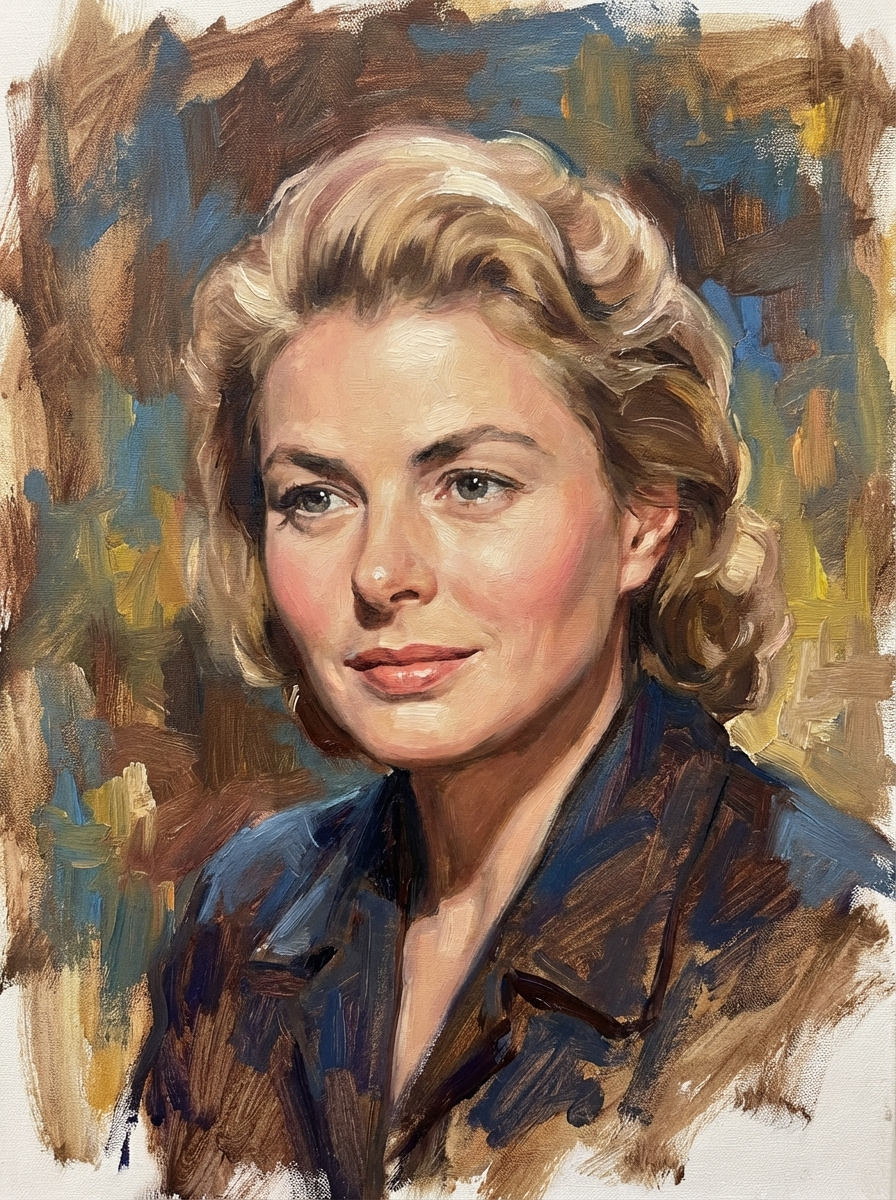
Ingrid Bergman — painted portrait Portrait · Ingrid Bergman

The Light That Hollywood Could Not Own

Born Ingrid Bergman on August 29, 1915, in Stockholm, Sweden, she was orphaned by fifteen — her mother dying when she was two, her father when she was twelve — and was thereafter raised by an aunt. She studied at the Royal Dramatic Theatre School in Stockholm, and was working in Swedish films by 1935. David O. Selznick saw her performance in Intermezzo (1936) and brought her to Hollywood for the American remake in 1939.

Her Hollywood years produced a constellation of landmark performances: the terrified wife in Gaslight (1944), for which she won her first Academy Award; the morally compromised Alicia in Notorious (1946); the saint in Joan of Arc (1948). Then, in 1949, she left her husband and daughter to go to Italy and work with director Roberto Rossellini, with whom she was having an affair. The resulting scandal was denounced on the floor of the US Senate. Hollywood declared her finished.

She spent seven years in Europe with Rossellini, making films that were largely failures. Then in 1956 she returned to Hollywood for Anastasia and won her second Academy Award — the audience's standing ovation was as much a statement of forgiveness as appreciation. A third Oscar, for Murder on the Orient Express in 1974, closed the arc of a career that had refused to end on anyone else's terms.

Her final masterwork was Ingmar Bergman's Autumn Sonata (1978), in which she played a concert pianist confronting the damage her career had done to her daughter. The film earned her seventh Oscar nomination and was widely seen as her definitive performance — and her most personal.
1915
Born in Stockholm, Sweden
1939
Hollywood debut — Intermezzo with Selznick
1942
Casablanca — Ilsa Lund; enduring cultural icon
1944
First Oscar — Best Actress, Gaslight
1949
Leaves Hollywood for Rossellini; Senate denunciation
1957
Second Oscar — Anastasia; Hollywood's redemption
1974
Third Oscar — Murder on the Orient Express
1982
Dies in London on her 67th birthday

From Casablanca to Autumn Sonata

1942Romance · War · Drama
Casablanca
Michael Curtiz's wartime masterpiece — and the film in which Bergman's Ilsa Lund became one of cinema's defining images of romantic sacrifice, luminous under the lights of Rick's Café Américain.

Bergman said she never understood which man Ilsa truly loved, and played it that way — uncertain, conflicted, and utterly believable. That ambiguity is the film's engine, and she is its source.

1944Thriller · Psychological
Gaslight
George Cukor's psychological thriller in which Bergman plays Paula, a woman slowly driven to believe she is losing her mind by a manipulative husband. The performance earned her first Academy Award.
Oscar Win

Bergman's descent from brightness into terror is meticulously constructed — she gives the audience both Paula's growing confusion and the intelligence that makes her eventual clarity all the more devastating. A landmark of psychological performance.

1946Thriller · Espionage
Notorious
Hitchcock's espionage masterpiece — Bergman as Alicia Huberman, the daughter of a convicted Nazi spy who is recruited by the American government to infiltrate a ring of former Nazis in Rio de Janeiro.

Bergman and Cary Grant created one of cinema's great screen couples, and the film's famous long kiss remains a technical marvel. Her Alicia — brave, compromised, and deeply in love — is among her finest roles.

1978Drama · Ingmar Bergman
Autumn Sonata
Ingmar Bergman's late masterwork — Ingrid plays a concert pianist who visits her estranged daughter and must confront decades of emotional absence. The final role many consider her greatest.
Oscar Nom

Two Bergmans, one film, one extended confrontation between a mother and daughter across a night — a work of extraordinary emotional precision. She was magnificent, raw, and completely unguarded.

1957Drama · Historical
Anastasia
The film that brought Bergman back from exile — playing a woman who may or may not be the surviving Russian princess, opposite Yul Brynner. The audience that gave her a standing ovation was welcoming her home.
Oscar Win

The comeback performance that silenced every critic who had written her off. Bergman plays uncertainty and identity with consummate skill. It remains one of Hollywood history's great second acts.

"

I have no regrets. I wouldn't have lived my life the way I did if I was going to worry about what people were going to say.

— Ingrid Bergman

Three Oscars and a Career Hollywood Couldn't Kill

Academy Awards — Best Actress
Gaslight
First Academy Award win
1945
Oscar Won
Academy Awards — Best Actress
Anastasia
The triumphant Hollywood return
1957
Oscar Won
Academy Awards — Best Supporting
Murder on the Orient Express
Third and final Academy Award
1975
Oscar Won
Tony Award · Emmy Award
Stage & Television
Won both — completing a rare career triple crown
1947 · 1959
Tony · Emmy Won

Luminosity as Moral Intelligence

Natural Light
Cinematographers described Bergman as uniquely photogenic — not in the manufactured sense of glamour lighting, but because her face registered thought and emotion with a transparency that made her appear lit from within.
Moral Complexity
Her greatest roles — Ilsa, Alicia, Paula, Charlotte — are women caught between competing claims: love against duty, desire against loyalty, art against family. She made the conflict feel genuinely unresolvable.
The Exile and Return
No career in Hollywood history more dramatically enacted the arc of fall and redemption. She was condemned by the US Senate in 1950 and collecting her third Oscar by 1975. The scandal became the story, and the story became her legend.
Transatlantic Range
Swedish films, Hollywood studio films, Italian neorealism, French theatre, British television, Ingmar Bergman's chamber dramas — she worked comfortably across every tradition of Western cinema and theatre.

The Standard by Which Everything Is Measured

Ingrid Bergman is on the short list of performers — perhaps three or four in the history of cinema — whose work is both a technical standard and a moral example. She showed that screen acting could carry genuine intelligence, that luminosity was not incompatible with depth, and that a career could be built and rebuilt on nothing but honesty.

Her refusal to pretend the Rossellini affair didn't happen, her decision to leave Hollywood rather than play the hypocrite, and her return on her own terms — these were not just biographical facts but artistic ones. They fed the authenticity that made her performances in Autumn Sonata possible, and they make her the kind of artist whose life and work cannot be separated.

Academy Awards Won
Gaslight · Anastasia · Orient Express
3
Oscar Nominations
Spanning four decades
7
Years in Exile
Hollywood blacklisting after Rossellini affair
7
Film Credits
Swedish, American, Italian, British
50+