The Lower East Side dancer who arrived at Warner Bros. in 1930 and immediately demonstrated that no one before or since has moved through a film with quite his combination of menace, grace, and electric speed. Gangster, song-and-dance man, George M. Cohan — the same instrument, playing different registers, at the same ferocious temperature.
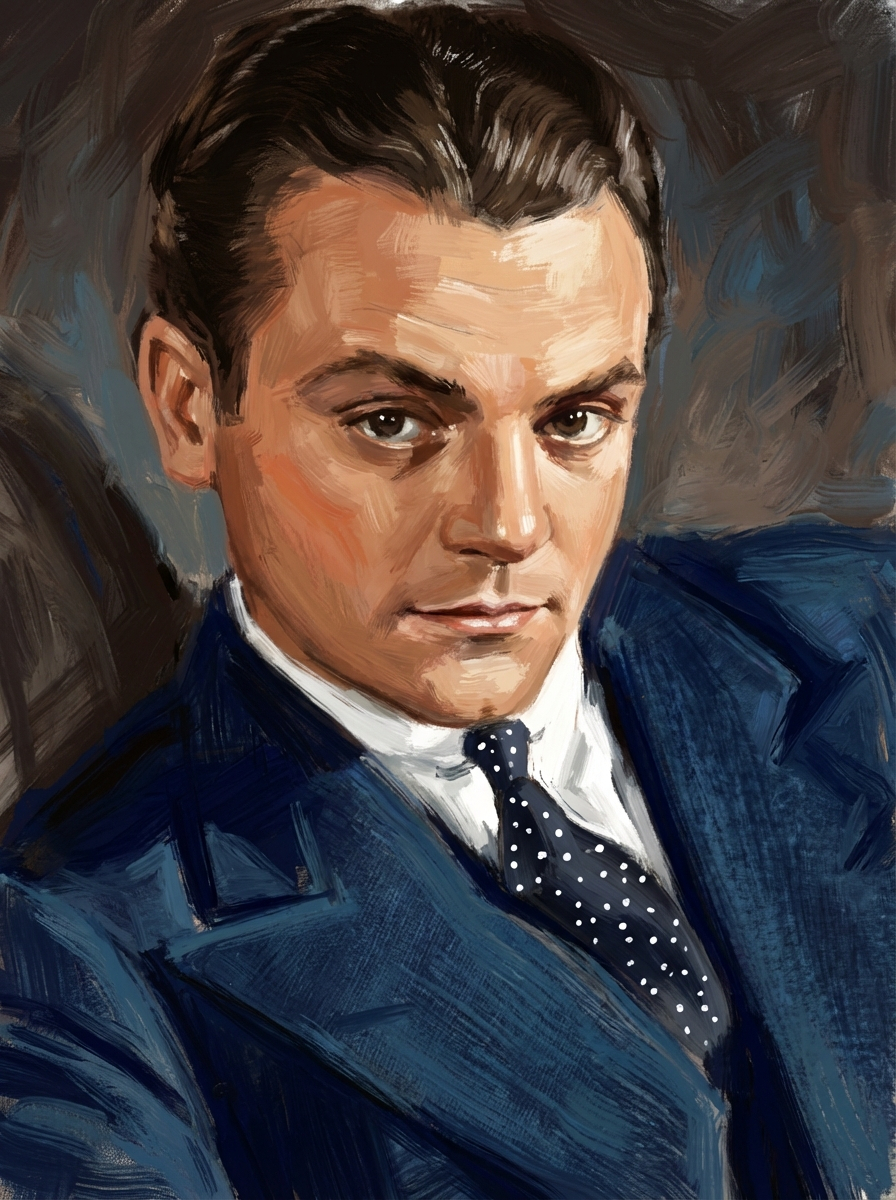
Portrait · James Cagney
Born James Francis Cagney Jr. on July 17, 1899, in the Lower East Side of Manhattan — the son of an Irish-American saloon keeper and a Norwegian-American mother, raised in one of the most economically and socially volatile neighbourhoods in America. He paid for his Columbia University education by dancing — in vaudeville, in taxi-dance halls, in female impersonation revues — and brought to the stage and eventually to Warner Bros. a physical intelligence that was unlike anything Hollywood had previously encountered: a dancer's awareness of space and timing deployed in the service of pure volcanic character.
William Wellman's The Public Enemy (1931) — in which Cagney mashed half a grapefruit into Mae Clarke's face at breakfast — established the screen's first fully realised gangster. Tom Powers is not a romanticised criminal but a specific kind of American product: the working-class boy whose intelligence and aggression found the only channel available to them, moving through a Depression-era world with the focused confidence of a man who has decided exactly what he wants and has no patience for anything else. The grapefruit became famous; what was actually remarkable was everything else in the performance.
Michael Curtiz's Angels with Dirty Faces (1938) gave him Rocky Sullivan opposite Pat O'Brien's Father Connolly — the gangster and the priest who grew up together, diverged entirely, and face each other across a system of values they both understand from the inside. The final scene — Rocky's walk to the electric chair, and whether the cowardice he shows is genuine or performed for the boys' sake — is one of cinema's great unanswerable moments, and Cagney plays it so that the ambiguity survives even a third or fourth viewing.
Michael Curtiz's Yankee Doodle Dandy (1942) — George M. Cohan in full flag-waving glory — won him the Oscar and demonstrated the range that the gangster roles had concealed: a dancer of genuine brilliance, a physical comedian of absolute precision, a performer whose patriotic excess was played with a sincerity that never tipped into camp. He retired to farming in 1961, returned briefly for Ragtime (1981), and died on March 30, 1986, in Stanfordville, New York.
Tom Powers moves through the film with the focused efficiency of a man who has decided what he wants and is constitutionally incapable of patience with anything that stands between him and it. Cagney plays him without self-pity or self-awareness — Tom doesn't think about what he is; he is simply what he is, as completely as possible. The grapefruit was improvised; Mae Clarke didn't know it was coming; the take they used was the first.
Cagney's dancing in Yankee Doodle Dandy is not a Hollywood version of dancing but actual dancing — technically precise, physically exuberant, expressing through movement a kind of joy that his gangster characters never got near. The Oscar for playing Cohan was the industry's acknowledgment that the menace and the grace were the same instrument. The staircase descent at the White House — improvised on set — is the film's most famous moment and his most characteristic: the dancer finding the physical solution that the script didn't provide.
Rocky's walk to the chair requires Cagney to play a man who may be performing cowardice as a final act of moral instruction for the boys who worship him, or may simply be terrified. The film refuses to resolve it. Cagney plays the scene so that both readings are simultaneously available, which is the most demanding thing a film can ask of an actor and the thing he does most completely. Father Connolly asks Rocky to die a coward, to break the boys' hero-worship; whether Rocky grants the request or simply can't help it is what you think about for days after.
Cody Jarrett is the Tom Powers template run through two decades of experience and a psychological complexity that 1931 Hollywood couldn't have accommodated. The madness is not performed but inhabited — Cagney plays a man whose connection to ordinary social reality has snapped at key points, and the result is something that feels genuinely dangerous rather than generically menacing. The prison cafeteria breakdown — news of his mother's death arriving through a chain of whispers across the dining room — is the finest sustained performance in the gangster film's long history.
Made it, Ma! Top of the world!
James Cagney's legacy is the kinetic intelligence — the dancer's awareness of space and timing deployed in the service of character — that made Tom Powers, Rocky Sullivan, Cody Jarrett, and George M. Cohan feel like they are moving through the same physical world as the audience, only faster and more decisively. Nobody before or since has moved through a film with quite his combination of menace, grace, and electric speed.
The misquote — "you dirty rat" — is the tribute the culture pays when an actor's persona is more compelling than the actual words. He never said it. What he said was better. The career stretched from 1930 to 1961, produced the gangster film's defining performances and its finest musical biography, and ended with a man choosing a farm over everything else — which was, characteristically, exactly the right decision.