Fairmount, Indiana · 1931 – 1955

James Dean

The Fairmount, Indiana actor who made three films between 1955 and September 30, 1955, when he died at twenty-four in a car crash on a California highway. East of Eden, Rebel Without a Cause, Giant — three performances that invented the language of adolescent longing that the twentieth century used for the rest of its duration. Three films. Twenty-four years. An eternity of influence.

3
Feature Films
Made
2
Posthumous Oscar
Nominations
24
Age at
Death
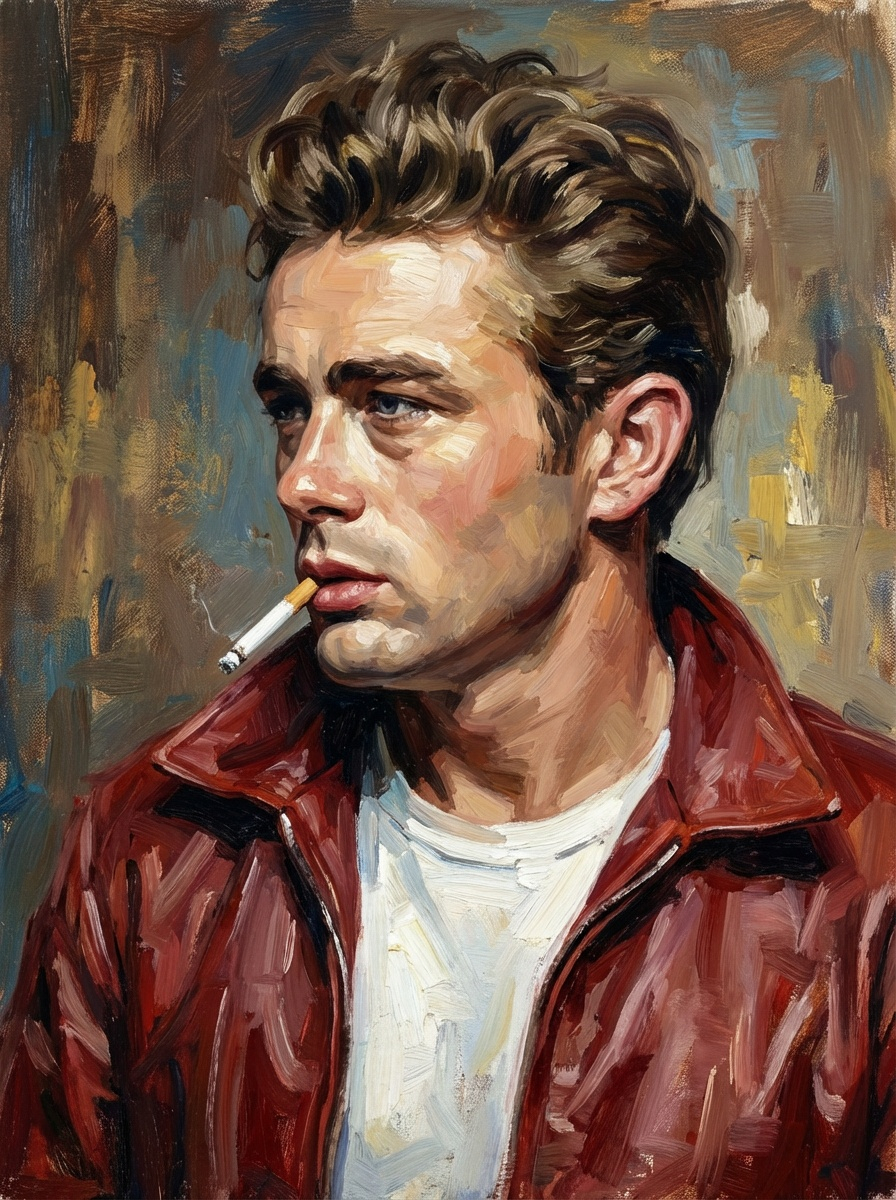
James Dean — painted portrait Portrait · James Dean

From Fairmount to Cal Trask's California

Born James Byron Dean on February 8, 1931, in Marion, Indiana — the son of a dental technician. His mother died of uterine cancer when he was nine; his father sent him to live with his aunt and uncle in Fairmount, Indiana, and returned to Los Angeles. The abandonment was the wound that the performances would spend a career examining without being fully conscious of doing so. He studied agriculture at Santa Monica College before transferring to UCLA to study drama, dropped out, and arrived in New York in 1951 to study at the Actors Studio with Lee Strasberg.

His television work in the early 1950s attracted Elia Kazan's attention. Kazan cast him as Cal Trask in East of Eden (1955) — the adaptation of John Steinbeck's retelling of the Cain and Abel story in 1917 Salinas Valley, California. Cal is the unloved twin, the son who cannot earn his father's approval no matter what he offers, the young man whose feeling is so intense it has nowhere to go except inward or outward in forms that damage everything they touch. The performance was unlike anything Hollywood had produced: an interiority so complete and so exposed that watching it felt like an intrusion.

Nicholas Ray's Rebel Without a Cause (1955) gave him Jim Stark — the middle-class teenager who is not delinquent but cannot find a form for the intensity of what he feels, whose parents' failure to provide any coherent model of how to be an adult leaves him constructing one from scratch in the worst possible circumstances. The red jacket became an icon; the performance was more serious than the icon implied.

George Stevens' Giant (1956) — filmed before his death and released afterward — cast him as Jett Rink, the ranch hand whose oil discovery transforms him from social inferior to grotesque nouveau riche. The performance covered thirty years of screen time; Dean's aging makeup was unconvincing; the characterisation beneath it was not. He died on September 30, 1955, on Route 466 in Cholame, California, when his Porsche 550 Spyder collided with a Ford Tudor sedan at a highway intersection. He was twenty-four.
1931
Born in Marion, Indiana; father a dental technician
1940
Mother dies; father sends him to Fairmount; the wound opens
1951
New York; Actors Studio; Strasberg; the method inhabited
1954
Kazan casts him as Cal; East of Eden — the arrival
1955
Rebel Without a Cause — Jim Stark; the red jacket; the icon
Sept 30, 1955
Route 466, Cholame; Porsche 550 Spyder; twenty-four years old
1956–57
Giant released posthumously; two Oscar nominations follow

Three Films — A Century of Influence

1955Drama · Elia Kazan · Steinbeck
East of Eden
Elia Kazan's Steinbeck adaptation — Dean as Cal Trask, the unloved twin whose need for his father's approval is so total and so unavailable that it shapes everything he does. The performance that announced him: an interiority so complete and so exposed that watching it felt like an intrusion into something that should have stayed private.
Oscar Nom

Cal's need is the film's subject — not the Salinas Valley, not the First World War, not the lettuce business, but the specific quality of a young man's hunger for a love that is withheld from him by a father who cannot give what he cannot understand that he has to give. Kazan said Dean understood the character because he was the character. The birthday party scene — Cal offering his father the money he has saved, the father refusing it as morally tainted, the son's collapse — is the most agonising display of filial longing in American cinema.

1955Drama · Nicholas Ray · Adolescence
Rebel Without a Cause
Nicholas Ray's teenage drama — Dean as Jim Stark, the new kid whose intensity is not delinquency but the consequence of adults who have provided no coherent model of how to be. The red jacket became the century's most recognisable garment; the performance beneath it was more serious, more specific, and more psychologically precise than the icon suggests.
Oscar Nom

Jim Stark is not a rebel — he is a young man who wants desperately to conform to something and finds nothing worth conforming to. His parents' marriage is a performance of incompatible failures; the school offers nothing; the gang offers the only community available. Ray understood that the tragedy was not Jim's intensity but the world's inadequacy to it. The knife fight sequence — Jim circling Buzz on the cliff edge — is choreographed with the precision of ballet and the stakes of actual danger, which is what it felt like for the audience in 1955.

1956Epic Western · George Stevens · Texas
Giant
George Stevens' Texas epic — Dean as Jett Rink, the ranch hand whose oil strike transforms him from social inferior to grotesque nouveau riche over thirty years of screen time. Released after his death; the aging makeup was unconvincing; the characterisation of envy, ambition, and self-destruction was not. His final performance, playing a man destroyed by getting what he wanted.

Jett Rink is the most technically demanding of Dean's three performances — covering thirty years, requiring him to play youth and age in a film where he would not live to see the final cut. Stevens kept the cameras rolling during takes knowing Dean would improvise, and the improvised moments — Jett alone with his oil derrick, Jett drunk at the banquet — are the film's most alive passages. He had already filmed most of his scenes when he died; the film was assembled without him; the performance survives intact as the demonstration of what he would have become.

"

Dream as if you'll live forever. Live as if you'll die today.

— James Dean

Two Posthumous Oscar Nominations — The Only Actor So Honored Twice

Oscar Nomination — Best Actor (Posthumous)
1956
East of Eden
Nominated posthumously for Best Actor — Cal Trask's birthday party scene alone would have justified it. He had been dead for six months when the nomination was announced. Ernest Borgnine won for Marty; the alternative history in which Dean lives and wins is the most imagined counterfactual in cinema.
Posthumous Nom
Oscar Nomination — Best Actor (Posthumous)
1957
Giant
Second posthumous nomination — the only actor to receive two posthumous Oscar nominations. Yul Brynner won for The King and I. Dean had been dead for over a year. The nominations confirm that three films were sufficient to establish a career of exceptional distinction.
Only Actor · Two Posthumous
The Cultural Icon
1955 — Present
The Red Jacket
The red jacket from Rebel Without a Cause has become the twentieth century's most recognisable garment — not for what it means but for what Dean put inside it. The icon preceded the analysis; the analysis has confirmed that the icon was not excessive.
Cultural Icon
The Porsche 550 Spyder
September 30, 1955
Route 466 · Cholame, California
He had named the car "Little Bastard." He was on his way to a road race in Salinas when a Ford Tudor sedan turned in front of him at an intersection near Cholame. He was pronounced dead on arrival at Paso Robles War Memorial Hospital at 5:59 p.m.
Age 24 · 5:59 PM

The Wound That Became the Performance

The Method
His Actors Studio training under Lee Strasberg gave him the method; what he brought to it was the wound that the method was designed to access. Kazan said Dean understood Cal Trask because he was Cal Trask — the unloved child whose need for approval from a withholding father was not a character choice but a personal history. The method was the instrument; the wound was the material.
The Interiority
His specific gift was the ability to communicate interior states without translating them into action. Other actors show what their characters feel; Dean shows the feeling before it has been organised into expression. The birthday party scene in East of Eden is the most complete example: Cal's collapse is not performed but allowed, which is what makes it devastating.
The Three Films
East of Eden, Rebel Without a Cause, Giant — three films in one year, released in 1955 and 1956, covering youth, adolescence, and the full arc of a life destroyed by ambition. The range across three films is the argument that the career was not beginning but complete — that what was lost in September 1955 was not potential but an already-realised achievement.
The Posthumous Life
He has been dead for seventy years and the cultural presence has not diminished. The red jacket, the slouch, the cigarette, the Porsche — the iconography maintains itself without the usual erosion of time because it captured something that the culture has not finished processing: the cost of feeling everything too intensely in a world that rewards feeling less.

Three Films — Seventy Years and Still Counting

James Dean's legacy is the interiority — the capacity to communicate what has not yet been organised into expression, to show the feeling before it becomes the act — that gave the twentieth century its primary image of what it cost to be young and sensitive in a world that had no room for either. Three films, twenty-four years of life, and a cultural presence that has outlasted every contemporary who had longer to work with.

The two posthumous Oscar nominations — the only actor to receive two — are the industry's most inadequate acknowledgment of an achievement that exceeded any ceremony's capacity to contain it. He did not need more time to prove what he was. East of Eden alone was sufficient. The other two were a bonus that the car crash took back before it could become the beginning of something even larger.

Feature Films Made
East of Eden · Rebel · Giant
3
Posthumous Oscar Nominations
Only actor to receive two
2
Age at Death
September 30, 1955
24
Years of Cultural Presence
1955 to present
70+