Kansas City, Missouri · 1911 – 1937

Jean Harlow

The Kansas City actress who became Hollywood's original platinum blonde — and whose comic intelligence was so complete, so unforced, so genuinely funny that the male gaze the studio promoted missed what she was actually doing. She made the wisecrack an art form and she died at twenty-six before anyone could adequately explain what had been lost.

26
Age at
Death
7
Years of
Screen Career
36
Feature
Film Credits
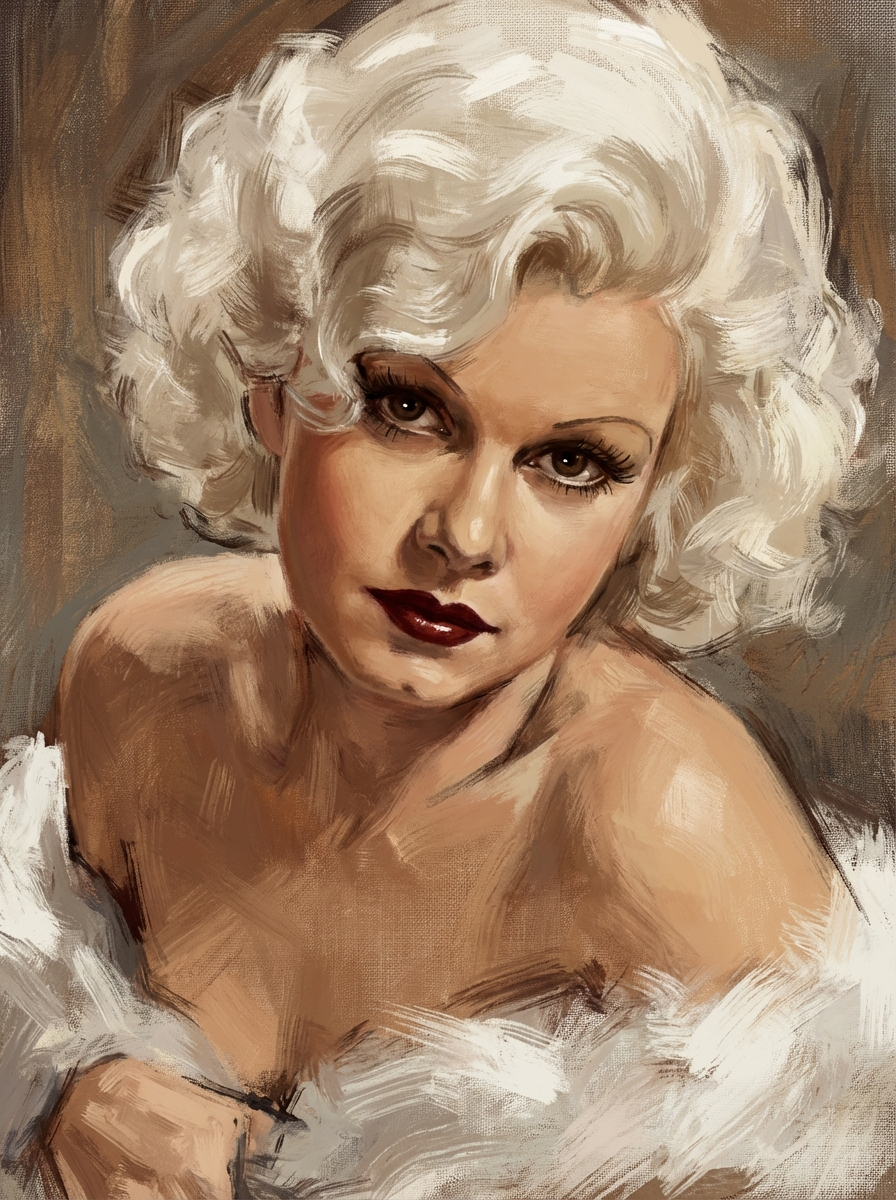
Jean Harlow — painted portrait Portrait · Jean Harlow

From Kansas City to Hell's Angels' Platinum Skies

Born Harlean Harlow Carpenter on March 3, 1911, in Kansas City, Missouri — the daughter of a dentist and a mother who was, by several accounts, the most overbearing stage mother in Hollywood history. She eloped at sixteen, arrived in Hollywood as a contract player's wife, and began picking up bit parts in Hal Roach comedy shorts and Laurel and Hardy films, trading on nothing but the extraordinary physical quality the camera was already learning to find. Howard Hughes cast her in Hell's Angels (1930) at eighteen — a film that was already in production when sound came in, and that required a scene to be reshot with a speaking actress who could match the silent footage's star. He picked Harlow, apparently on the basis of the hair and the face. What the film revealed was considerably more than either.

MGM signed her in 1932 and put her opposite Clark Gable, Spencer Tracy, Cary Grant, and William Powell — the studio system's recognition that she generated a specific kind of screen electricity that made whoever she was playing against better. Victor Fleming's Red Dust (1932) established the template: the wisecracking woman whose sexuality is so unashamed it becomes comedy, played opposite a male star whose masculinity she deflates with a single line delivered with perfect timing. It was not what the 1930s expected from its blonde bombshells, and it was entirely hers.

George Cukor's Dinner at Eight (1933) gave her the scene that critics still cite as evidence of her genius: the staircase exchange with Marie Dressler's Millicent Jordan, in which Harlow's Kitty Packard announces breathlessly that she has read a book predicting that machinery will replace every profession — "Oh, my dear," Dressler responds, looking her up and down, "that is something you need never worry about." The timing between them is flawless. Harlow's pause before the punchline lands — the moment in which Kitty doesn't yet know she's been insulted — is the finest two seconds of comic acting in 1930s Hollywood.

She died on June 7, 1937, of cerebral edema caused by kidney failure, in Los Angeles. She was twenty-six years and three months old. William Powell, her fiancé, sat beside her throughout the final days. MGM had a film — Saratoga — half-finished; they completed it with a double and released it. It was the year's highest-grossing film. The audience wanted to see her even when she wasn't there.
1911
Born in Kansas City; dentist father; ambitious mother; the hair
1927
Elopes at sixteen; Hollywood wife; discovers bit parts
1930
Howard Hughes — Hell's Angels; platinum hair; the arrival
1932
MGM signs her; Red Dust with Gable; the comic genius visible
1933
Dinner at Eight — the staircase scene; the finest two seconds
1936
Libeled Lady — Powell; Tracy; Loy; the ensemble peak
1937
Dies June 7; kidney failure; age 26; Powell at her side

From Hell's Angels to Dinner at Eight

1933Comedy · George Cukor · All-Star Cast
Dinner at Eight
George Cukor's ensemble comedy — Harlow as Kitty Packard, the nouveau-riche wife of a tycoon, whose exchange with Marie Dressler on a staircase produced the finest two seconds of comic acting in 1930s Hollywood. The pause before the insult lands is the distillation of everything she was: the timing, the apparent guilelessness, the intelligence hiding inside the performance of stupidity.

Kitty is nominally the comic relief — the vulgar social climber in a film full of people with more refined problems — but Harlow plays her with an intelligence that makes the apparent vulgarity strategic rather than genuine. When Dressler's Mrs. Jordan implies that machinery will never replace Kitty's profession, the pause before Harlow's guileless response is the performance: Kitty doesn't yet know she's been insulted, and the audience's awareness that she doesn't is what makes it devastating. The scene lasts approximately ninety seconds. It is the argument for her genius.

1932Pre-Code · Victor Fleming · Gable
Red Dust
Victor Fleming's pre-Code Indo-China drama — Harlow as Vantine, the good-hearted prostitute stranded at a rubber plantation opposite Clark Gable's brutal manager. The film that established the Harlow template: the woman whose sexuality is unashamed and whose wit is deployed to deflate male pomposity. She takes a bath in a rain barrel and complains about the conversation. The scene was never bettered.

Vantine is the first fully realised Harlow character — the woman who knows exactly what she is and has made a complete peace with it, whose worldliness is not cynicism but a kind of radical self-acceptance that makes everyone around her look absurdly pretentious. Her rain-barrel bath scene — conducted while chatting companionably with Gable, entirely unbothered by the absurdity of the situation — set the template for how she would play every role for the rest of her career.

1936Comedy · Jack Conway · Four Stars
Libeled Lady
Jack Conway's screwball comedy — Harlow opposite William Powell, Spencer Tracy, and Myrna Loy in a four-way romantic comedy about newspaper libel. The film that demonstrated her range most completely: holding the screen against three of MGM's finest while being the funniest thing in every scene she's in. Powell and Harlow were engaged at the time; the chemistry is real.

The Libeled Lady ensemble is the strongest in 1930s screwball comedy — Powell, Tracy, Loy, and Harlow, each at their peak — and Harlow holds her own without effort. Her relationship with Powell, both on and off screen, produced their finest individual work: people who genuinely knew each other, playing people who do. She was engaged to Powell when she died; he spent most of her final weeks at her bedside and refused to comment on her death for the rest of his life.

1930War · Howard Hughes · Sound Era Debut
Hell's Angels
Howard Hughes' WWI aviation epic — Harlow's breakthrough, cast in her first speaking role at eighteen when the transition to sound required reshooting scenes originally filmed with another actress. Her line — "Would you be shocked if I put on something more comfortable?" — became the era's defining example of pre-Code audacity.

Hell's Angels was Hughes' vanity project — the most expensive film made to that point, shooting interrupted by the coming of sound — and Harlow was a late replacement chosen for physical qualities that the camera confirmed were rather more interesting than expected. Her debut is not the performance her talent would produce later, but the quality is already present: the timing, the refusal to apologize for the character's sexuality, the ease in front of a camera that should have been intimidating.

"

Darling, they don't know what good acting is. They just know what they like to look at.

— Jean Harlow

Seven Years — Thirty-Six Films — An Argument That Was Never Finished

The Staircase Scene
1933
Dinner at Eight
Ninety seconds opposite Marie Dressler. The pause before the punchline lands. Still cited as the finest piece of comic acting in 1930s Hollywood by critics who have spent decades looking for its equal and not finding it.
The Finest Ninety Seconds
The Platinum Hair
1930
A Cultural Invention
The platinum blonde — not blonde but white, chemically achieved at considerable damage to the hair beneath it — was a specific aesthetic invention that the culture immediately recognised as something new: the sexual frankness of a pre-Code America that the Hays Code would shortly prohibit.
Cultural Invention
The William Powell Years
1935 — 1937
Love and Work
Her relationship with William Powell — professional and personal simultaneously — produced their finest individual work and the closest thing to a genuine screen partnership the era contained. He was at her bedside when she died and did not discuss it publicly for decades.
True Partnership
Saratoga — Completed Without Her
1937
The Highest-Grossing Film
MGM completed the half-finished Saratoga with a body double after her death and released it. It was the year's highest-grossing film. The audience paid to see her even when she wasn't there, which is the most brutal possible statement of what had been lost.
Posthumous #1

The Comic Intelligence Inside the Bombshell

The Timing
Comic timing is the rarest skill in acting — the ability to hold a beat precisely long enough for the audience to register what is coming without being given time to prepare for it. Harlow's timing was structural, not learned: the pause in the Dinner at Eight staircase scene is exactly the right length, not because she calculated it but because she felt it, which is the only way it works.
The Unashamed Sexuality
The pre-Code era allowed a specific kind of screen sexuality that the Hays Code would prohibit — the woman who knows what she is and has made peace with it, who plays her sexuality as a quality rather than a secret. Harlow was the defining instance of that type, and the Hays Code's arrival in 1934 effectively ended it. What replaced it was considerably less interesting.
The Intelligence Hidden in Plain Sight
The studio promoted the hair and the body; what the films contain is a mind working at speed. Kitty Packard, Vantine, Lola Burns — the Harlow characters appear to be giving the audience what it expects and are actually giving it something more complicated. The intelligence is structural: it is in the timing, the inflection, the decision of when to play the line straight.
The Unfinished Argument
She died at twenty-six with seven years of screen work behind her and no indication that she had reached her peak. The Dinner at Eight staircase scene is a fully mature performance from a twenty-two-year-old actress. The argument for what she would have become — given another twenty or thirty years and the dramatic roles she was beginning to pursue — was never allowed to be made. Saratoga was the highest-grossing film of 1937 with a body double in her scenes.

Twenty-Six Years — The Argument That Was Never Finished

Jean Harlow's legacy is the staircase scene and the question it generates: what would thirty more years have produced? The finest comic actress of the pre-Code era, working at a pace and standard that her contemporaries could not match, died at twenty-six and left thirty-six films and a question that has no answer.

The platinum hair became the century's most imitated style; the comic intelligence that produced it was never adequately described while she was alive and has been underestimated ever since. The studio sold the hair; what the films contained was a mind. Saratoga grossed more money after her death with a double in her scenes than most of her competitors' complete films. The audience understood what had been lost, which is more than the industry ever fully acknowledged.

Age at Death
June 7, 1937
26
Screen Career
1928 to 1937
9 yrs
Feature Film Credits
MGM and prior
36
The Staircase Scene
Dinner at Eight · 1933
90s