New York City · 1913 – 1952

John Garfield

The Lower East Side actor born Jacob Julius Garfinkle who brought the street to Hollywood before the Method had a name for what he was doing — who played the working-class male condition with a psychological honesty that the studio system found uncomfortable and the HUAC found suspicious. He died at thirty-nine, two months after his HUAC testimony, with his heart failing and his career destroyed.

2
Oscar
Nominations
39
Age at
Death
1952
Year of
Blacklist & Death
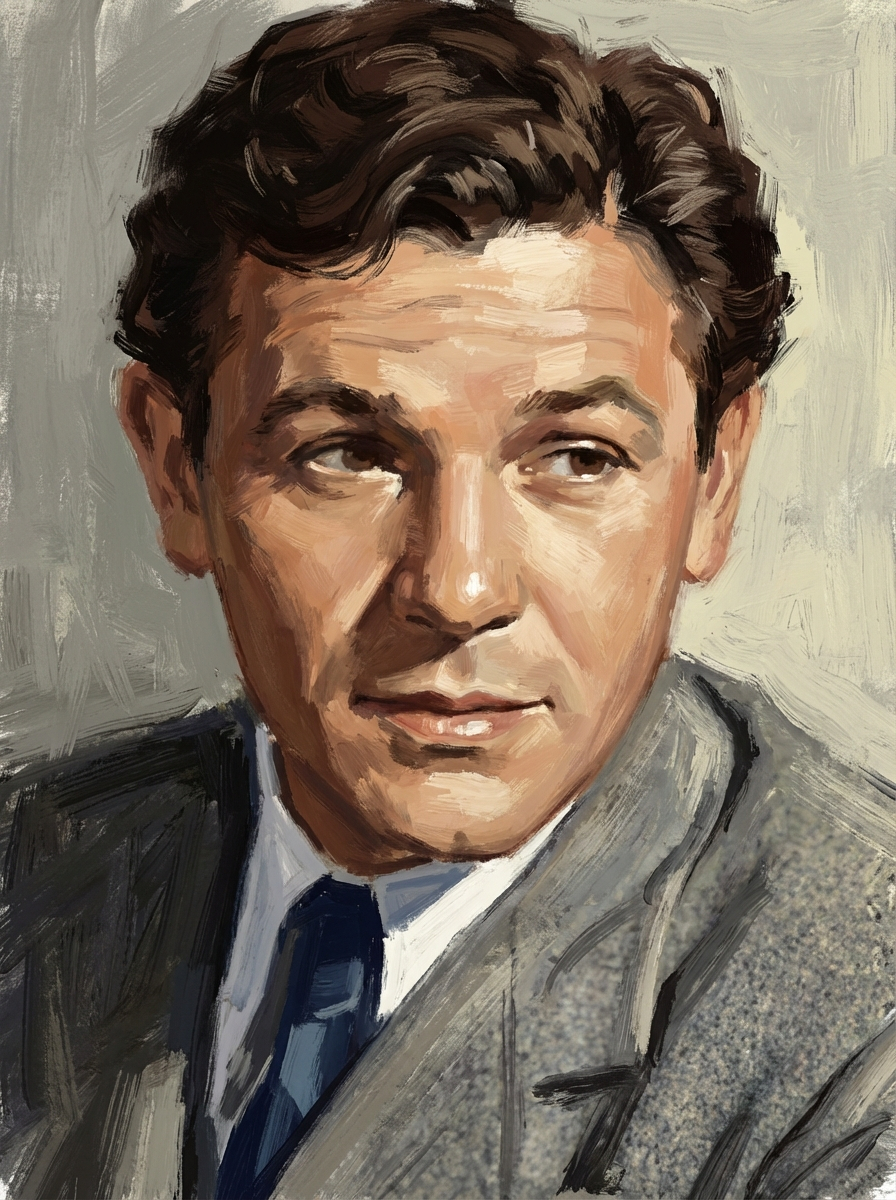
John Garfield — painted portrait Portrait · John Garfield

From the Lower East Side to Frank Chambers' Highway

Born Jacob Julius Garfinkle on March 4, 1913, in the Bronx, New York — the son of Jewish immigrants, raised on the Lower East Side after his mother's death when he was seven, placed briefly in an orphanage, reclaimed by his father, educated in reform school and on the street in roughly equal proportions. He discovered acting at the American Laboratory Theatre, studied at the Civic Repertory, and arrived at the Group Theatre in 1932 — the company that included Stella Adler, Lee Strasberg, Harold Clurman, and Elia Kazan, and that was inventing what would later be called the Method before it had that name or any agreed upon theory.

Warner Bros. signed him in 1938 and immediately tried to smooth out what the Group Theatre had put in. They failed. Michael Curtiz's Four Daughters (1938) — his film debut — gave him Mickey Borden, the cynical drifter whose energy disrupts a conventional musical romance so completely that the studio had to kill him off to restore the genre's order. He was nominated for the Oscar. The nomination confirmed that what the studio found uncomfortable was what the audience found essential.

Tay Garnett's The Postman Always Rings Twice (1946) — Garfield as Frank Chambers, the drifter who walks into a roadside diner, falls for the owner's wife, and conspires to murder the owner — established the film noir archetype of the working-class man destroyed by desire and moral vacancy, played with a physicality and psychological transparency that no other actor of the period brought to the role. Abraham Polonsky's Body and Soul (1947) — his production company, his Oscar nomination — gave him Charlie Davis, the Lower East Side boxer whose rise and contemplated fall is the most complete screen portrait of the working-class male condition the 1940s produced.

The House Un-American Activities Committee subpoenaed him in 1951. He testified as a friendly witness but refused to name names, which satisfied neither side and destroyed his career. He died of a heart attack — congenital heart disease, the death certificate said, though the stress of the preceding months was universally cited as a contributing cause — on May 21, 1952, in New York City. He was thirty-nine years old. Abraham Polonsky said that HUAC had killed him as surely as if they had put a bullet in him.
1913
Born Jacob Garfinkle in the Bronx; orphanage; reform school; the street
1932
Group Theatre; Strasberg, Kazan, Adler; the Method before the Method
1938
Four Daughters — first film; first Oscar nom; the studio discomfited
1946
The Postman Always Rings Twice — Frank Chambers; the noir archetype
1947
Body and Soul — produced; second Oscar nom; Charlie Davis
1951
HUAC subpoena; testifies; refuses names; career destroyed
May 21, 1952
Dies in New York; age 39; heart attack; Polonsky's verdict

From Frank Chambers to Charlie Davis

1946Noir · Tay Garnett · James M. Cain
The Postman Always Rings Twice
Tay Garnett's film noir — Garfield as Frank Chambers, the drifter who stops at a roadside California diner, falls for the owner's wife (Lana Turner), and conspires with her to murder the husband. The working-class noir archetype: the man whose desires exceed his moral resources, whose very physical attractiveness is the mechanism of his destruction.

Frank is not evil but insufficient — the man whose desires are stronger than his will, whose capacity for feeling is not matched by any capacity for moral navigation. Garfield plays the insufficiency as physical fact: the body wants what it wants, and the mind rationalises whatever the body requires. The chemistry with Turner — which the studio attempted to suppress and the camera refused to conceal — is the film's argument: that desire of this intensity produces its own logic, and the logic is fatal.

1947Boxing Drama · Robert Rossen · Self-Produced
Body and Soul
Robert Rossen's boxing drama — Garfield as Charlie Davis, the Lower East Side boy who fights his way to the championship and is then asked to throw the title fight by the gangsters who own him. His production, his Oscar nomination, and the most complete portrait of the working-class male condition the 1940s produced: the man who achieved everything the American dream promised and found the dream required his soul as payment.
Oscar Nom

Charlie's situation — the champion who must choose between what he has achieved and what it cost him — is played by Garfield with the full biographical weight of a man who grew up on the Lower East Side and understood from the inside what the options were and what each of them meant. The film's final scene — Charlie refusing to throw the fight, walking out of the ring past the gangsters who own him, saying "What are you going to do, kill me? Everybody dies" — is the most complete statement of Garfield's specific quality: the man who knows the cost and pays it anyway.

1948Noir · Abraham Polonsky · Numbers Racket
Force of Evil
Abraham Polonsky's numbers-racket noir — Garfield as Joe Morse, the lawyer who has sold his talent to a criminal organisation and is confronted by his brother's involvement in the same system. The most formally ambitious of his films: Polonsky's script is written in verse rhythms, and Garfield's performance navigates the heightened language with a naturalness that makes it invisible.

Joe Morse's corruption is not dramatic but institutional — the lawyer's deal with the criminal system is what lawyers do, rationalised in exactly the terms lawyers use, and Garfield plays the rationalisation as a living psychology rather than a moral lesson. Polonsky's script was written in iambic pentameter; the critics who noticed this were accused of pretension; it is in fact the reason the film's dialogue sounds like nothing else in 1940s Hollywood — heightened, rhythmically distinct, and entirely natural in Garfield's mouth.

1938Drama · Michael Curtiz · Debut
Four Daughters
Michael Curtiz's family drama — Garfield as Mickey Borden, the cynical drifter whose arrival in a musical family disrupts every conventional arrangement the film has established. His debut, his first Oscar nomination, and the proof that the studio's desire to soften him was in conflict with what the audience wanted: the street, unsmoothed, in the middle of a drawing-room comedy.
Oscar Nom

Mickey Borden has to be killed off because the genre cannot accommodate him — his energy disrupts the conventional romantic arrangements so completely that the film's resolution requires his removal. The studio understood this as a structural problem; the audience understood it as a loss. His debut Oscar nomination is the clearest possible evidence that what the studio wanted to manage was exactly what the audience wanted preserved.

"

What are you going to do, kill me? Everybody dies.

— Charlie Davis · Body and Soul, 1947

Two Nominations — A Career Destroyed — Dead at Thirty-Nine

Oscar Nomination — Supporting Actor
1938
Four Daughters
Nominated for his debut film — Mickey Borden, the drifter who disrupts a musical family. The nomination confirmed that what Warner Bros. found uncomfortable was what the Academy found remarkable: the street energy that no studio smoothing could remove.
Debut Nomination
Oscar Nomination — Best Actor
1948
Body and Soul
Nominated for Charlie Davis — the boxer who refuses to throw the title fight. His production company, his Oscar nomination, and the film he produced specifically to demonstrate the range that the Warner Bros. system had been constraining. The most complete statement of his specific quality.
Lead Nomination
The HUAC Testimony
1951
Refused to Name Names
He testified as a friendly witness and refused to name names — a position that satisfied neither the committee nor the left, and that effectively ended his career. He was thirty-eight. He died eleven months after the testimony, of a heart attack that Polonsky described as politically caused.
Career Destroyed
Polonsky's Verdict
May 1952
Age 39 · Heart Attack
Abraham Polonsky said HUAC had killed Garfield as surely as a bullet. The congenital heart disease was real; the stress of the preceding months was real; the career that had been destroyed in the interim was real. He died at thirty-nine, which is younger than Marlon Brando's Vito Corleone and younger than the career deserved.
Age 39

The Street Before the Method Had a Name for It

The Pre-Method Method
His Group Theatre training — Strasberg, Adler, the Stanislavski inheritance — gave him the technique that would later be called the Method, a decade before Brando made it famous. The Lower East Side gave him the material. The combination produced an actor whose authenticity was not a style but a biographical fact: he was the character, or had been close enough that the gap was invisible.
The Working-Class Body
His physicality — compact, coiled, carrying the body of a man who has worked and fought and been formed by physical necessity — was unlike anything else in 1940s Hollywood. The Paramount actors looked like they had been born in suits; Garfield looked like he had earned his. The difference was not performance but formation.
The Insufficient Man
His recurring character type — the man whose desires are larger than his moral resources, whose energy and intelligence have nowhere to go that the system will permit — is the specific contribution of working-class male psychology to American cinema. Frank Chambers and Charlie Davis and Joe Morse are the same formation, expressed in different circumstances.
The Political Death
He died at thirty-nine, partly of a congenital heart condition and partly of what Polonsky called the political murder of an actor who had refused to betray his colleagues. The HUAC blacklist was a system designed to destroy people who had it in them not to give names, which is to say it was designed to destroy the people whose refusal was most genuine.

The Method Before Brando — The Career Ended Before Fifty

John Garfield's legacy is Body and Soul's final scene — "What are you going to do, kill me? Everybody dies" — and the HUAC testimony that came four years later, in which the same refusal to capitulate produced a different result. Charlie Davis walks out of the ring past the gangsters who own him; Garfield refused to walk out of the HUAC hearing past the committee members who wanted names; the outcome of the second refusal was his career, and then his life.

The two Oscar nominations and the body of work between them constitute the argument for what was lost. Brando and Dean absorbed the Method credit that Garfield had earned before either of them arrived in Hollywood; the Lower East Side boy who had done it first, from biographical necessity rather than technique, died before the culture was ready to acknowledge what he had been doing.

Oscar Nominations
1938 debut · 1948 produced
2
Age at Death
May 21, 1952, New York
39
Months HUAC to Death
Polonsky's verdict
11
Years of Major Career
1938 to 1951
13