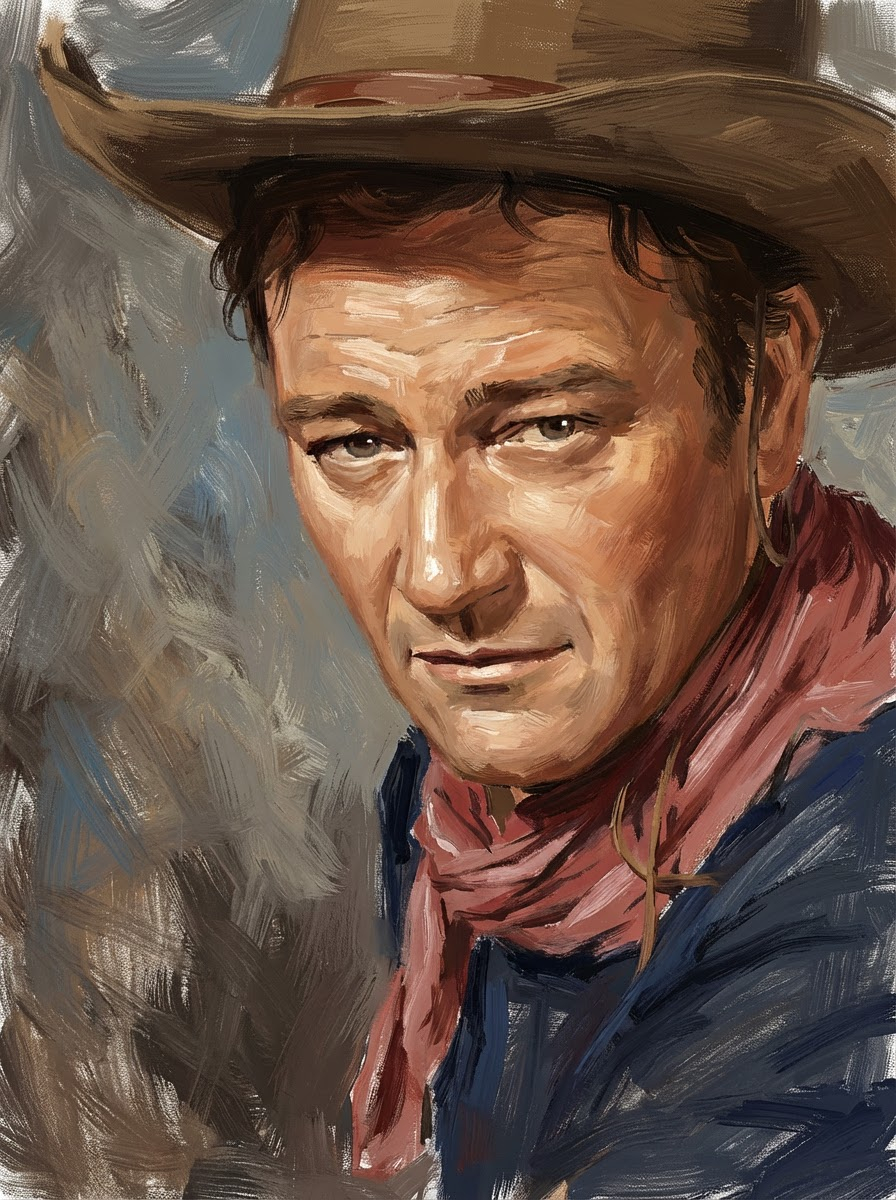
The Winterset, Iowa actor born Marion Robert Morrison who became America's most durable image of itself: two hundred films, one Oscar, one walk that has been imitated so often the original has become invisible, and a persona so complete and so contested that the arguments about what it represented have outlasted everyone who made them.
Portrait · John Wayne
Born Marion Robert Morrison on May 26, 1907, in Winterset, Iowa — the son of a pharmacist who moved the family to California for his health when Marion was six. He attended the University of Southern California on a football scholarship, worked as a prop man and extra at Fox Film Corporation in the late 1920s, and was given his first leading roles by director Raoul Walsh before John Ford's Stagecoach (1939) transformed him from B-Western performer to major Hollywood star. The transformation took a single film; the persona had been forming for a decade.
The Ford collaboration — Stagecoach (1939), Fort Apache (1948), She Wore a Yellow Ribbon (1949), The Quiet Man (1952), The Searchers (1956), and a dozen others — produced the most sustained actor-director partnership in Western cinema and the most complex version of the Wayne persona: the American frontiersman whose codes of honour are both the source of his moral authority and the mechanism of his moral failure. The Ringo Kid in Stagecoach is the version of the hero America wanted; Ethan Edwards in The Searchers is the version it had actually produced.
Howard Hawks' Red River (1948) — Wayne as Tom Dunson, the cattle baron whose obsessive drive to complete the first Chisholm Trail drive becomes a tyranny that his adopted son must overthrow — was the first film to use his established heroic persona against itself, and the performance that demonstrated his range extended beyond the Ringo Kid template. Henry Hathaway's True Grit (1969) — Wayne as Rooster Cogburn, the one-eyed, hard-drinking, morally flexible US Marshal who helps a girl avenge her father's murder — won him the Oscar at sixty-two.
Don Siegel's The Shootist (1976) — his last film, Wayne as J.B. Books, the dying gunfighter who chooses his own death — was the most personal performance of his career: an actor playing a man of his own type dying of cancer, as Wayne was dying of cancer, in a film that serves simultaneously as Western and as elegy. He died on June 11, 1979, in Los Angeles, of stomach cancer. He was seventy-one years old and had been the AFI's most beloved male screen legend for four decades.
Ethan Edwards is the Wayne persona at its darkest and most honest: the frontier hero whose code of honour is inseparable from a racial hatred so complete that it eventually becomes indistinguishable from what he is fighting against. Ford frames him repeatedly in doorways — the man who belongs neither inside the civilisation he protects nor outside with the wilderness he fights — and Wayne inhabits the ambiguity completely. The final shot — the door closing on Ethan, who cannot enter, who has never entered — is the most famous ending in American cinema precisely because it refuses the comfort the preceding two hours had earned.
Tom Dunson's arc — from visionary to tyrant, from father-figure to the thing that must be defeated — required Wayne to play the corruption of virtue rather than its expression, which was the first significant test of whether the persona could bear psychological weight. It could. The confrontation between Wayne and Clift — the old hero displaced by the new one — is the clearest statement of what Hollywood stardom does when two incompatible masculinities occupy the same screen: each makes the other more visible.
The Ringo Kid entrance — the camera tracking toward Wayne as he twirls his rifle and the frame stops — is the introduction of a presence so complete that the film changes register around it. Ford knew what he had and showed it immediately. The performance is not The Searchers — it doesn't need to be; it is the version of the hero that the myth requires before the myth can interrogate itself, and it establishes the standard against which every subsequent Wayne performance, including Ethan Edwards, measured itself.
Books' decision — to choose the manner of his death, to refuse the slow diminishment the cancer offers, to die as the man he has been rather than the patient he is becoming — is the Wayne persona's most complete and most personal statement. The film opens with a montage of previous Wayne performances to establish who Books is; the effect is to make the film explicitly a meditation on the career itself, the actor watching his younger self and playing the older man that younger man became. It is the most honest thing he made, and the most moving.
Courage is being scared to death but saddling up anyway.
John Wayne's legacy is the doorway at the end of The Searchers — the door closing on the man who cannot enter, who has never been able to enter, who has made the house possible by remaining outside it. The Ringo Kid is the version of America it wanted to be; Ethan Edwards is the version it had produced; and Ford and Wayne made both, with the same face, twenty years apart, which is the most complete artistic argument about what the myth requires and what it conceals.
Two hundred films, one Oscar at sixty-two, one Congressional Gold Medal, one walk that has been imitated so often the original has become invisible. The Shootist is the elegy he made for himself before the cancer finished the sentence; and J.B. Books' decision to choose his own death rather than accept the slow diminishment the disease offers is the same decision every great career makes when it recognises what it is and refuses to be something smaller.