Walton-on-Thames, Surrey · Born 1935

Julie Andrews

The Walton-on-Thames singer born Julia Elizabeth Wells who had the four-octave soprano voice, the precision, and the warmth to make Mary Poppins and Maria von Trapp the two most beloved female characters in mid-century cinema — and who kept working when the surgically damaged voice could no longer hit the notes that had made her famous, which was itself a form of courage distinct from and equal to the singing.

1
Academy Award
Won
3
Oscar
Nominations
4
Octave
Vocal Range
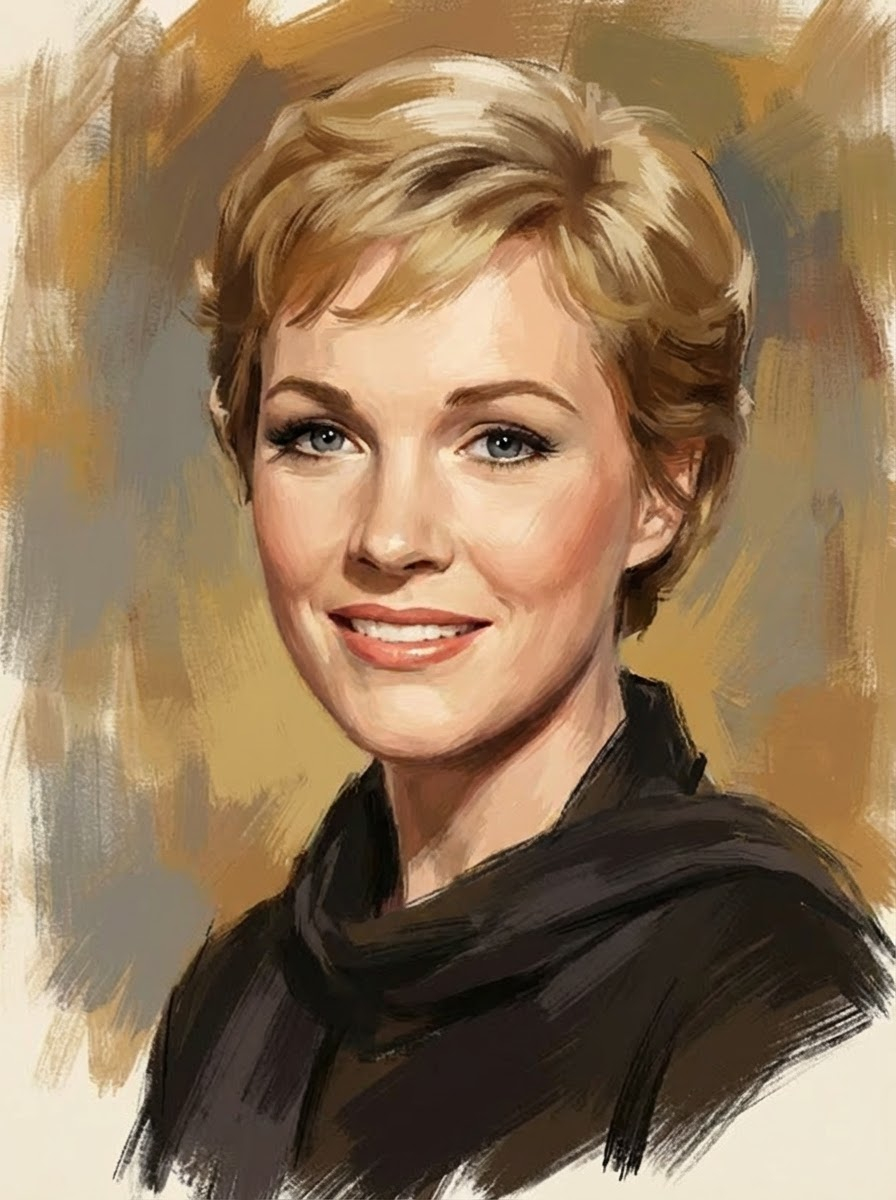
Julie Andrews — painted portrait Portrait · Julie Andrews

From Walton-on-Thames to A Spoonful of Sugar

Born Julia Elizabeth Wells on October 1, 1935, in Walton-on-Thames, Surrey — the daughter of a schoolteacher mother and a stepfather who was a music hall performer, and who discovered at nine that she possessed an extraordinary soprano voice with a range that her stepfather's vocal coach described as the finest natural instrument he had encountered. She made her West End debut at twelve and her Broadway debut in 1954 in The Boy Friend, following it with Eliza Doolittle in the original 1956 Broadway production of My Fair Lady — the role she originated alongside Rex Harrison, spent six years performing, and was then denied when the film adaptation went to Audrey Hepburn.

Jack Warner's decision to give the My Fair Lady film role to Hepburn rather than to the woman who had created it on Broadway was explained as a lack of "marquee value" — which is the industry's way of saying it preferred a known film star to the person who had actually invented the performance. Walt Disney had no such hesitation. He cast Andrews in Mary Poppins (1964), her film debut, and she won the Academy Award for it, which she accepted with the specific graciousness of a woman who understood the context exactly.

Robert Wise's The Sound of Music (1965) — Andrews as Maria von Trapp, the aspiring novice nun who becomes governess to the seven von Trapp children and marries their father — became the highest-grossing film in history at the time of its release and one of the most beloved films ever made. Blake Edwards's Victor/Victoria (1982) — Andrews playing a woman playing a man playing a woman, the gender-bending comedy that demonstrated she had comedic range the musical films had not fully explored — gave her a fourth Oscar nomination.

A 1997 throat surgery intended to remove nodules left her voice permanently damaged — the soprano range that had defined her career largely gone. She continued to work in film, television, and narration, directing productions and writing children's books, and in 2004 won a lawsuit against the surgeons. She was given her voice back to some degree; the four-octave range was not recovered. She has not stopped working.
1935
Born Julia Wells in Walton-on-Thames; stepfather's vocal coach; the instrument
1956
My Fair Lady on Broadway — Eliza; Rex Harrison; six years; then Hepburn
1964
Mary Poppins — Disney; film debut; Oscar won; the specific graciousness
1965
The Sound of Music — Maria; highest-grossing film in history at the time
1982
Victor/Victoria — Blake Edwards; fourth nom; the comedic range revealed
1997
Throat surgery; voice damaged; lawsuit won 2004; kept working
Present
Films, narration, books, directing; the instrument changed; still going

From Mary Poppins to Victor/Victoria

1964Musical · Robert Stevenson · Walt Disney
Mary Poppins
Robert Stevenson's Disney musical — Andrews in her film debut as Mary Poppins, the magical nanny who arrives via umbrella at the Banks family home in Edwardian London. The Oscar won over Audrey Hepburn in My Fair Lady — the role Andrews had created on stage and had been denied on film — which she accepted with the specific graciousness of a woman who understood the symmetry completely.
Oscar Win

Mary Poppins is practically perfect in every way, as she says herself, and Andrews plays the perfection not as warmth but as precision — the nanny whose standards are absolute and whose affection for the children is expressed through the application of those standards, which is the more truthful portrait of the type. The film's famous response to the My Fair Lady snub — Andrews thanked Jack Warner in her acceptance speech with the specific warmth of a woman who had just made her point more eloquently than any direct statement could have — is one of Hollywood's most elegant pieces of irony.

1965Musical · Robert Wise · Austria
The Sound of Music
Robert Wise's Rodgers and Hammerstein musical — Andrews as Maria von Trapp, the aspiring nun who becomes governess and then wife to a widowed Austrian naval captain and his seven children. The highest-grossing film in history at its release; one of the most beloved films ever made; the performance that confirmed the specific combination of warmth and precision that made Andrews unlike any other musical star of her era.
Oscar Nom

Maria's quality — the guilelessness that is also a form of intelligence, the directness that can read as naivety but is actually confidence — is played by Andrews with the vocal and physical precision that the stage had trained and the camera had learned to find. The opening shot — Andrews spinning on the Salzburg hillside, the helicopter pulling back to reveal the landscape — is the most famous entrance in musical film history and the most complete single image of what the Andrews persona promised and delivered.

1982Comedy · Blake Edwards · Gender
Victor/Victoria
Blake Edwards' gender comedy — Andrews as Victoria, a struggling singer in 1930s Paris who agrees to pose as a gay male female impersonator named Victor. The film that demonstrated her comedic range the musicals had not fully explored, and her willingness to use the precision and the controlled image as comic material: the woman who plays perfectly now plays a man who plays a woman, with complete awareness of every layer.
Oscar Nom

Victor/Victoria works because Andrews understands that the joke is the persona — that the audience's belief in her precision and control is the thing the film is playing with, and that the precision deployed in service of the comedy is funnier than the comedy deployed against the precision. The film's most satisfying quality is Andrews' willingness to be physically and vocally comedic with the same commitment she brought to the spoonful of sugar, which is the evidence that the instrument's range was always wider than the musicals required.

1956Musical · Broadway · Eliza Doolittle
My Fair Lady (Broadway)
The 1956 Broadway production — Andrews as Eliza Doolittle, the Cockney flower girl transformed by phonetics professor Henry Higgins (Rex Harrison) into a society lady. The role she originated, performed for six years, and was then denied in the film adaptation in favour of Audrey Hepburn. The injustice was so complete that it became its own kind of justice: the Oscar for Mary Poppins carried the argument.

The original cast recording of My Fair Lady — Andrews and Harrison, before the film that replaced her — is the record of a performance the cinema never captured, which is the most complete form of loss: the thing was real, the evidence exists, and the version that survives is not the one that was given the larger audience. What the original cast recording confirms is that the soprano voice and the comedic intelligence and the dramatic precision were all fully present in 1956, eight years before Mary Poppins established her for the people who hadn't been at the theatre.

"

Some people regard discipline as a chore. For me, it is a kind of order that sets me free to fly.

— Julie Andrews

One Oscar — Three Nominations — And the Sound of Music

Academy Award — Best Actress
1965
Mary Poppins
Won for her film debut — over Audrey Hepburn in My Fair Lady, the role Andrews had created and been denied. The symmetry was not lost on anyone in the room. She accepted it with impeccable graciousness, which is the most cutting possible form of response to the situation it was responding to.
Oscar Won
Three Oscar Nominations
1965 · 1966 · 1983
Mary Poppins · Sound of Music · Victor/Victoria
Three nominations across eighteen years — each for a different musical mode, each confirming a range that the singular "Julie Andrews persona" label consistently understated. She won the first and was nominated for the third, which is itself a statement about career longevity.
3 Nominations
The My Fair Lady Injustice
1964
Given to Audrey Hepburn
Jack Warner's decision to give the film adaptation of My Fair Lady to Audrey Hepburn rather than to the woman who had created the role on Broadway — for lack of "marquee value" — is one of Hollywood's most-cited casting errors. The Oscar for Mary Poppins, won over Hepburn in the same year, is Hollywood's most elegant corrective.
History's Corrective
The Surgical Loss
1997 — Present
Voice Permanently Damaged
A 1997 throat surgery left her soprano voice permanently damaged. She won a lawsuit against the surgeons in 2004. The four-octave range was not recovered. She continued working in film, television, narration, and children's literature without it — the discipline, as she has said, setting her free to find other forms of flight.
Still Working

The Precision That Made the Warmth Possible

The Four Octaves
Her four-octave soprano voice was the instrument that the musicals required and the loss of which the career survived. What the surgical damage revealed was that the voice had never been the whole of what she was — that the precision, the timing, the physical intelligence, and the warmth were independent of the soprano range, and that the career could continue without it, which it has.
The Precision
Mary Poppins and Maria von Trapp are both portraits of a woman whose standards are absolute — who knows exactly what she wants and has the technical capacity to achieve it. The precision is not coldness but the expression of a care that takes the form of getting things right. Andrews understood this and played it without the softening that would have made the characters easier and less interesting.
The My Fair Lady Correction
The narrative of the Oscar won over Hepburn in the same film Andrews had been denied is the most publicly known career story of the 1960s. What it confirms is that Andrews' response to the injustice was to make a better film than the one she hadn't been allowed to make — which is the only response available to a person who can sing and act at that level and has been given the opportunity to prove it.
The Second Act
The career after the 1997 surgery — voice diminished, range gone, still working — is its own form of argument about what the instrument actually was. Victor/Victoria had already shown that the comedic range existed independently of the soprano; the Shrek franchise, The Princess Diaries, Aquaman, and continuing stage work showed that the person the voice had expressed was present whether or not the voice was at full power.

A Spoonful of Sugar — The Hills Are Alive

Julie Andrews' legacy is the two openings: Mary Poppins descending from the sky, umbrella-first, over the Banks household; Maria spinning on the Salzburg hillside, the helicopter pulling back to reveal everything. Two of the most beloved musical films ever made, one Oscar, three nominations, the soprano voice that defined her career and the work that continued after it was taken from her: a complete life in the performing arts, longer and more various than the "practically perfect" image suggested.

The My Fair Lady story — the role created and denied and corrected by the Oscar — is the most famous narrative in her career and the least important part of it. The important parts are the Carnegie Hall-equivalent moments: Mary Poppins spinning an umbrella at the camera, Maria singing on a hillside, Victoria playing Victor playing Victoria — three complete uses of a complete instrument, each making the other more convincing.

Academy Award Won
Mary Poppins, 1965
1
Oscar Nominations
Across eighteen years
3
Vocal Range
Before the 1997 surgery
4 oct
Years on Stage & Screen
1947 to present
77+