Gary, Indiana · 1912 – 2009

Karl Malden

The Gary, Indiana actor born Mladen Sekulovich who studied at the Goodman Theatre, joined the Group Theatre, created Mitch in the original 1947 Broadway Streetcar alongside Brando and Tandy, won the Oscar for the film version, and spent the next fifty years making every film he appeared in more honest. The character actor as guarantor of truth: what you saw was exactly what it was.

1
Academy Award
Won
2
Oscar
Nominations
97
Age at
Death
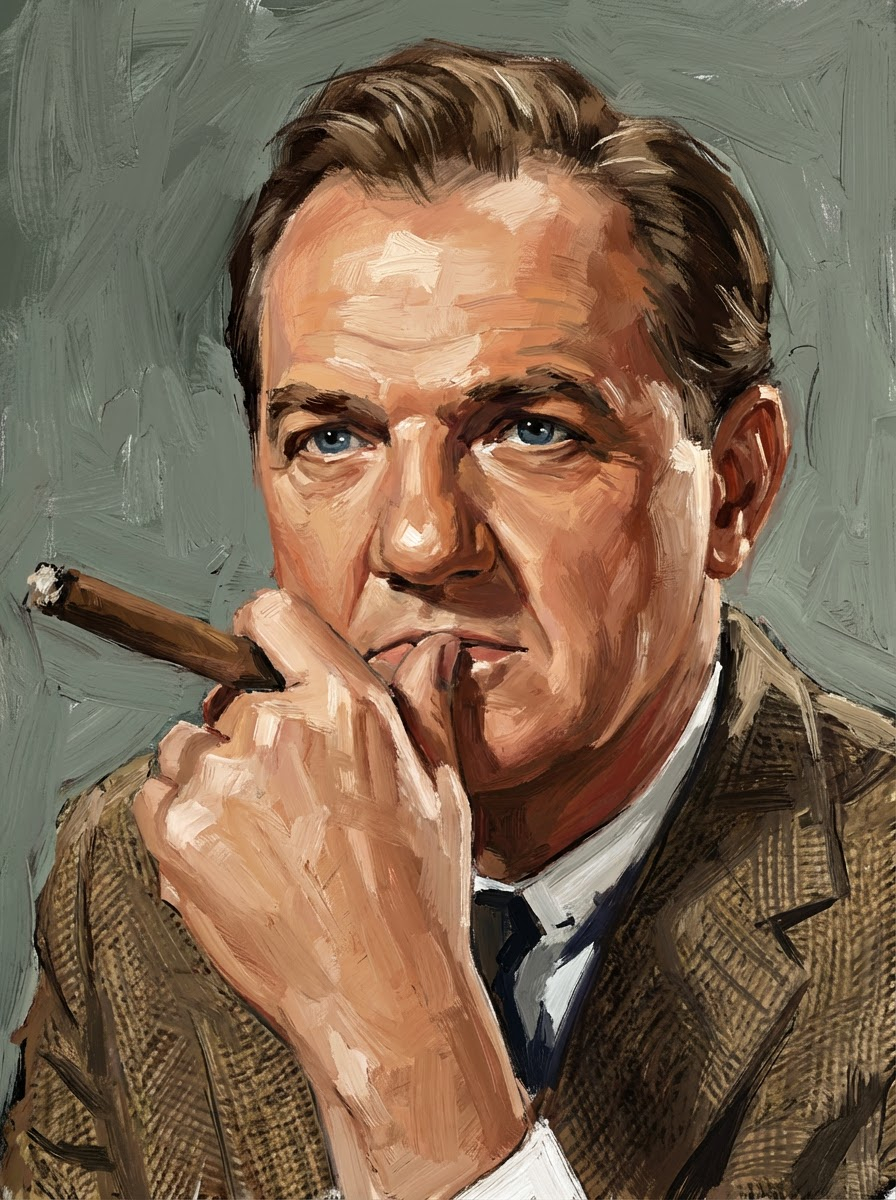
Karl Malden — painted portrait Portrait · Karl Malden

From Gary, Indiana to Mitch in the Elysian Fields

Born Mladen Georgo Sekulovich on March 22, 1912, in Chicago, Illinois, raised in Gary, Indiana — the son of Serbian immigrant parents, his father a steelworker and his mother a Chicago Czech family's descendant. He worked in the steel mills while studying at the Goodman Theatre School of Drama in Chicago, arrived in New York in the 1930s, joined the Group Theatre alongside Elia Kazan, Lee J. Cobb, and John Garfield, and made his Broadway debut in 1937. The Group Theatre's approach to psychological realism shaped everything he would subsequently do on stage and screen.

Elia Kazan's original 1947 Broadway production of A Streetcar Named Desire gave him Mitch — the guileless, lonely mama's boy who is Blanche DuBois's last realistic hope, whose revelation of Blanche's past breaks whatever chance she had of being saved. Kazan brought Malden, Brando, Kim Hunter, and Vivien Leigh (replacing Jessica Tandy, who had originated Blanche on Broadway) to the film version in 1951, and Malden won the Academy Award for Supporting Actor — the deserved recognition of a performance that requires the actor to be simultaneously the most ordinary and most poignant person in a room full of extraordinary people.

Kazan's On the Waterfront (1954) — Malden as Father Barry, the dockside priest who challenges the longshoremen's silence about mob murder with a sermon delivered over a dead man's body in the ship's hold — is the performance that most completely demonstrates what his instrument could do at its most demanding: the moral authority without sentimentality, the anger without self-righteousness, the faith that is expressed through action rather than declaration.

He became president of the Screen Actors Guild (1989–1994), won Emmy nominations for the television series The Streets of San Francisco (1972–1977) opposite a young Michael Douglas, and spent fifteen years as the spokesman for American Express — "Don't leave home without it" — which was the most commercially successful non-acting use of an actor's specific quality in advertising history. He died on July 1, 2009, in Los Angeles, aged ninety-seven.
1912
Born Mladen Sekulovich in Chicago; Serbian parents; Gary steel mills
1930s
Goodman Theatre; Group Theatre; Kazan; the instrument formed
1947
Streetcar on Broadway — Mitch; Brando; Tandy; Kazan; creation
1952
Oscar won — Streetcar film; Supporting Actor; the instrument confirmed
1954
On the Waterfront — Father Barry; the hold sermon; second nom
1972
Streets of San Francisco — fifteen years; Emmy noms; Douglas
2009
Dies in Los Angeles; age 97; SAG President; ninety years of work

From Mitch's Honesty to Father Barry's Sermon

1951Drama · Elia Kazan · Tennessee Williams
A Streetcar Named Desire
Elia Kazan's Williams film — Malden as Mitch, the lonely factory worker who is Blanche DuBois's last realistic hope, whose gentleness and earnestness make him the most sympathetic person in the film, and whose revelation of Blanche's past is both understandable and the mechanism of her destruction. The Oscar for a performance that requires the actor to be the most ordinary and most heartbreaking person in a room full of extraordinary ones.
Oscar Win

Mitch's tragedy is that he is entirely sincere — the man who genuinely loves Blanche, who is capable of the tenderness she has been performing her need for, and who cannot forgive the gap between the woman she was and the woman she presented herself as. The confrontation scene — Mitch demanding to see Blanche in the light, holding the lantern to her face — is the most painful scene in Williams on film precisely because both people are right and both are causing damage they cannot stop causing.

1954Drama · Elia Kazan · Brando · Waterfront
On the Waterfront
Elia Kazan's waterfront masterwork — Malden as Father Barry, the dockside priest who challenges the longshoremen's silence about mob murder with a sermon delivered in a ship's hold over a murdered man's body. The second Oscar nomination and the performance that most completely demonstrates his instrument's range: moral authority delivered without sentimentality, faith expressed through anger.
Oscar Nom

Father Barry's hold sermon — delivered over Joey Doyle's body as the longshoremen above them decide whether to continue their silence — is the finest single scene of Malden's film career: the priest who has decided that faith without action is complicity, whose anger at the murder is expressed not as grief but as demand. The character's specific quality — the willingness to be publicly furious in the service of justice — is exactly the quality that requires an actor who has never learned to protect himself from his own convictions.

1970War Drama · Franklin Schaffner · Patton
Patton
Franklin Schaffner's military epic — Malden as General Omar Bradley, the counterweight to George C. Scott's Patton: the careful, methodical, soldier's-soldier whose qualities are the opposite of Patton's and whose presence makes Patton's both more visible and more understandable. Supporting a George C. Scott performance of that magnitude required exactly the quality Malden always delivered: total commitment to truth over visibility.

Bradley's function in the film is to be everything Patton is not — the commander whose authority is earned through patience rather than charisma, whose decisions are made through analysis rather than intuition — and Malden plays the contrast not as failure of personality but as a different kind of excellence. His restraint in the shadow of Scott's extravagance is the film's structural argument: that the war required both types, and that the type that wins the war is not necessarily the type that wins the audience's attention.

1956Drama · Elia Kazan · Carroll Baker · Eli Wallach
Baby Doll
Elia Kazan's provocative Tennessee Williams adaptation — Malden as Archie Lee Meighan, the middle-aged Mississippi cotton gin owner who has entered an unconsummated marriage with the childlike Baby Doll (Carroll Baker), and who watches Vacarro (Eli Wallach) seduce her while investigating the fire that destroyed his gin. The most morally uncomfortable film of the Kazan-Malden collaboration: the brutish, desperate husband whose grievances and desires are presented without the usual softening.

Archie Lee's quality — the man whose violence comes from impotence rather than strength, whose possessiveness is more pitiful than threatening — is played by Malden without the protection of making him simply villainous. The central dynamic — Archie Lee watching helplessly as Wallach's Vacarro outmanoeuvres him in his own home, with his own wife — required Malden to sustain humiliation across the film's length without losing the character's specific weight: the defeated man who does not know he is defeated and would rather burn the world than admit it.

1972 – 1977Television · Michael Douglas · San Francisco
The Streets of San Francisco
The ABC television series — Malden as Detective Lieutenant Mike Stone, the veteran San Francisco detective partnered with the younger Detective Steve Keller (Michael Douglas). The role that demonstrated his television gifts were equal to his film gifts: the procedural drama as a vehicle for the same psychological precision and moral authority that the Group Theatre had formed and Kazan had shaped.

Mike Stone's specific quality — the experienced detective whose patience with his younger partner is an expression of genuine care rather than professional tolerance — is played by Malden with the same complete commitment he brought to Mitch and Father Barry: a fully inhabited person rather than a television type. Michael Douglas has said that watching Malden work was the most useful acting lesson he received; the lesson was that there was no technique separate from the commitment to truth, and that the commitment was total or it was nothing.

"

You're sitting here thinking about your own personal morality while people are being murdered. Don't you ever think of your own personal morality?

— Father Barry · On the Waterfront, 1954

One Oscar — Two Nominations — Ninety Years of Making Films More Honest

Academy Award — Best Supporting Actor
1952
A Streetcar Named Desire
Won for Mitch — the guileless factory worker who is Blanche DuBois's last realistic hope. The Academy's recognition of a performance that asked the actor to be the most ordinary and most heartbreaking person in a room of extraordinary people, and to make the ordinariness the source of the heartbreak.
Oscar Won
Oscar Nomination — Best Supporting Actor
1955
On the Waterfront
Nominated for Father Barry — the priest whose hold sermon is the moral centre of Kazan's waterfront film. Two nominations from two Kazan films in four years; the most concentrated use of a single director-actor partnership in the Academy's 1950s history.
Oscar Nominated
Screen Actors Guild President
1989 — 1994
Union Leadership
His five years as SAG President — negotiating contracts, representing members' interests, navigating the industry's changing production landscape — reflected the same commitment to colleagues and craft that had characterised the work. He took the role as seriously as he had taken every other one.
SAG President
The American Express Campaign
1975 — 1990
"Don't Leave Home Without It"
Fifteen years as the spokesman for American Express — the most commercially successful use of an actor's specific trustworthy quality in advertising history. He was the right face for the campaign because his specific quality — the sense that what you saw was exactly what it was — was the quality the campaign required. He brought the same commitment to the thirty-second spots that he brought to the Tennessee Williams.
15 Years

The Honesty That Made Every Film Around Him More True

The Group Theatre Formation
His training at the Group Theatre — alongside Kazan, Garfield, Cobb, Strasberg — gave him the psychological realism that became his instrument. The Group's commitment to truth over effect, to character over performance, to the interior life as the source of external behaviour: all of this is visible in every scene he played for the next sixty years.
The Character Actor
The distinction between star and character actor is frequently used to diminish the latter; in Malden's case it describes the opposite of a limitation. The character actor's job is to make the world the protagonist inhabits feel real, and Malden's total commitment to truth meant that his presence guaranteed the world's reality in a way that no amount of production design could substitute for.
The Kazan Partnership
Five Kazan films across ten years — A Streetcar Named Desire, On the Waterfront, Baby Doll, Bombers B-52, and earlier stage productions — constitute the most concentrated use of a director-actor partnership in postwar American cinema. Kazan understood what Malden was doing and provided material that required it; Malden understood what Kazan needed and delivered it completely.
The Longevity
He died at ninety-seven, having worked steadily from the 1930s to the 2000s — nearly seventy years of professional activity. The longevity is not separate from the quality but an expression of it: an actor who brings complete honesty to every role he takes is not an actor who runs out of things to bring, and the roles kept finding him because what he had was genuinely useful.

Mitch and Father Barry — The Standard of Honesty Every Character Actor Is Measured Against

Karl Malden's legacy is the hold sermon — Father Barry standing over Joey Doyle's body, demanding that the longshoremen choose between silence and conscience — and the lightbulb scene in Streetcar — Mitch holding the lamp to Blanche's face, demanding to see her as she is. Two scenes that require an actor to be simultaneously sympathetic and the mechanism of someone else's destruction, and that he played with a completeness that has not been exceeded.

The ninety-seven years and the seven decades of work are the other argument. An actor who brings that quality of honesty to every role he takes, across every format and every decade, is not demonstrating range — he is demonstrating character, which is the quality the Group Theatre trained and which Malden possessed in a form that was indistinguishable from the man.

Academy Award Won
A Streetcar Named Desire, 1952
1
Oscar Nominations
Both from Kazan films
2
Years as SAG President
1989 to 1994
5
Age at Death
July 1, 2009, Los Angeles
97