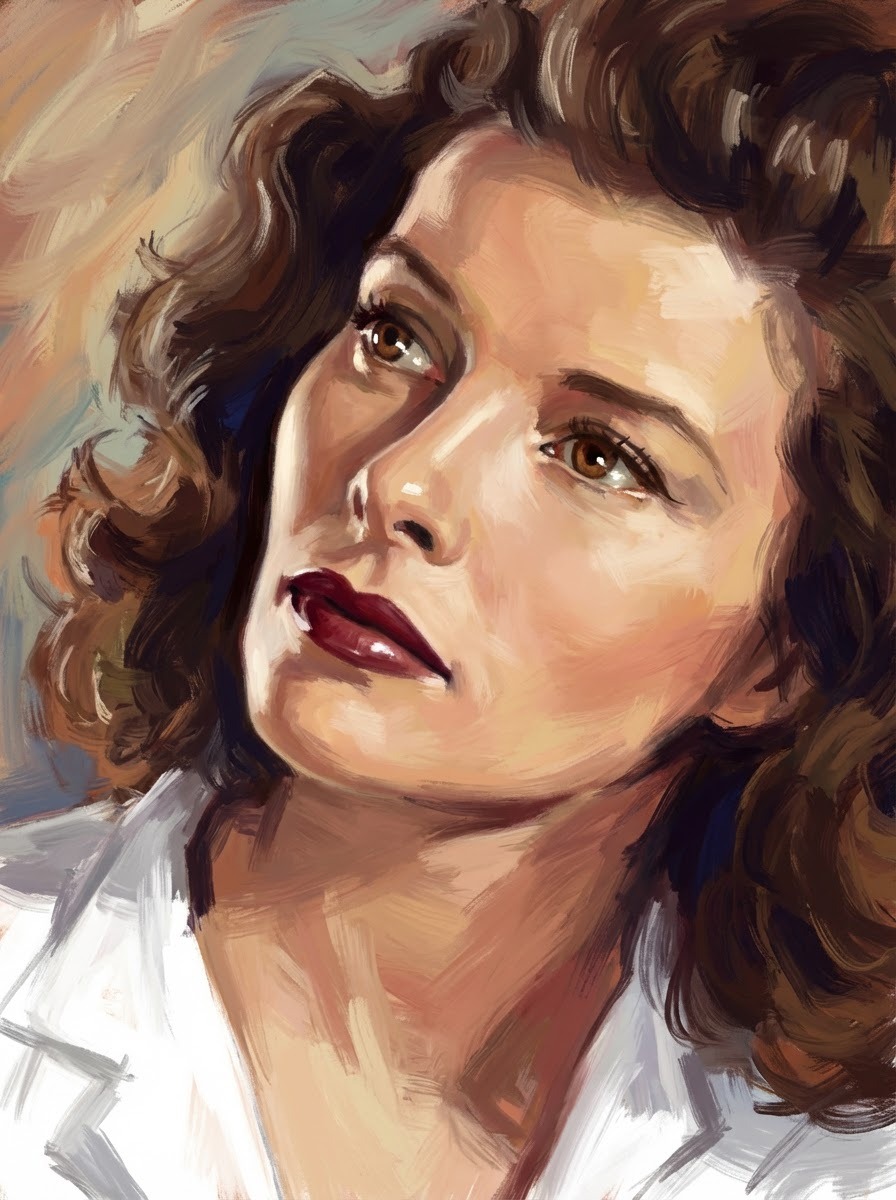
The Hartford actress who won four Academy Awards — more than any performer in history — wore trousers before Hollywood permitted it, refused to grant interviews for decades, never attended the ceremonies where she received the awards, and managed a twenty-five-year relationship with Spencer Tracy without ever discussing it publicly. She was entirely herself for ninety-six years and never offered an apology for it.
Portrait · Katharine Hepburn
Born Katharine Houghton Hepburn on May 12, 1907, in Hartford, Connecticut — the daughter of a urologist and a suffragist mother who took her children to political marches and taught them that compliance was a choice rather than a requirement. She attended Bryn Mawr College, made her Broadway debut in 1928, and arrived in Hollywood in 1932. By 1938 she was on the Independent Theatre Owners' "box-office poison" list. She bought back the rights to a Philip Barry play, produced The Philadelphia Story for Broadway, sold the film rights in a package that required her own casting, and made the film that ended the discussion.
The four Academy Awards — for Morning Glory (1933), Guess Who's Coming to Dinner (1967), The Lion in Winter (1968, shared with Barbra Streisand), and On Golden Pond (1981) — span forty-eight years and four different modes of performance, which is itself the most complete statement of sustained excellence in the Academy's history. She was nominated twelve times in total; the record stands.
John Huston's The African Queen (1951) — Hepburn as Rose Sayer, the prim missionary's sister who navigates a river in German East Africa during WWI alongside Humphrey Bogart's Charlie Allnut — demonstrated that the angular intelligence could coexist with warmth and physical comedy, and that the persona people had found difficult was a resource rather than a limitation. George Cukor's Adam's Rib (1949) — the first and best of the Tracy-Hepburn comedies — is the fullest expression of the professional and personal partnership that defined her life.
She lived with Spencer Tracy — who remained married to his wife throughout their relationship — for twenty-five years, until his death in 1967 seventeen days after they completed Guess Who's Coming to Dinner together. She did not discuss the relationship publicly until 1991. She never attended the Academy Award ceremonies where she received her four Oscars. She died on June 29, 2003, in Old Saybrook, Connecticut, at ninety-six.
Tracy Lord is the character that the "box-office poison" label had been partly created by — the woman whose self-possession reads as arrogance until the film re-examines it and finds that she was merely more intelligent than everyone who found her difficult. Hepburn plays the re-examination as self-discovery rather than correction, which is why the film still feels like a victory rather than a concession. She bought the play rights specifically to prevent anyone else from being cast in the film adaptation; the purchase is the most complete possible statement of artistic self-confidence.
Rose's quality — the missionary strictness that is also genuine courage, the primness that is also a form of determination — is played by Hepburn with a physical comedy that her earlier films had rarely required and that Huston correctly identified as available. The relationship with Bogart's Charlie works because both characters are entirely themselves and neither tries to make the other something different. The film was shot on location in Africa under conditions Huston described as deliberately punishing and that Hepburn described, in her autobiography, as among the most exciting experiences of her life.
Eleanor's quality — the political intelligence operating behind the personal emotion, the love for Henry that is also a form of war, the maternal feeling for sons she is simultaneously using as pawns — is played by Hepburn with a completeness that makes the character feel like a fully realised historical person rather than a dramatic construction. Her exchanges with Peter O'Toole's Henry II are the finest prolonged verbal combat in historical cinema: two people who know each other completely, who love each other completely, and who are doing everything in their considerable power to destroy each other's plans.
The film's emotional centre is not the interracial marriage question but the Tracy-Hepburn marriage question — the twenty-five years of a relationship conducted in private, visible on screen for the first time in a context that allows the camera to catch them being themselves with each other. Tracy's final monologue, delivered directly to Hepburn's Christina, is the most personal scene in either performer's career: a man of seventy speaking about love to the woman he has loved for a quarter century, knowing and not knowing that he had seventeen days left to do it.
If you always do what interests you, at least one person is pleased.
Katharine Hepburn's legacy is the four Oscars she never attended and the twelve nominations that span half a century — the most decorated performing career in Academy history and the most consistent refusal to perform anything other than what she had decided to perform. The box-office poison chapter and its correction; the trousers; the relationship with Tracy conducted for twenty-five years in private; the non-attendance at the ceremonies: each is the same decision in different form.
She died at ninety-six having given no interviews for most of her career and having published one autobiography that was, by all accounts, as controlled in its revelations as everything else she managed. The films are the argument and they stand without supplement: twelve nominations, four wins, forty-eight years between first and last, and the complete record of what a person can achieve when they refuse to be anything other than exactly what they are.