Chicago, Illinois · Born 1933

Kim Novak

The Chicago-born actress whom Columbia tried to manufacture as a blonde commodity and who insisted, quietly and repeatedly, on being something more complicated — playing Hitchcock's double woman, Preminger's addict's lover, and a witch in love, and retiring to Oregon with her horses when Hollywood stopped offering work worth doing.

2
Golden Globe
Nominations
1958
Year of
Vertigo
5
Years as
Top Box Office
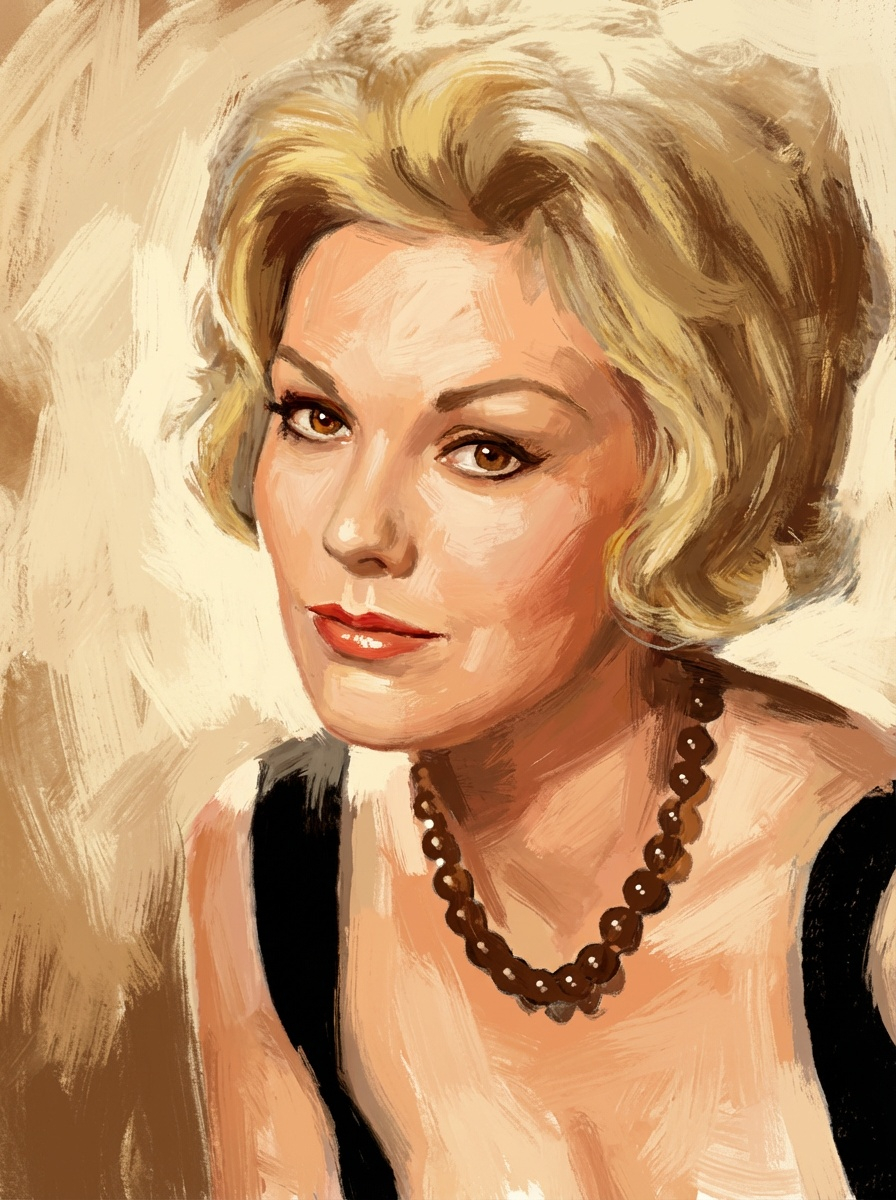
Kim Novak — painted portrait Portrait · Kim Novak

From Chicago to Madeleine's Tower

Born Marilyn Pauline Novak on February 13, 1933, in Chicago, Illinois — the daughter of working-class Czech immigrants, a shy girl who drifted from community college into modelling. Columbia Pictures signed her in 1954 as a deliberate counter to Marilyn Monroe — a blonde with a different kind of cool, remote where Monroe was warm, self-contained where Monroe was combustible. Harry Cohn ran her through a production line of roles, dyed her hair platinum, renamed her Kim, and scheduled her so heavily that she went on strike. The studio backed down.

Joshua Logan's Picnic (1955) — Novak as Madge Owens, the most beautiful girl in a small Kansas town who is also the least known — established the essential quality: beauty that withheld something, a presence that seemed to be located slightly behind itself. Otto Preminger's The Man with the Golden Arm (1955), same year, cast her opposite Frank Sinatra's heroin addict, and the warmth she brought to Molly confirmed the range beneath the surface.

Alfred Hitchcock's Vertigo (1958) — Novak as both the fabricated Madeleine and the working-class Judy who is paid to impersonate her — is the performance around which her legacy organises. She plays two women who are one woman who becomes the first again, and the specific quality of her slightly-behind-itself presence is exactly what the film's psychology requires: the woman who seems unreal because she has been made into something unreal, played by an actress who understood unreality from the inside. The film is now almost universally regarded as the greatest American film ever made.

She left Hollywood largely in the 1970s, moved to Oregon, raised horses and painted, and returned to acting selectively. She received a standing ovation at the 2014 Academy Awards when she and Matthew McConaughey presented the Best Cinematography award — not for anything she had said, but simply for being there, which was itself the tribute the room had been waiting to pay.
1933
Born in Chicago; Czech immigrant family; modelling; Columbia signs her
1954
Columbia Pictures; Harry Cohn's blonde product; she strikes; they back down
1955
Picnic and Golden Arm — the two registers; same year
1957
Pal Joey and Bell Book and Candle — the range confirmed
1958
Vertigo — Hitchcock; Madeleine and Judy; the film the century needed
1970s
Oregon; horses; painting; the deliberate withdrawal
2014
Oscars standing ovation; simply for being there; the room understood

From Madge's Kansas to Judy's Tower

1958Psychological Thriller · Alfred Hitchcock
Vertigo
Hitchcock's masterwork — Novak as Madeleine Elster and Judy Barton: one woman playing two, the first a ghost constructed from the second, the second reconstructed into the first by a man's obsessive grief. The film now considered the greatest American film ever made, and the performance at its centre the most psychologically complex double role in cinema.

Novak's quality — the slightly-behind-itself presence, the beauty that seems to come from somewhere else — is exactly what Vertigo's psychology required. She isn't performing unreality; she is conveying it from the inside. Her Judy scene — learning she must become Madeleine again — is played in a sustained close-up of extraordinary transparency: the woman who has already done the thing she is being asked to do again, knowing this time what it will cost.

1955Drama · Joshua Logan · William Inge
Picnic
Joshua Logan's Inge adaptation — Novak as Madge Owens, the most beautiful girl in a small Kansas town who is also the most invisible, whom a charismatic drifter (William Holden) sees and disrupts. The film that established her essential screen quality: beauty that costs something, presence that seems to be protecting itself from being fully seen.

Madge's quality — the woman who has been seen only as beautiful and never as a person — is played by Novak with a longing for recognition that goes beyond the romantic. The famous dance scene, in which Holden and Novak move through a crowd that has stopped to watch them, is one of the decade's most complete images of mutual desire and mutual acknowledgment — two people who see each other simultaneously.

1955Drama · Otto Preminger · Sinatra
The Man with the Golden Arm
Otto Preminger's narcotics drama — Novak as Molly, the upstairs neighbour and the only genuine support in a heroin addict's life. The warmth she brings to a role that exists largely to enable Frank Sinatra's Oscar-nominated performance demonstrates the range that the Columbia machinery had been covering: she is not a type but a person, and the person matters.

Molly's love for Frankie Machine is unsentimentalised — the woman who cares about someone in the full knowledge that caring may not be enough. Novak gives the role a specificity that prevents it from being the passive supportive female that the script could easily have produced; Molly has her own interior life, her own history, her own reasons.

1958Romantic Fantasy · Richard Quine · James Stewart
Bell Book and Candle
Richard Quine's whimsical romantic film — Novak as Gillian Holroyd, a Manhattan witch who uses a spell to attract her upstairs neighbour (James Stewart) and finds, inconveniently, that she has actually fallen in love with him. Released the same year as Vertigo, and the evidence that the quality she had could operate in a completely different register without diminishing itself.

Gillian's predicament — the creature of magic who discovers she wants ordinary human feeling — is played by Novak with exactly the cool self-possession that makes its crumbling convincing. She and Stewart had played obsession in Vertigo that same year; here they play something lighter, and the lightness is entirely credible — a different use of the same instrument.

"

I was never the girl next door. I was always the woman next door — and that's a very different thing.

— Kim Novak

Top Box Office — Vertigo's Centre — The Ovation She Earned

BAFTA Nomination — Best Foreign Actress
1956
Picnic
Nominated by the British Academy for Madge Owens in Picnic — early recognition, from across the Atlantic, of a quality the American industry was busy trying to manage rather than celebrate.
BAFTA Nominated
Top Ten Box Office — 5 Consecutive Years
1956 – 1960
Box Office Dominance
Five consecutive years in Quigley Publications' list of the top ten box office draws — the commercial confirmation that what the studio had tried to package was less than what audiences actually wanted. The numbers represent the public's verdict on a quality the industry's awards machinery did not award.
5 Years Top Ten
Vertigo — Reassessed Legacy
1958 → Eternity
The Greatest American Film
Vertigo was not a hit on release; its reputation grew with every passing decade. The 2012 Sight & Sound poll ranked it the greatest film ever made, displacing Citizen Kane after fifty years. Novak's performance is at its psychological centre, and no reassessment of the film has separated her work from its greatness.
Greatest Film Ever Made
2014 Academy Awards Standing Ovation
2014
The Room Understood
She and Matthew McConaughey presented Best Cinematography at the 2014 Oscars. The audience gave her a standing ovation as she walked to the stage — not for a speech, not for an announcement, but for having arrived. The ovation was the industry's belated acknowledgment of everything it had not adequately honoured when it had the chance.
Standing Ovation

The Woman Behind the Surface — Resisting the Manufacture

The Columbia Product
Harry Cohn signed her specifically as a Monroe alternative — blonde, manufactured, schedulable. She went on strike, insisted on her own choices, and forced the studio to negotiate with a person rather than manage a commodity. The resistance was quiet and consistent and it produced better films than compliance would have.
The Slight Reserve
Her specific screen quality — the presence located slightly behind itself, the beauty that seems to be withholding something — is not a performance but a constitutional characteristic that Hitchcock, Logan, and Preminger all recognised and built roles around. Vertigo's entire psychology depends on it.
The Oregon Withdrawal
She left Hollywood in the 1970s for Oregon, where she raised horses, painted, and lived on her own terms — a choice that the industry read as failure and she clearly did not. The withdrawal was principled: she had done what she wanted to do on film and preferred the horses to the negotiations.
Vertigo's Revaluation
The film's rise from commercially disappointing 1958 release to the greatest film ever made is the most complete retrospective vindication in cinema history. Her performance has been central to every revaluation — the film cannot be discussed without her, and every discussion of her career now passes through it.

Madeleine and Judy — One Woman Playing Two

Kim Novak's legacy is Vertigo — specifically the moment Judy realises she must become Madeleine again, played in a close-up of such transparency that the camera seems to be reading a thought rather than watching a performance. The film has been called the greatest American film ever made, and her performance is the performance the film is about: the woman who has been made into something, playing the process of being made into it again.

She retired to Oregon and did not need the industry's belated recognition — though the 2014 standing ovation, given simply because she walked on stage, was the most honest tribute the Academy has ever paid. What Columbia tried to manufacture and what she actually was are the same story told from opposite directions, and the distance between them is exactly the distance that Hitchcock filmed.

Consecutive Top Ten Box Office Years
1956 to 1960
5
Sight & Sound Ranking of Vertigo
Greatest Film Ever Made, 2012
#1
Columbia Strikes Won
Quiet resistance; they backed down
1
Years Active in Film
1954 to 1991
37