From a ragman's son in upstate New York to Hollywood royalty — a jawline, a dimple, and a volcanic intensity that defined the postwar American screen. And the man who broke the Blacklist.
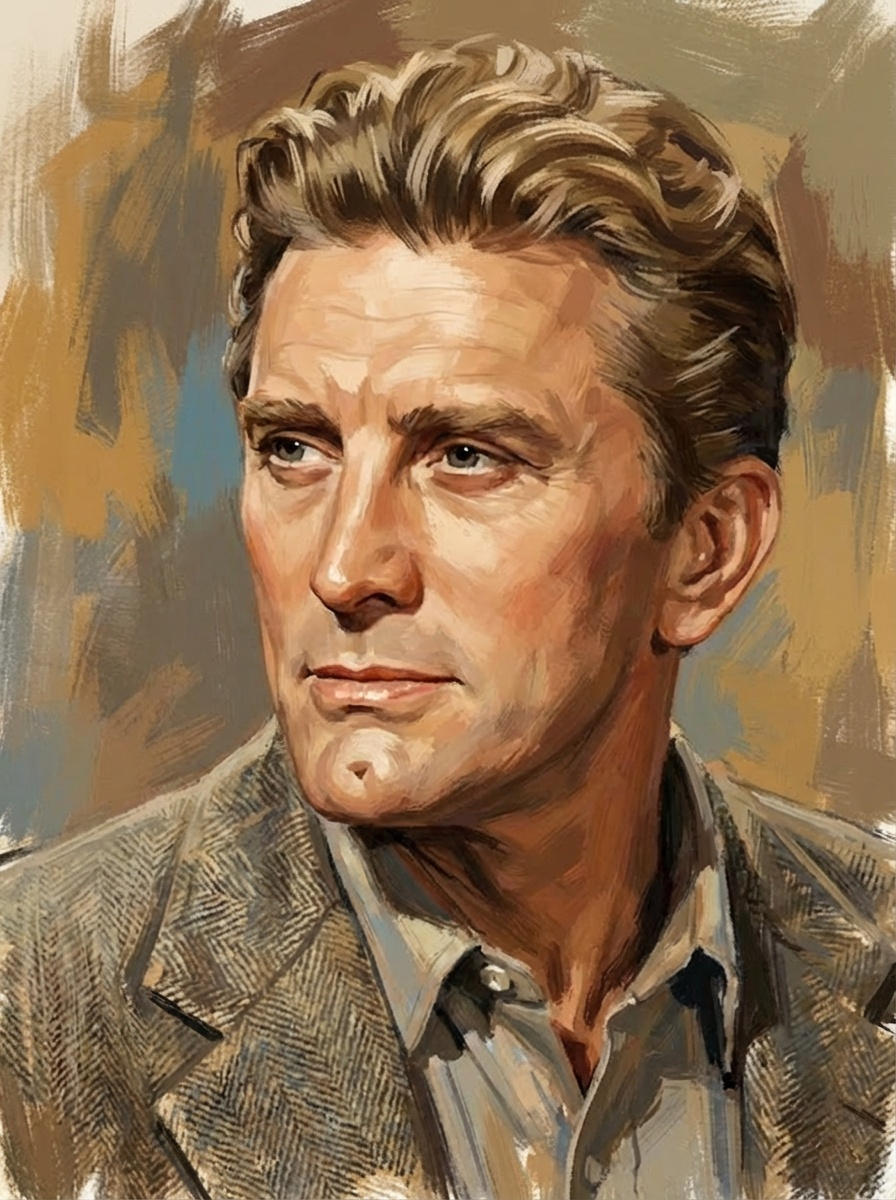
Portrait · Kirk Douglas
Born Issur Danielovitch on December 9, 1916, in Amsterdam, New York, to illiterate Russian Jewish immigrant parents, Kirk Douglas grew up in poverty so acute that his father's ragpicking cart was both livelihood and neighborhood spectacle. He put himself through St. Lawrence University and the American Academy of Dramatic Arts on scholarships and odd jobs.
After serving in the Navy during World War II, he established himself on Broadway before Hollywood's notice arrived. His breakthrough was Champion (1949), in which he played a ruthlessly ambitious boxer with a burning physical intensity that the studios hadn't seen before. The Oscar nomination followed immediately.
His career encompassed westerns, war films, epics, noirs, and psychological dramas. But it was his production company, Bryna Productions, that enabled his most significant legacy act: he produced and starred in Spartacus (1960), and publicly credited blacklisted screenwriter Dalton Trumbo by name — the act that effectively ended the Hollywood Blacklist.
He survived a devastating stroke in 1996 and a helicopter crash that killed two others, and lived to 103 — writing books, funding schools, and remaining a public presence of remarkable clarity and purpose. President Clinton awarded him the Presidential Medal of Freedom in 1981.
Douglas produced this film with Bryna Productions specifically to star Dalton Trumbo, the blacklisted screenwriter, and credit him openly. President Kennedy crossing picket lines to see it effectively ended McCarthyite Hollywood. The film is both a cinematic epic and one of the bravest acts in Hollywood history.
Douglas's Colonel Dax is noble and ultimately powerless — a man of conscience who witnesses how institutions devour individuals and cannot stop it. His grief in the film's closing scene — listening to a German girl sing to hostile soldiers who slowly, reluctantly, begin to weep — is one of cinema's most quietly devastating moments.
Douglas's third Oscar nomination, and arguably his most technically demanding — he inhabited Van Gogh's physical bearing, psychological fragility, and creative passion so fully that the film was screened in art schools for decades. Anthony Quinn won Supporting Actor for his Gauguin in just 15 minutes of screen time.
Douglas plays one of cinema's great villains — Chuck Tatum is charming, intelligent, utterly amoral, and genuinely funny. The film was too dark for 1951 audiences, bombed on release, and is now considered essential. Its critique of media manipulation remains more relevant with each passing decade.
Midge Kelly's rise and corruption introduced a new kind of Hollywood leading man — not just heroic, but morally complex and physically raw. The film made Douglas a star and established the intense, volcanic quality that would define his career.
I am not a champion of lost causes, but of causes not yet won.
Kirk Douglas lived long enough to see his courage on the Blacklist fully recognized and celebrated. He survived a stroke and a near-fatal helicopter accident, and used his later decades for philanthropy — donating tens of millions of dollars to schools, parks, and hospitals across America, most notably the Kirk Douglas Theatre in Los Angeles and multiple playgrounds through his foundation.
As an actor, he is the emblematic figure of the transition between classical Hollywood and the modern studio era. His willingness to produce and take artistic risks — particularly in the Kubrick collaborations — helped create the space in which New Hollywood could emerge. Without Kirk Douglas, there may have been no Easy Rider.