The Bronx-born actress who invented The Look at nineteen — tilting her chin down and her eyes up at Humphrey Bogart in her first film — and spent the next sixty years proving it was the least interesting thing about her. Four films with Bogart, twenty-five years on Broadway, one Oscar nomination at seventy-two, and the most complete refusal to be diminished that Hollywood has ever produced.
Portrait · Lauren Bacall
Born Betty Joan Perske on September 16, 1924, in The Bronx, New York — to Jewish Romanian and Polish immigrant parents, raised primarily by her mother after her parents' divorce. She studied at the American Academy of Dramatic Arts and worked as a theatre usher and model before her photograph on the cover of Harper's Bazaar in 1943 caught the attention of Howard Hawks's wife, who showed it to her husband, who showed it to Humphrey Bogart, who was fifty-six films into a twenty-year career and about to make his most important one.
Howard Hawks's To Have and Have Not (1944) — Bacall's film debut, at nineteen — gave her Slim, the adventuress who matches Bogart's Steve Morgan line for line and look for look. She tilted her chin down to stop her nervousness from showing and kept her eyes on Bogart, and the camera found something that no director had planned and no coaching had produced. She and Bogart married in 1945. They made three more films together; the marriage lasted until his death in 1957 from esophageal cancer.
The post-Bogart career is the career that Hollywood underestimated and she refused to. She returned to Broadway repeatedly — winning Tony Awards for Applause (1970) and Woman of the Year (1981) — and made selective, distinguished film appearances across five decades: John Huston's Key Largo (1948), Vincent Minelli's Designing Woman (1957), Robert Altman's Ready to Wear (1994), Barbra Streisand's The Mirror Has Two Faces (1996) earning her the Oscar nomination at seventy-two that she received — with characteristic grace and minimal fuss — in lieu of any earlier ones the Academy had neglected to give her.
She died on August 12, 2014, in New York City, of a stroke, having maintained for seventy years the quality she had invented at nineteen: the irony that was also warmth, the coolness that was also feeling, the Look that had always been the least interesting thing about her.
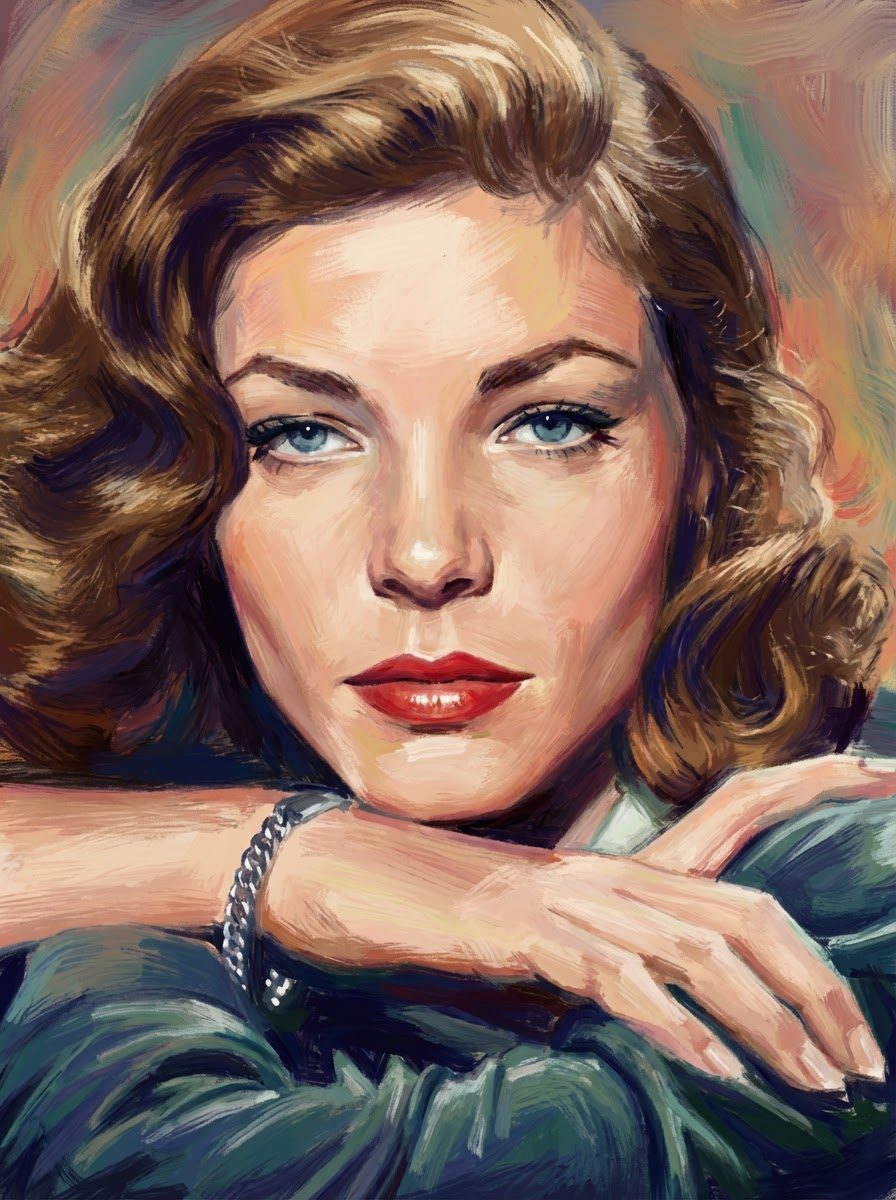
She tilted her chin down to stop her trembling, kept her eyes on Bogart, and the camera found what Hawks had not designed. The "whistle" scene — "You know how to whistle, don't you, Steve? You just put your lips together and blow" — is the most relaxed piece of seduction in 1940s Hollywood, delivered by a nineteen-year-old on her first film day with a composure she has said she was entirely faking.
The racetrack dialogue — in which Vivian and Marlowe conduct an entire conversation about something other than what they are talking about — is the most elegant double-entendre scene in the genre and the clearest demonstration that the Bacall-Bogart chemistry had become something neither Hawks nor the screenplay could have engineered. They were by this point married and it showed, which was the best possible outcome for a noir whose plot required viewers to trust the leads more than the story.
Nora's quality — the woman whose composure in the face of threat comes from having already lost the thing she most valued, making every subsequent risk smaller — is played by Bacall with a specificity that goes beyond the supporting role the script had intended. Her scenes with Lionel Barrymore as her father-in-law are the film's emotional anchor; Robinson's gangster is the film's threat; Bacall is the film's moral centre, which is a different and more interesting function.
She is often overlooked in discussions of this film in favour of Monroe's Pola, which is understandable — Monroe's nearsighted fumbling is the film's comic set piece — but Bacall's Schatze is the film's structural intelligence, the woman who understands the scheme clearly and whose abandonment of it is the most convincing character arc. Her facility for comedy was consistently underused by a studio system that had decided she was noir.
I think your whole life shows in your face and you should be proud of that.
Lauren Bacall's legacy is the whistle scene and its aftermath — the nineteen-year-old who invented a look to stop trembling and spent sixty years proving it was incidental to what she actually was. Two Tony Awards, one Oscar nomination at seventy-two, four Bogart films, twenty-five years on Broadway, and the most sustained refusal to be defined by a single quality that any actress of her generation managed.
The industry never awarded her during the years when the performances were at their peak, and gave her the Oscar nomination when she was old enough to receive it without requiring validation. She received it with grace and without pretending it was timely, which was itself the most complete statement of the quality she had always had: the warmth that did not need to be confirmed to be real.