London, England · 1893 – 1943

Leslie Howard

The Stratford-born actor of Hungarian-Jewish descent who played Ashley Wilkes and Henry Higgins and Philip Carey and Alan Squier, and who died at fifty when a civilian flight from Lisbon to London was shot down over the Bay of Biscay — possibly because German intelligence believed Winston Churchill was aboard. The war that produced his best wartime films claimed him before they did.

2
Oscar
Nominations
50
Age at
Death
1943
Year of
the Shooting
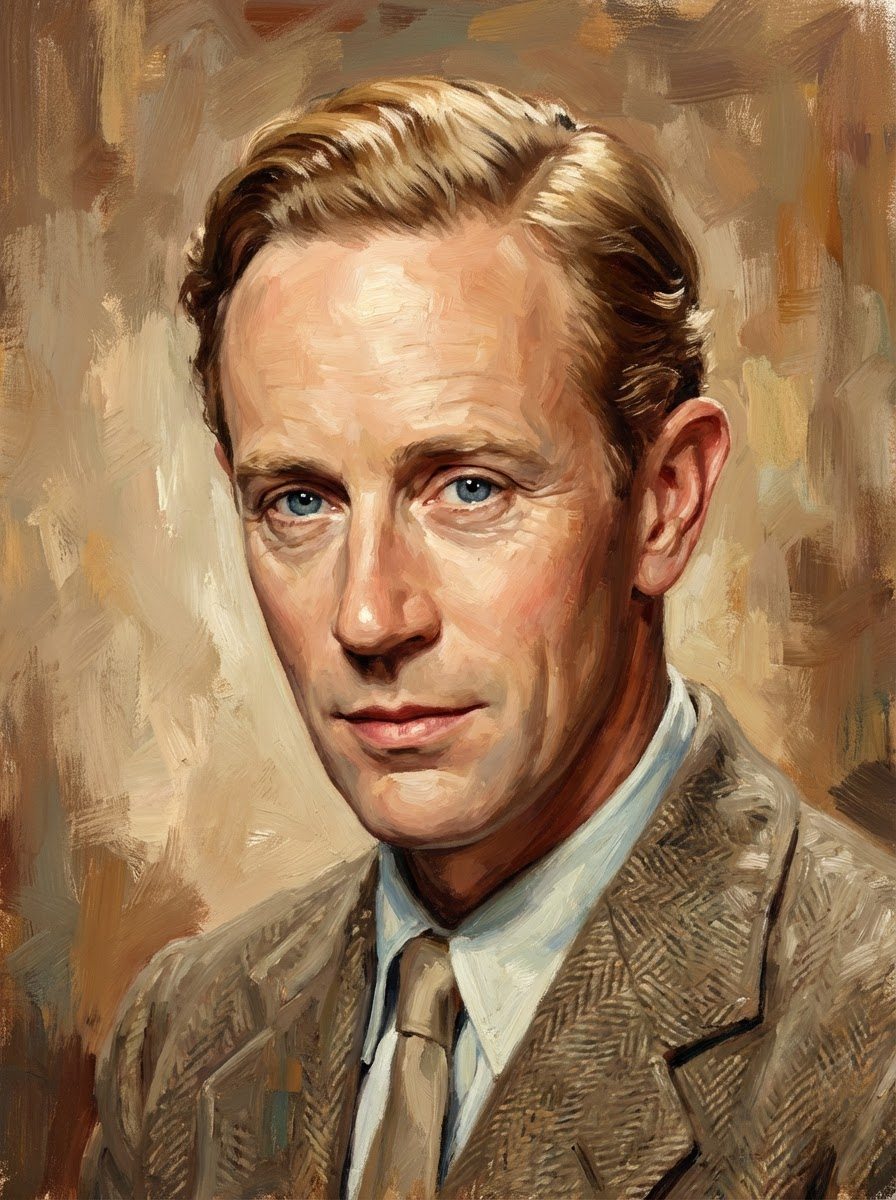
Leslie Howard — painted portrait Portrait · Leslie Howard

From Stratford to The Bay of Biscay

Born Leslie Howard Steiner on April 3, 1893, in London — the son of a Hungarian-Jewish father who had come to England from Budapest and an English mother. He was educated at Dulwich College, worked as a bank clerk, and took up acting after a nervous breakdown following the Battle of Ypres in 1917, for which he had been invalided out of the army. He made his London stage debut in 1917 and his Broadway debut in 1920, and was established as one of the English-speaking theatre's finest actors by the mid-1920s.

Hollywood found him elegant, poetic, and somewhat English in a way that American audiences in the 1930s found irresistible. John Cromwell's Of Human Bondage (1934) — Howard as Philip Carey, the clubfooted medical student destroyed by his obsession with Bette Davis's Mildred Rogers — gave him the role that most completely demonstrated the specific quality of his suffering: the intelligent man who sees his own destruction with complete clarity and proceeds toward it anyway. Archie Mayo's The Petrified Forest (1936) — Howard as the disillusioned wandering intellectual Alan Squier — gave Humphrey Bogart his career-making role, and Howard's quietly desperate romanticism gave Bogart's violence its full meaning.

Anthony Asquith and Gabriel Pascal's Pygmalion (1938) — Howard as Henry Higgins, which he co-directed — won him a shared Oscar nomination for Best Actor and established the film as the template for the Shavian film adaptation. He reluctantly accepted the role of Ashley Wilkes in Gone with the Wind (1939), finding the character weak and the film commercially obligatory, and played him with the specific quality of a good actor doing work he doesn't respect: the performance is impeccable and the impatience with it is invisible.

After the declaration of war, he returned to Britain, refused Hollywood offers, and made propaganda films of genuine artistic distinction — The First of the Few (1942), in which he played the Spitfire designer R.J. Mitchell, which he also directed. On June 1, 1943, the civilian BOAC flight on which he was returning from a lecture tour in Portugal was intercepted by Luftwaffe Junkers Ju 88s over the Bay of Biscay and shot down. All seventeen aboard were killed. German intelligence may have believed Churchill was on the flight; Churchill was not. Howard was fifty years old.
1893
Born Leslie Steiner in London; Hungarian father; Dulwich College; banking
1917
Invalided from Ypres; acting as recovery; London stage debut
1920
Broadway debut; the American career begins; the English Hamlet of Hollywood
1934
Of Human Bondage — Philip Carey; Bette Davis; the first Oscar nom
1938
Pygmalion — Higgins; co-directed; second Oscar nom; Shaw approved
1939
Gone with the Wind — Ashley; reluctant; impeccable; returns to Britain
1942
The First of the Few — Spitfire designer; directs; wartime commitment
June 1, 1943
BOAC flight shot down; Bay of Biscay; seventeen dead; age fifty

From Philip Carey's Bondage to Higgins's Triumph

1938Shaw Adaptation · Anthony Asquith · Co-Directed
Pygmalion
Asquith and Howard's Shaw adaptation — Howard as Professor Henry Higgins, the phonetics expert who bets he can pass off a Cockney flower girl (Wendy Hiller) as a duchess. Howard co-directed the film and won a shared Academy Award nomination for Best Actor. Shaw himself approved Howard's performance as the most accurate realisation of Higgins he had seen, which is the most authoritative possible endorsement.
Oscar Nom

Higgins's quality — the brilliant man who is constitutionally incapable of recognising other people as fully human — is played by Howard with the intellectual authority the role requires and the comic self-satisfaction that prevents it from becoming merely cruel. His Higgins is not cruel because he cannot imagine cruelty; the failure of imagination is the character's tragedy and Howard plays it as a form of innocence that is also a form of damage.

1934Drama · John Cromwell · Bette Davis
Of Human Bondage
John Cromwell's Maugham adaptation — Howard as Philip Carey, the clubfooted medical student who falls into a destructive obsession with a cruel waitress (Bette Davis). The role that most completely demonstrated his specific quality: the intelligent man who sees his own destruction with perfect clarity and is unable to prevent it — intelligence and helplessness as simultaneous, inseparable conditions.
Oscar Nom

Philip's suffering is not operatic but precise — the suffering of a man who knows what is happening to him, can articulate it, and cannot stop it. Davis received the more celebrated reviews — her Mildred is the film's most spectacular performance — but Howard's Philip is the film's moral and psychological argument, and without his quality the film would simply be the story of a man abused by a bad woman, which is not what Maugham wrote.

1936Drama · Archie Mayo · Bogart's Breakthrough
The Petrified Forest
Archie Mayo's desert thriller — Howard as Alan Squier, the disillusioned wandering intellectual who encounters a gangster (Bogart) in an Arizona roadhouse and makes the decision that resolves the story. Howard had insisted on Bogart for the film adaptation of the play; the insistence gave Bogart the role that made his career. Howard's quietly romantic Alan Squier gives Bogart's violence its full dramatic weight.

Alan Squier's specific quality — the man who has decided that his own life has no further value and is looking for a meaningful use of it — is played by Howard with the controlled romanticism that the 1930s allowed and that his particular combination of refinement and exhaustion made entirely credible. He insisted Bogart play Duke Mantee when the studio wanted someone more famous; Bogart sent Howard a silver cigarette case inscribed "To Leslie Howard, with appreciation" and kept it until he died.

1939Epic · Victor Fleming · Selznick
Gone with the Wind
David O. Selznick's Civil War epic — Howard as Ashley Wilkes, the honourable, ineffectual Southern gentleman who is loved by Scarlett O'Hara and belongs to Melanie Hamilton. Howard took the role reluctantly, found Ashley weak, and played him with the impeccable craft of a good actor doing work he doesn't respect — which is itself a form of professional discipline that the result entirely conceals.

Ashley's problem — the man who knows what is right and lacks the force to do it, who loves correctly and helplessly, whose decency is a form of inadequacy — is the role the film required to give Scarlett's desire its tragic dimension. Howard hated the role, hurried back to Britain when production ended, and within months was making Pygmalion and preparing wartime propaganda films that he considered genuinely important. Ashley was the price he paid for the freedom to do the other work.

"

I am not sufficiently in love with the role. Ashley is too much of a dream figure. I prefer flesh and blood characters.

— Leslie Howard · on playing Ashley Wilkes

Two Nominations — Shaw's Approval — Bogart's Silver Case

Academy Award — Best Actor Nomination
1939
Pygmalion
Nominated for Henry Higgins in Pygmalion — the film he co-directed and that George Bernard Shaw approved as the most faithful realisation of the character. Shaw's endorsement is worth more than the nomination; both together constitute the argument for a performance that has served as the template for every subsequent Higgins.
Oscar Nominated
Academy Award — Best Actor Nomination
1935
Berkeley Square
Nominated for his performance in the time-travel fantasy Berkeley Square — the first of his two Academy Award nominations, both received by a career that lasted only thirteen years from his first Hollywood film to his death. The brevity of the career and the quality of the work it contains make the nominations a small fraction of what the recognition should have been.
Oscar Nominated
The Bogart Gift
1936
The Petrified Forest
Humphrey Bogart sent Howard a silver cigarette case inscribed "To Leslie Howard, with appreciation" for insisting that Bogart be cast as Duke Mantee in The Petrified Forest when Warner Bros. wanted someone more famous. The gesture is the most complete acknowledgment available of what the insistence had done for Bogart's career — and the most personal tribute Howard received.
Bogart's Tribute
The Bay of Biscay
June 1, 1943
IBIS Flight — Shot Down
Returning from a cultural mission to Portugal, his civilian BOAC aircraft was intercepted by eight Luftwaffe Junkers Ju 88s and shot down over the Bay of Biscay. German intelligence may have believed Churchill was aboard. Churchill had taken a different route. Howard was fifty years old. The wartime films he was still making when he died are among the finest British propaganda films of the Second World War.
Died in Service

The Poetic Intelligence — And the Clear-Eyed Destruction

The Sensitive Man
His recurring character type — the intelligent, poetic, sensitive man who sees clearly and acts helplessly — was both his specific quality and the quality the 1930s needed him to embody. Philip Carey, Alan Squier, Ashley Wilkes, Henry Higgins: each is a version of the same formation, differentiated by the material each provides for it.
The Actor-Director
He co-directed Pygmalion and directed The First of the Few — in each case giving himself the lead role and shaping the film around the character's interior life rather than its external drama. The films work because the director and the actor were making the same argument from different positions simultaneously.
The Wartime Choice
He refused Hollywood during the war and returned to Britain to make propaganda films of genuine artistic quality — refusing to treat the work as lesser because the purpose was instrumental. The First of the Few is a beautiful film that is also a recruitment poster, and the two qualities are inseparable in a way that most propaganda films cannot manage.
The Truncated Career
Thirteen years from his first major Hollywood film to his death; fifty years of age; two Oscar nominations; and the specific question of what the career would have become had the war not claimed him. The question is unanswerable, which is the specific grief that attaches to a talent cut off before its full expression.

Philip's Clarity — Higgins's Genius — The Biscay Sky

Leslie Howard's legacy is Philip Carey's face as he watches himself be destroyed — the intelligence and the helplessness in the same expression, the clarity that cannot prevent what it sees. Two Oscar nominations, Shaw's personal approval of Pygmalion, Bogart's silver cigarette case, and the wartime films that he was still making when the Luftwaffe intercepted his aircraft: the career was complete by any measure except its own potential.

He was fifty years old and working. The German intelligence that may have targeted his aircraft because it carried Churchill was wrong about the passenger and right about the principle: Howard was doing for Britain's cultural self-understanding in 1943 what Churchill was doing for its political will, and both were worth destroying from a German strategic perspective.

Oscar Nominations
Berkeley Square · Pygmalion
2
Age at Death
June 1, 1943 · Bay of Biscay
50
Years of Major Film Career
1930 to 1943
13
Films Also Directed
Pygmalion · First of the Few · others
4