Born Norma Jeane Mortenson in a Los Angeles charity hospital, raised through foster homes and an orphanage, and remade herself — by will, by study, by an understanding of the camera that amounted to a form of genius — into the most photographed person of the twentieth century, while remaining more complicated than any photograph she ever took.
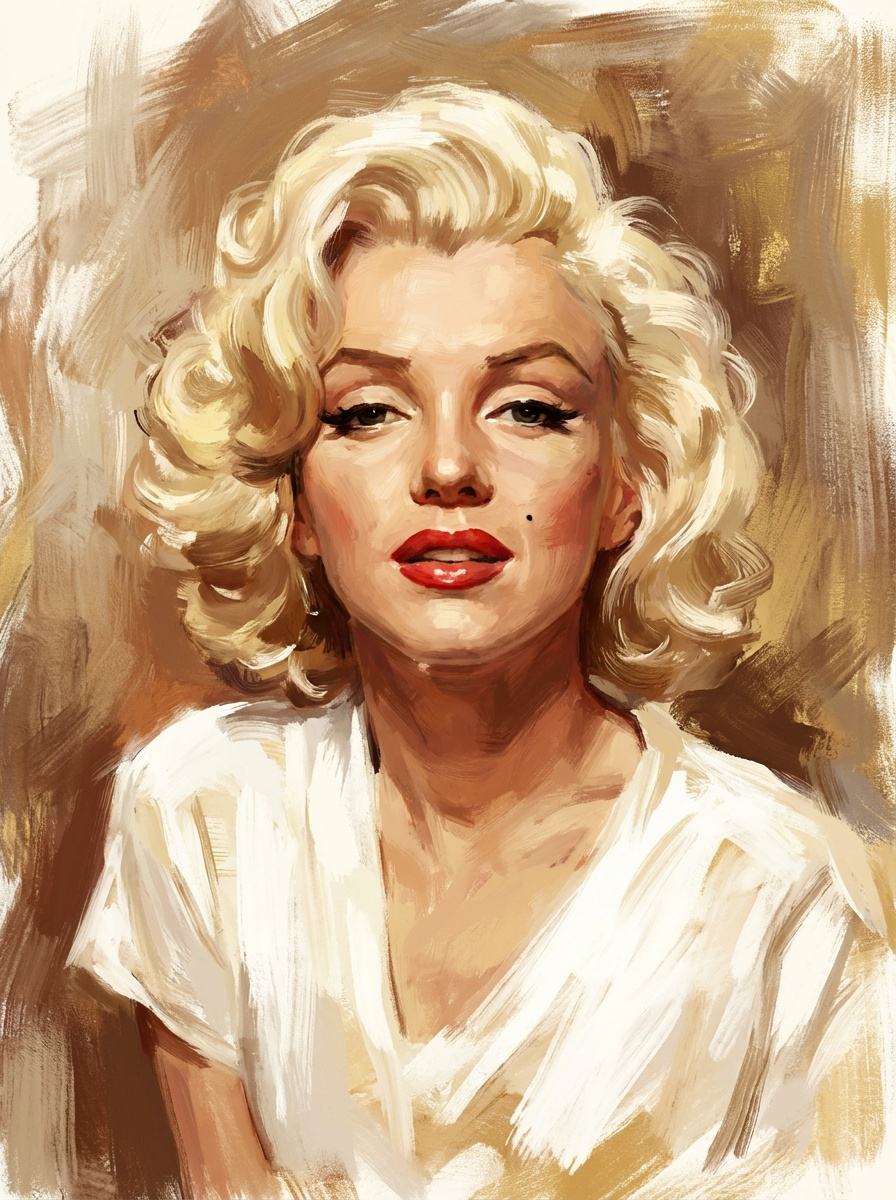
Portrait · Marilyn MonroeBorn Norma Jeane Mortenson on June 1, 1926, in Los Angeles — her father unknown, her mother hospitalised for mental illness, raised through a series of foster homes and an orphanage. She married at sixteen to avoid another foster placement. Modelling led to a studio contract with 20th Century Fox, who gave her a new name and dropped her after two years. She studied, persisted, and negotiated her way back into the industry on her own terms.
The early 1950s established the persona — Gentlemen Prefer Blondes (1953), How to Marry a Millionaire (1953) — that made her the most recognised face in the world. She co-founded Marilyn Monroe Productions in 1954, the first major actress-owned production company, specifically to escape Fox's control and develop her own material. She studied at the Actors Studio in New York under Lee Strasberg, and the serious engagement with craft was not supplementary to the persona but constitutive of it.
Billy Wilder's Some Like It Hot (1959) remains the critical consensus for her comic genius — Sugar Kane, the singer in an all-women's band who is the most buoyant and the most bruised person in the film simultaneously, a quality only she could make coexist. John Huston's The Misfits (1961), written for her by Arthur Miller, is the darker companion — Roslyn Taber, the woman whose empathy extends further than the world the film contains.
She died on August 4, 1962, in Brentwood, of a barbiturate overdose. She was thirty-six. The Misfits had been her last completed film; The Something's Got to Give footage, which she was filming when she died, suggests the range she had not yet been given space to demonstrate.
The "bourbon bourbon bourbon" takes — reportedly eighty of them before Monroe delivered the line — produced a performance of comic timing that no amount of calculated professionalism would have generated. Wilder, who complained about her throughout and called her the most talented actress he had ever directed, understood the distinction between the difficulty of the process and the quality of the result; only one of them mattered.
Lorelei's quality — the woman who performs dumbness as a strategy and whose intelligence is visible only to people paying close enough attention — is the most concentrated statement of the Monroe paradox. She is playing someone pretending to be what everyone assumes she is, and the comedy lives in the gap between the pretence and the person conducting it.
Roslyn's quality — the woman whose feelings are too immediate and too undefended for the world she is in — is played without the protective irony Monroe used elsewhere. The result is a performance of unusual vulnerability, the instrument fully exposed, which is why The Misfits and Some Like It Hot together constitute the fullest picture of what she was capable of: the full range, in the same career, two years apart.
Chérie's quality — the woman whose modest dreams are as large as any ambition the film contains — is played by Monroe with a specificity that goes well beyond the comedy the film's poster had promised. The scene in which Chérie describes where she wants to go and what she wants to be is played with the uncalculated directness that Lee Strasberg's method aimed at and Monroe achieved without apparent effort.
I don't want to make money. I just want to be wonderful.
Marilyn Monroe's legacy is the gap between the photograph and the person — the distance between the most reproduced image of the twentieth century and the woman who constructed it, from a Los Angeles charity hospital through foster homes to a production company she owned and an Actors Studio she attended by choice. The comic genius is the thing the photographs cannot convey: Sugar Kane's timing, Lorelei's irony, Chérie's longing — the performances that required intelligence to produce and that the industry surrounding them preferred to attribute to luck.
She died at thirty-six with more range remaining than the films had used. The Misfits footage and the Something's Got to Give dailies suggest a performer moving toward something the early death prevented — which is the specific grief that attaches to a career that was both complete and incomplete simultaneously.