Omaha, Nebraska · 1924 – 2004

MarlonBrando

The Omaha actor who arrived on Broadway at twenty and changed what American screen acting was — making the emotion visible from the inside rather than performed from the outside — and who spent the remaining fifty years of his career refusing to let the industry forget that he had done so, on terms the industry found alternately magnificent and infuriating.

2
Academy Awards
Won
8
Oscar
Nominations
80
Years
of Life
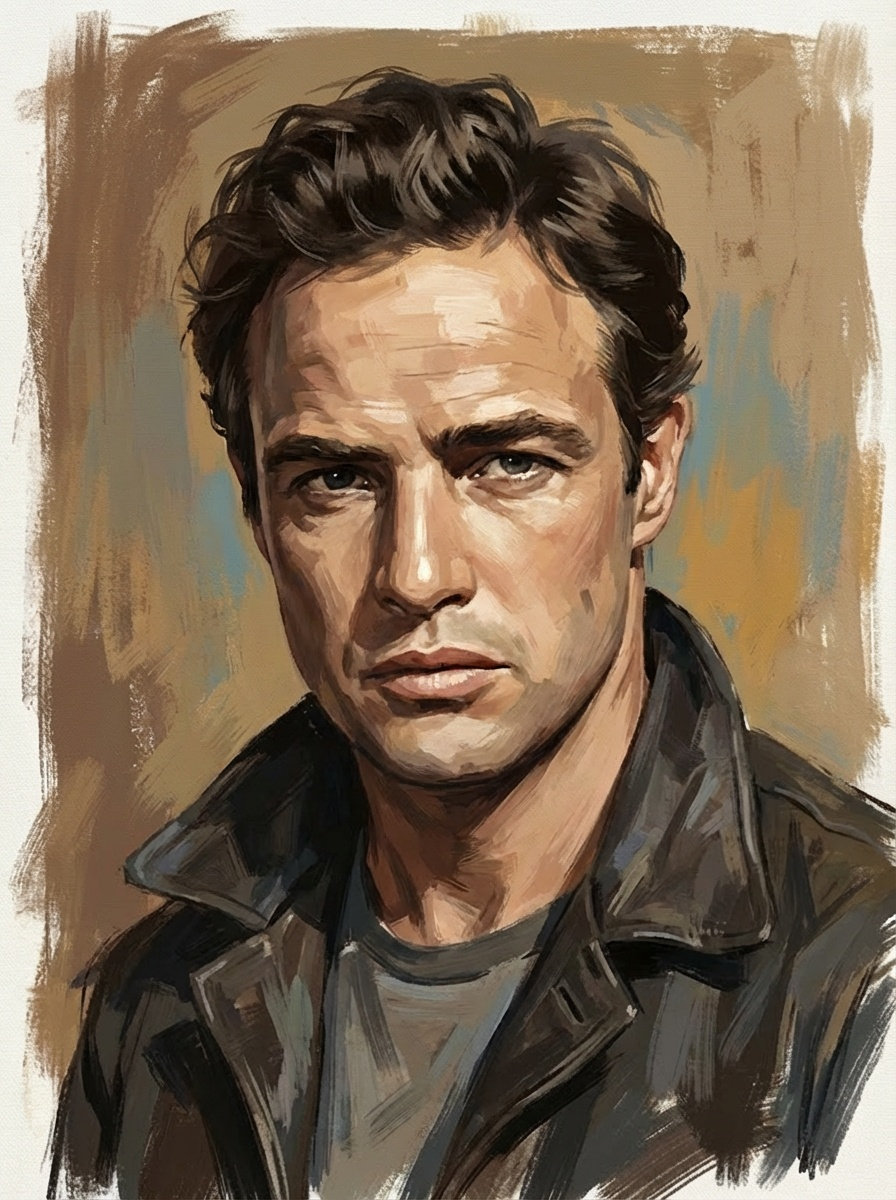
Marlon BrandoPortrait · Marlon Brando

From Stella's Cry to The Godfather's Whisper

Born Marlon Brando Jr. on April 3, 1924, in Omaha, Nebraska — the son of a cattle feed salesman and an amateur actress who was also an alcoholic. He was raised primarily by his mother's energy and his own rebellion, expelled from military school, and arrived in New York at nineteen where Stella Adler taught him what became the specific quality of his screen work: that the character's emotion was felt, not demonstrated.

Elia Kazan's Broadway production of A Streetcar Named Desire (1947) — Brando as Stanley Kowalski — is the inflection point in American acting history. The performance replaced the mannered externality of classical stage acting with something that appeared to be happening rather than being performed. The film (1951) transferred it to cinema, where it was even more disorienting: the camera at this proximity had not seen anything like it before.

Eight Oscar nominations followed across a career of exceptional range: the dock worker in On the Waterfront (1954, Oscar); the Mexican revolutionary in Viva Zapata! (1952); the leather-jacketed outlaw in The Wild One (1953); the Japanese interpreter in Sayonara (1957). Then the cultural drift: a period of commercial misuse, difficult productions, the specific contempt for the industry that his performances had generated a right to feel.

Francis Ford Coppola's The Godfather (1972) — Brando as Don Vito Corleone — is the comeback no one had the right to expect after a decade of mediocre material, and it is the performance against which all subsequent American screen acting in the crime genre has been measured. He sent a Native American activist to decline the Oscar. Bernardo Bertolucci's Last Tango in Paris (1972), the same year, is the companion piece: Paul, the American expatriate in Paris, the grief and the rage without the protective archetype. He died on July 1, 2004, in Los Angeles.
1924
Born in Omaha; expelled from military school; arrives in New York at nineteen
1944
Stella Adler; the method; the interior emotion; the instrument forming
1947
Broadway — Streetcar; Stanley Kowalski; American acting changes
1951
Film debut — Streetcar; the camera at this proximity; first Oscar nom
1954
On the Waterfront — Terry Malloy; first Oscar won; Kazan again
1972
The Godfather — Vito Corleone; second Oscar; declined via activist
2004
Dies in Los Angeles; age 80; the language he changed still the language

From Stanley's Rage to Vito's Garden

1972Crime Drama · Francis Ford Coppola · Puzo
The Godfather
Coppola's epic — Brando as Don Vito Corleone, the aging patriarch of a crime family, conducting business with the specific authority of a man whose power comes not from threat but from the absolute expectation of respect. The comeback after a decade of mediocre material; the second Academy Award; the performance against which all subsequent crime cinema has been measured.
Oscar Won

The cotton in the jowls, the hoarsened voice, the deliberate physicality of a man whose body has earned its age — Brando built the character from the outside in, which is the opposite of his usual method and the reason the result has a quality his earlier work doesn't have. The garden scene — Vito playing with his grandson, the tomatoes, the death — is the most moving thing in a film of overwhelming force, played by a man who had earned the right to that kind of simplicity.

1954Drama · Elia Kazan · Eva Marie Saint
On the Waterfront
Kazan's dockworkers' drama — Brando as Terry Malloy, the former boxer turned mob errand boy who becomes a witness against the union corruption that killed someone he cared about. The first Oscar; the "I coulda been a contender" speech; and the clearest demonstration that what he had done to stage acting in 1947 was fully transferable to the close-up of cinema.
Oscar Won

The "contender" speech — delivered in the back seat of a car to Rod Steiger's Charlie, the brother whose choices ended Terry's boxing career — is the most analysed scene in American screen acting history and the one most consistently cited by subsequent actors as the moment they understood what the form could do. Brando plays it not as a speech but as a series of discoveries — the character arriving at the thought as the character, not the actor, finds it.

1951Drama · Elia Kazan · Tennessee Williams
A Streetcar Named Desire
Kazan's Williams adaptation — Brando as Stanley Kowalski, the brutish, sensual brother-in-law whose collision with Blanche DuBois constitutes the film's entire moral and psychological argument. The performance that introduced a generation to the possibility that cinema could do what it had not previously done: place a human interior fully in view.
Oscar Nom

Stanley's quality — the man whose animal intelligence is more honest than any refinement the play contains — is played by Brando without the moral framing the script provides, which is the reason the performance remains disturbing. He does not perform Stanley's violence; he performs Stanley's desire, which is more frightening — the violence arrives as a consequence of the desire, not as a demonstration of villainy.

1972Drama · Bernardo Bertolucci · Maria Schneider
Last Tango in Paris
Bertolucci's Paris drama — Brando as Paul, the American expatriate grief-stricken by his wife's suicide, conducting an anonymous sexual relationship in an empty apartment. The companion piece to The Godfather — the same year, the same actor, the opposite of archetype: the raw material before the character has been given protective form, played with a transparency that the earlier method work had always aimed at and here achieved.
Oscar Nom

Paul's quality — the man whose grief has removed all the social scaffolding that makes a person legible — is the most unguarded performance Brando gave. He used his own biographical material without fictional mediation, which is the most extreme application of the method's principle and the reason the result has a quality that his more consciously constructed performances don't approach — the nakedness of a person who has stopped performing.

"

An actor is at most a poet and at least an entertainer.

— Marlon Brando

Two Oscars — Eight Nominations — The One He Declined

Academy Award — Best Actor
1973
The Godfather
Won for Don Vito Corleone — the comeback performance that demonstrated what a decade of inadequate material had not extinguished. He declined the Oscar, sending Sacheen Littlefeather to the ceremony to read a statement about Hollywood's treatment of Native Americans. The statement was the most consequential use of an Oscar acceptance moment in the award's history.
Declined — Via Activist
Academy Award — Best Actor
1955
On the Waterfront
Won for Terry Malloy — the first Oscar, for the performance that confirmed what the Streetcar Broadway production had promised. The "contender" speech; the back seat; the discovery in real time. The most influential single scene in the history of American screen acting, delivered in a performance that won the award on its own terms without requiring the award's validation.
Oscar Won
AFI Greatest Actor
1999
AFI 100 Years · Top Four
Ranked fourth on the American Film Institute's list of the greatest screen legends of the twentieth century — a measure less of his individual films than of the structural change he made to the form. Every American screen actor who came after him was trained in a tradition he defined; the list is a footnote to the influence.
AFI Legend
Stella Adler's Assessment
1944 →
The Greatest Student
Stella Adler, who had studied with Stanislavski himself, said Brando was the greatest acting talent she had encountered. Lee Strasberg of the Actors Studio said the same of Marilyn Monroe. The two assessments together define the specific quality that the method, properly taught and properly received, could produce — and that the camera at close range could then record.
Adler's Verdict

The Method — The Refusal — The Language He Changed

The Interior Emotion
What Brando brought to American screen acting was the interior emotion — the feeling happening before the expression rather than the expression demonstrating the feeling. The distinction is technical and its consequences are enormous: every American film actor trained since 1950 has trained in a tradition his Streetcar performance defined.
The Contempt for the Industry
He found the film industry intellectually beneath him and said so, repeatedly and publicly, which the industry experienced as ingratitude and which was in fact an accurate assessment. The contempt did not prevent him from making great films; it prevented him from making enough of them, which is the specific loss the career represents.
The Political Acts
Declining the Godfather Oscar to protest Hollywood's treatment of Native Americans; refusing to attend functions; using celebrity as a platform for civil rights — the political acts were continuous with the artistic ones, expressions of the same refusal to accept the industry's framing of what an actor was and what an actor owed.
The Late Greatness
The Godfather and Last Tango in Paris in 1972 — two films in the same year, after a decade of professional drift, representing two entirely different registers of mastery. The late greatness is the most complete argument against the narrative of decline: the instrument had not deteriorated; the material had finally caught up again.

Stanley's Door — And Everything That Came Through It

Marlon Brando's legacy is a door he opened in 1947 — the door between the stage actor performing emotion and the screen actor transmitting it — through which every subsequent American screen actor has walked, whether they know it or not. Two Oscars, eight nominations, the Godfather, the Waterfront, the Streetcar, and the specific quality that no subsequent actor has surpassed: the emotion happening before the expression, the thought arriving in real time.

He found the industry unworthy of his attention and said so. He was wrong about that — the industry's best films were worthy — but he was right about the specific claim: the actor who changed the language of American screen performance had more right to contempt for the institutions that managed it than any other person in Hollywood history, and the contempt was itself a form of intellectual honesty that the institution consistently failed to reward.

Academy Awards Won
Waterfront · Godfather (declined)
2
Oscar Nominations
Across forty years
8
Years Between Oscars
Waterfront 1954 — Godfather 1972
18
Age at Death
July 1, 2004
80