← Return to Stars
Vienna, 1930 — Innsbruck, 2014

Maximilian Schell

Actor, director, producer, and polyglot — one of the most complete and commanding artists European cinema has ever given Hollywood. His eyes held the weight of the century he lived through.

1
Academy Award
Won
3
Oscar
Nominations
6
Languages
Spoken
Maximilian Schell — painted portrait Portrait · Maximilian Schell
Biography

Born Into History

Maximilian Schell was born on December 8, 1930, in Vienna — a city that was itself on the precipice of catastrophe. His father, Hermann Ferdinand Schell, was a Swiss poet and playwright; his mother, Margarethe Noé von Nordberg, was an Austrian actress who ran her own acting school. The family was Roman Catholic and vehemently anti-Nazi. When the Anschluss came in 1938, they fled to Zurich — made possible by his father's Swiss citizenship. He grew up there, and that displacement — the permanent awareness of being between worlds — would define his art for the rest of his life.

He studied at the University of Zurich and the Ludwig Maximilian University of Munich, earning his doctorate in philosophy — a credential rare in the acting profession and one that showed in his work. He brought the analytical rigor of the scholar to every role, finding the ideological and moral architecture beneath the surface of each character he inhabited.

He made his stage debut in Zurich and quickly established himself as one of Europe's leading theatrical talents. He appeared in Shakespearean productions, Schiller, Brecht — the full range of the continental repertoire. The stage remained his first love even as Hollywood came calling.

His film breakthrough came with Stanley Kramer's Judgment at Nuremberg (1961), in which he played Hans Rolfe, the defense attorney arguing on behalf of convicted Nazi judges. The role required him to make a morally repugnant argument with full intellectual conviction — to be dazzling, charismatic, and wrong. He succeeded so completely that he won the Academy Award for Best Actor at age 31, defeating co-stars Spencer Tracy and Burt Lancaster in one of Hollywood's most competitive fields.

The Paradox at the Heart of His Career

Schell was Roman Catholic with no Jewish ancestry — yet he spent his career alternating between playing Nazis and playing Jews, inhabiting both with equal conviction. In Judgment at Nuremberg he defended Nazi war criminals; in The Diary of Anne Frank, The Chosen (1981), and Left Luggage (1998) he played Jewish fathers and survivors. He brought the same moral seriousness to both sides — a feat only possible because his art was rooted in understanding, not identity.
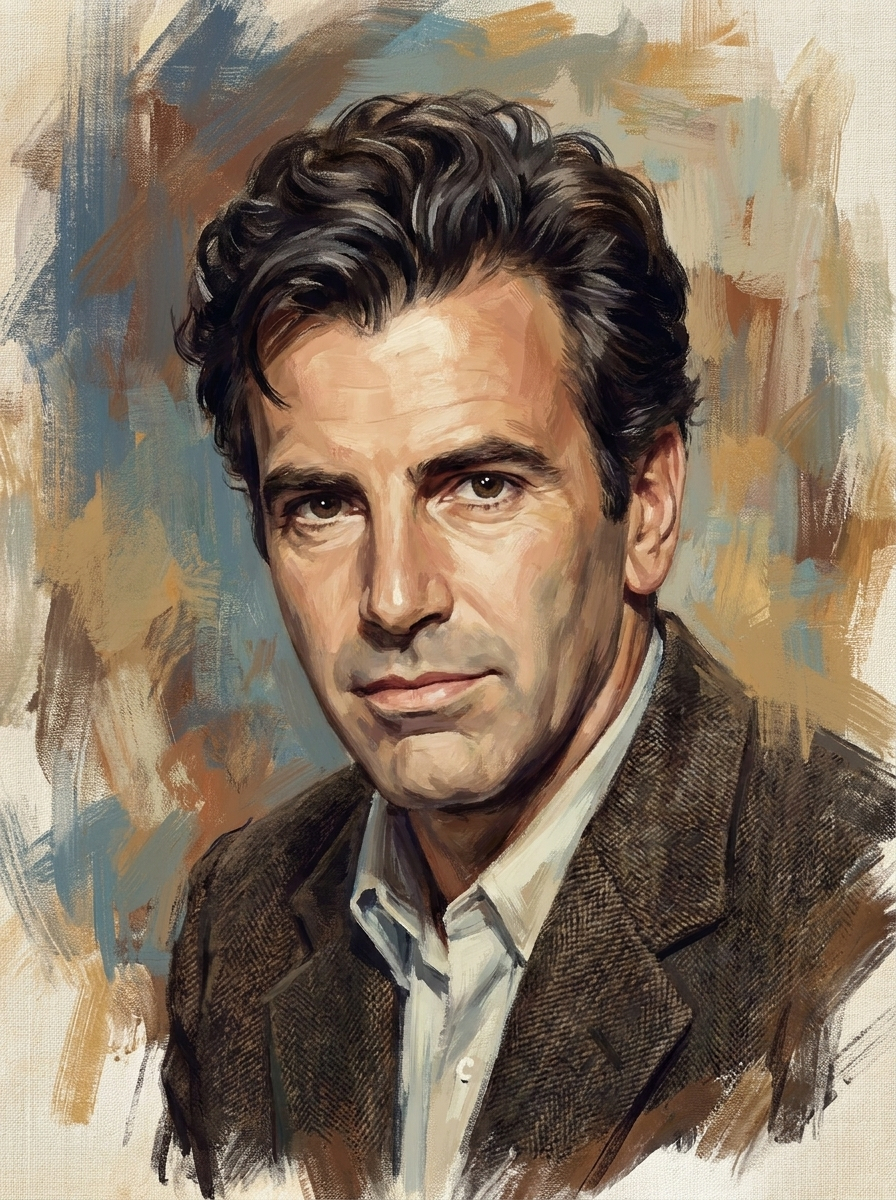
Maximilian Schell
Maximilian Schell · Vienna-born, 1930
Filmography

A Career Across Continents

★ Academy Award — Won
1961
Judgment at Nuremberg
Hans Rolfe, Defense Attorney · Dir. Stanley Kramer
Performance

In a film populated by Hollywood royalty — Tracy, Lancaster, Dietrich, Garland, Clift — it was Schell who walked away with the Oscar. His Hans Rolfe is the film's most uncomfortable character: brilliant, sincere, and defending the indefensible. He made the defense not villainous but genuinely argued — which made the verdict all the more powerful. It remains one of the finest courtroom performances in cinema history.

Judgment at Nuremberg · 1961
1968
Krakatoa, East of Java
Captain Hanson · Dir. Bernard Kowalski
Performance

One of several Hollywood adventure productions in which Schell brought his unmistakable authority to genre material. His command of English, German, French, Italian, Spanish, and Serbo-Croatian made him uniquely employable across the international co-productions that dominated European cinema in the late 1960s — and his bearing elevated whatever he appeared in.

Krakatoa, East of Java · 1968
Krakatoa · 1968
★ Oscar Nomination
1975
The Man in the Glass Booth
Arthur Goldman / Adolf Karl Dorff · Dir. Arthur Hiller
Performance

Adapted from Robert Shaw's stage play, this was Schell's second Oscar-nominated performance — and arguably his most demanding. He plays a Jewish New York millionaire who may or may not be a Nazi war criminal, interrogating the nature of guilt, identity, and survival across a harrowing two-hour performance that requires him to inhabit two contradictory men simultaneously. A towering one-man tour de force.

The Man in the Glass Booth · 1975
Glass Booth · 1975
1981
The Chosen
David Malter · Dir. Jeremy Paul Kagan
Performance

Jeremy Paul Kagan's adaptation of Chaim Potok's beloved novel set Schell as David Malter, the secular Jewish scholar and father whose son Danny (Robby Benson) forms a profound friendship with a Hasidic rabbi's son (Barry Miller) in post-war Brooklyn. The film navigates the collision between tradition and modernity, Zionism and Orthodoxy, with Schell's David at its moral centre — a man of reason and compassion who must hold open the door to a world his son is straining to reach. That Schell, a Catholic Austrian, brought such warmth, such particular Jewish intellectual dignity, and such genuine paternal love to the role is among the most striking demonstrations of his range. His scenes with Benson have the quiet authority of a man who has thought deeply about the questions the film is asking and arrived at his own hard-won answers.

The Chosen · 1981
The Chosen · 1981
1977
Julia
Johann · Dir. Fred Zinnemann
Performance

Fred Zinnemann's adaptation of Lillian Hellman's memoir featured Jane Fonda and Vanessa Redgrave, but Schell's supporting role as a contact in occupied Europe brought his particular brand of danger and intelligence to the film. Working with two actresses at the peak of their craft, he matched them without effort — a reminder that supporting roles were never small when Schell inhabited them.

Julia · 1977
Julia · 1977
1980 · TV Film
The Diary of Anne Frank
Otto Frank, Anne's Father · Dir. Boris Sagal
Performance

Based on the celebrated stage play and Frances Goodrich and Albert Hackett's screenplay, this television film gave Schell one of his most demanding and emotionally exposed roles. Otto Frank — the only member of his family to survive the Holocaust — is a man required to hold hope, grief, and impossible love together simultaneously. That Schell, a Catholic Austrian, brought such authentic humanity to the role is a testament to the depth of his craft and his intimate understanding of what the twentieth century had done to Europe.

The Diary of Anne Frank · 1980
1979
The Black Hole
Dr. Hans Reinhardt · Dir. Gary Nelson
Performance

Disney's ambitious science fiction venture cast Schell as its villain — a rogue scientist obsessed with breaching the event horizon of a black hole. He played the role with the same committed intensity he brought to Nuremberg. A lesser actor would have been swallowed by the spectacle; Schell made Reinhardt genuinely terrifying. Proof that he never condescended to genre.

The Black Hole · 1979
1993
A Far Off Place
John Ricketts · Dir. Mikael Salomon
Performance

Even in later career adventure films, Schell's presence transformed the material around him. His ability to suggest depth and history in minimal screen time — the hallmark of the truly great character actor — was undiminished decades after Nuremberg. He was incapable of a throwaway performance.

A Far Off Place · 1993
1998
Left Luggage
Mr. Silberschmidt, Chaya's Father · Dir. Jeroen Krabbé
Performance

Jeroen Krabbé's Dutch drama — based on Carl Friedman's novel The Shovel and the Loom — gave Schell one of his most quietly devastating late-career roles. He plays Mr. Silberschmidt, a Holocaust survivor in post-war Antwerp consumed by a single obsession: recovering two suitcases he buried during the Nazi occupation, suitcases that contained everything dear to him before the war took his family. He prowls the city with old maps, digging ceaselessly, unable to grieve what he cannot locate. His daughter Chaya (Laura Fraser), a secular young woman, takes work as a nanny for a Hasidic family — and through her relationship with their youngest son begins to understand her father's wound. The film screened in competition at the 48th Berlin International Film Festival, where it won the Blue Angel Award. In an ensemble that included Isabella Rossellini, Chaim Topol, and Miriam Margolyes, Schell's Silberschmidt haunts every scene he is absent from as much as those he occupies — the embodiment of a grief too large and too specific for ordinary language. A late masterwork in his sustained engagement with the Jewish European experience.

Collector's Art

A Tribute Poster

Maximilian Schell: A Tribute to a Legend — custom poster art
View & Purchase ↗

This hand-crafted tribute poster captures the dual worlds Maximilian Schell inhabited across his career — the glass booth of Arthur Goldman, the courtroom of Hans Rolfe, the wartime shadows of Julia, and the military fire of A Bridge Too Far — all anchored by the commanding gaze that made him one of cinema's most magnetic presences.

Available as a fine art print from Retro Movie Art.

View & Purchase Print ↗

"I always felt I was an Austrian in exile. That is not a small thing to carry. But it is, perhaps, what makes one understand the weight of a courtroom, the weight of a verdict, the weight of history on a single man's shoulders."

— Maximilian Schell
Behind the Camera

Schell as Director

1975
Der Fussgänger (The Pedestrian)
Director · Writer · Actor

His directorial debut earned an Academy Award nomination for Best Foreign Language Film — an extraordinarily rare achievement. A morally complex examination of a German industrialist confronting his wartime past, the film announced Schell as a filmmaker of serious intellectual intent, not merely an actor who had picked up a camera.

1984
Marlene
Director · Interviewer

His documentary about Marlene Dietrich — who agreed to be interviewed but refused to be filmed — is one of cinema's most unusual portraits. We hear her voice; we see only archival footage and Schell's reactions. It was nominated for the Academy Award for Best Documentary Feature. Dietrich later sued to prevent its release. A masterpiece of imposed absence.

1979
Tales from the Vienna Woods
Director · Producer

An adaptation of Ödön von Horváth's pre-war Viennese play, suffused with the bittersweet nostalgia and darkness of a world on the edge of catastrophe. Schell brought to it his intimate knowledge of Austrian culture and his own family's experience of displacement — the past made personal.

1993
Candles in the Dark
Director

A television film about life under Soviet oppression in Eastern Europe — further evidence that Schell's directorial concerns were consistent with his acting preoccupations: conscience, complicity, survival, and the moral choices made under impossible pressure. History was never abstract for him.

Recognition

Academy Award Honours

34th Academy Awards · 1962
Best Actor — Winner
Judgment at Nuremberg
Film: 1961 · Defeated Spencer Tracy
48th Academy Awards · 1976
Best Actor — Nominated
The Man in the Glass Booth
Film: 1975
45th Academy Awards · 1973
Best Foreign Language Film — Nominated
Der Fussgänger
As Director · Film: 1973
57th Academy Awards · 1985
Best Documentary Feature — Nominated
Marlene
As Director · Film: 1984

The European Conscience

Maximilian Schell occupied a singular position in twentieth-century cinema: he was a European intellectual who worked fluently in Hollywood without ever being absorbed by it. He brought to American films a gravity and a cultural memory that was distinctly continental — the memory of fascism, exile, and the moral wreckage of the twentieth century.

He was also, by any measure, one of the most versatile actors of his era. He worked with Stanley Kramer, Fred Zinnemann, Luchino Visconti, and Sam Peckinpah. He acted in six languages. He directed films that earned Oscar nominations. He produced theatre in Vienna and Salzburg. He was, in every sense, a man of the full cultural tradition — not merely a film star but an artist who moved between mediums as easily as he moved between languages.

His recurring subject was the nature of guilt — collective and individual, historical and personal. In Judgment at Nuremberg, in The Man in the Glass Booth, in Der Fussgänger, and in Marlene, he returned again and again to the question of what it means to be responsible for the past you have lived through. It was not an academic question for him. It was the question of his own life.

Languages in which Schell performed professionally
German English French Italian Spanish Serbo-Croatian
At a Glance
Academy Award wins
1
Oscar nominations (acting)
2
Oscar nominations (directing)
2
Age at first Oscar win
31
Languages spoken
6
Decade of first film
1950s
Career span
55 yrs