The New Jersey actor who produced One Flew Over the Cuckoo's Nest at thirty-one, won the Oscar for playing Gordon Gekko at forty-three, and built one of the most commercially intelligent careers in Hollywood — understanding both the producer's view of what audiences want and the actor's understanding of what characters require, and using each to serve the other.
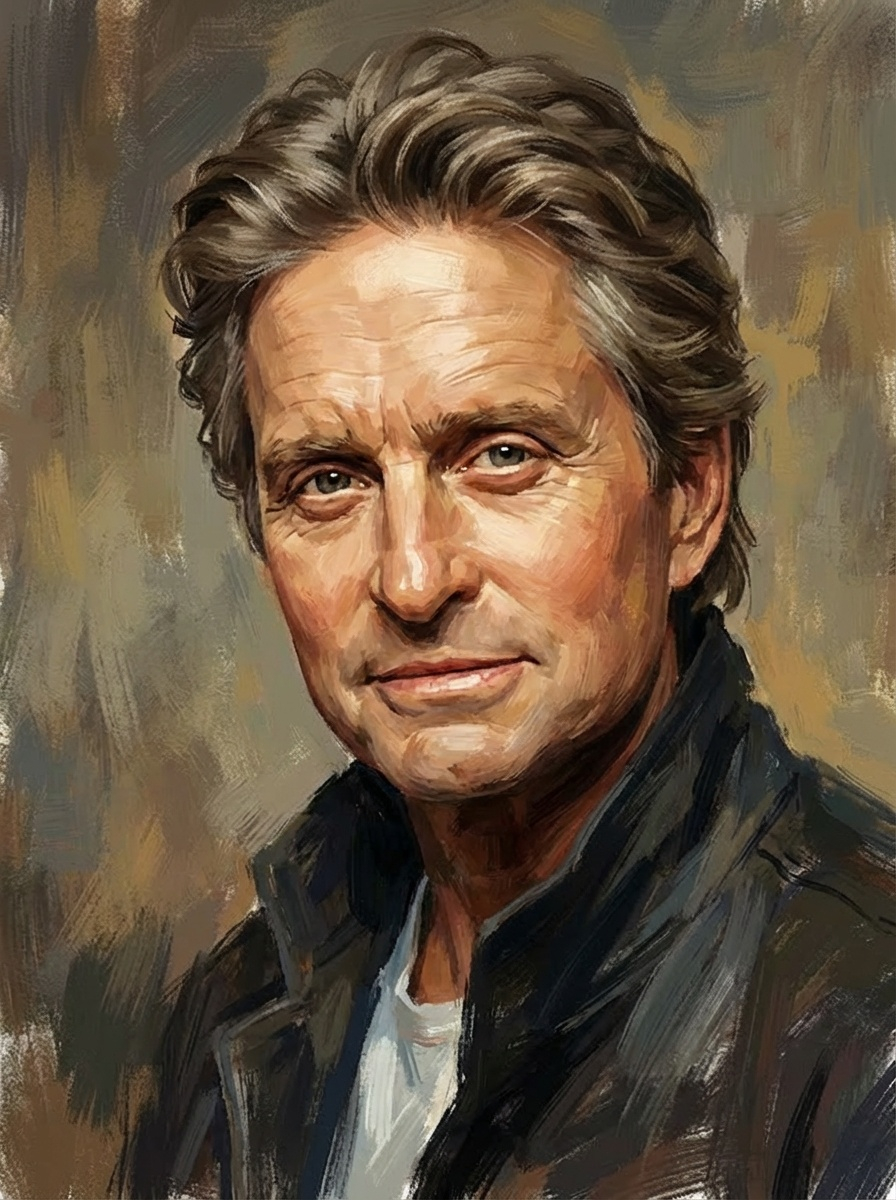
Portrait · Michael DouglasBorn Michael Kirk Douglas on September 25, 1944, in New Brunswick, New Jersey — the son of Kirk Douglas and Diana Dill, raised largely by his mother after his parents' divorce, educated at the University of California, Santa Barbara and the American Film Institute. He established himself on television in the police drama The Streets of San Francisco before turning his attention to both acting and producing.
He produced Miloš Forman's One Flew Over the Cuckoo's Nest (1975) at thirty-one — the film that swept the five major Academy Awards, including Best Picture. His father Kirk had owned the rights to Ken Kesey's novel for fifteen years without managing to get a film made; Michael acquired them, hired Forman, and the result is one of the most honoured films in Hollywood history. The producing Oscar established that the Douglas career would not be defined by who his father was.
The acting career built steadily — The China Syndrome (1979), Romancing the Stone (1984) — before Oliver Stone's Wall Street (1987) gave him Gordon Gekko and the acting Oscar at forty-three. Gekko's "greed is good" speech is the most quoted expression of 1980s financial culture's self-understanding in American cinema. He continued with Fatal Attraction (1987), Basic Instinct (1992), Falling Down (1993), and Wonder Boys (2000), building a filmography of consistent commercial and critical intelligence.
He survived throat cancer in 2010, returned with Soderbergh's Behind the Candelabra (2013), for which he received a Golden Globe and Emmy, and has continued working with the sustained professionalism of a person who has always understood the industry he operates in more clearly than it understands itself.
Gekko's quality — the intelligence that has decided morality is an obstacle rather than a constraint — is played by Douglas with a specific charm that makes the ideology seductive rather than merely contemptible. The "greed is good" speech works because Douglas makes Gekko believe it, and Gekko believing it is more frightening than Gekko knowing it is wrong and proceeding anyway — which is the difference between a villain and a worldview.
The film's quality — the specificity of each patient's psychology, the credibility of the institution, the tragedy that builds from apparent comedy — was Forman's achievement, and Douglas had the judgment to hire Forman and the tenacity to get the film financed when everyone else had found reasons not to. The producer who identifies the right director for the right material and ensures the conditions for the director's vision is doing something the credit structure of Hollywood doesn't adequately honour.
The China Syndrome is the film that confirmed Douglas's understanding of the commercially viable serious picture — the thriller that carries a political argument without announcing it, the entertainment that leaves the audience with something to think about. The film's specific quality is its refusal to resolve the tension between the public interest and the personal safety of the people who serve it, which is a morally honest position that most Hollywood pictures about whistleblowing are not willing to sustain.
D-FENS's quality — the man whose grievances are real and whose responses are catastrophically wrong — is played by Douglas without the reassurance of clear villainy. The film's intelligence is its refusal to make D-FENS sympathetic or monstrous; Douglas plays him as comprehensible, which is the more disturbing choice and the one the film requires to make its argument about what American masculinity produces when it finds itself without a role.
Greed, for lack of a better word, is good.
Michael Douglas's legacy is the dual career — the only person in Hollywood history to win Academy Awards both as producer of Best Picture and as lead actor, in two films made thirteen years apart. One Flew Over the Cuckoo's Nest is one of the most honoured films in history; Wall Street is the film the 1980s produced to understand itself; and the career that contains both was built by the same intelligence applied to two different crafts.
Gordon Gekko is the character. The "greed is good" speech outlasted the decade that produced it, was used as a genuine business motivation by people who had missed the film's critique, and returned in a sequel twenty-three years later still capable of generating the same ambivalent fascination — the measure of a character that has entered the language rather than merely appeared in a film.