Omaha, Nebraska · 1920 – 1966

MontgomeryClift

The Omaha actor who arrived on screen in 1948 already doing something the cinema had not previously seen — the wound made visible, the interior life fully present, the beautiful face that seemed to be looking inward rather than outward — and who was destroyed by a car accident at thirty-six and by the industry's indifference to the person it had used, and died at forty-five with four Oscar nominations and no wins.

4
Oscar
Nominations
45
Years
of Life
1956
Year of
the Accident
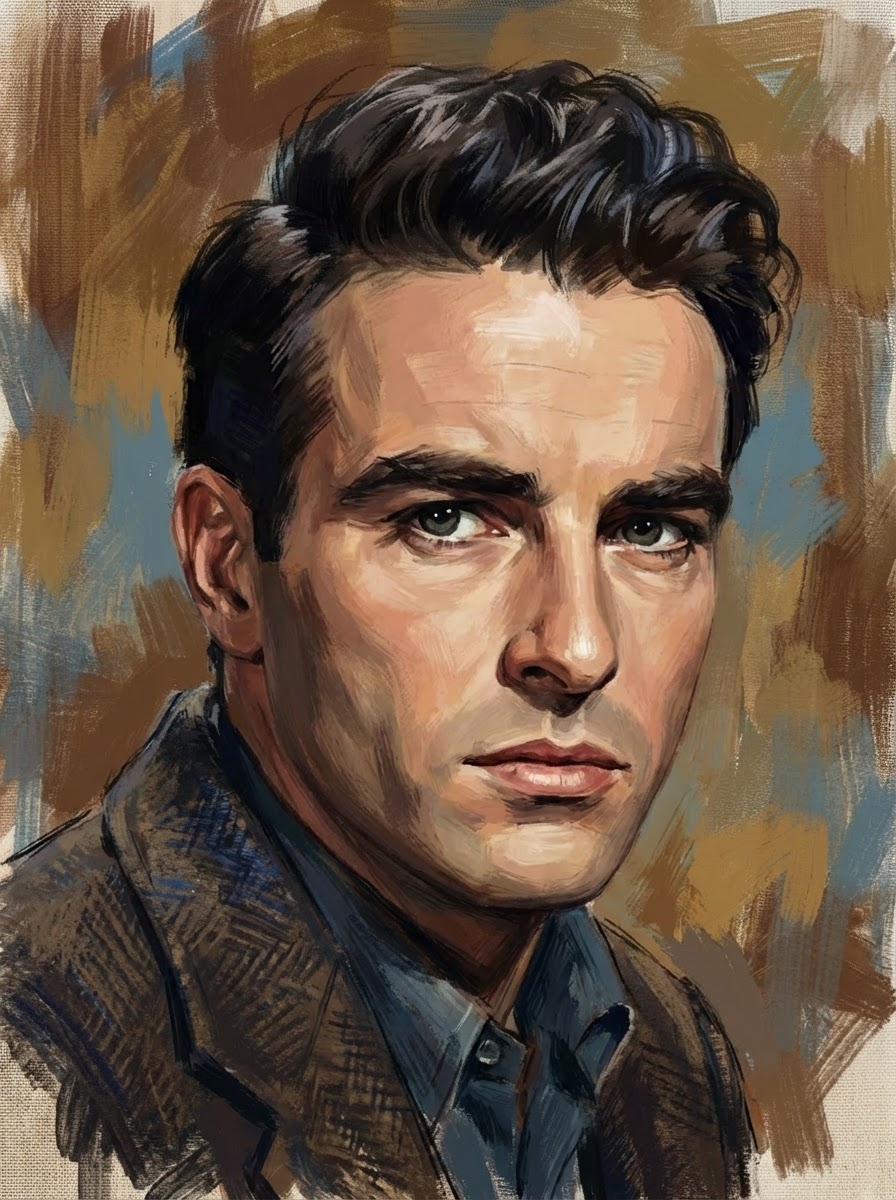
Montgomery CliftPortrait · Montgomery Clift

From Broadway's Child to Hollywood's Wound

Born Edward Montgomery Clift on October 17, 1920, in Omaha, Nebraska — one of twins, raised in a household of unusual privilege and unusual instability, on the stage from the age of thirteen when a summer stock company cast him. He spent a decade on Broadway before Hollywood, arriving at nineteen already fully formed as a stage actor — trained, disciplined, technically precise.

Howard Hawks's Red River (1948) — Clift as Matthew Garth, the adopted son who challenges John Wayne's cattleman patriarch on a cattle drive — introduced him to film audiences as something that had not previously existed in the Western genre: the sensitive man who is also capable of physical action, the interior life available to the camera in a form the genre had not previously accommodated. John Huston's The Search (1948), the same year, gave him his first Oscar nomination for playing an American soldier helping displaced children in postwar Germany.

George Stevens's A Place in the Sun (1951) — Clift as George Eastman, the ambitious working-class young man caught between Elizabeth Taylor's society girl and Shelley Winters's factory worker — is the film most completely built around his specific quality: the man whose desire exceeds his means and whose moral failure proceeds from the excess rather than from cruelty. The scene where he watches Winters drown rather than saving her is the most psychologically honest depiction of a coward's specific guilt in American cinema.

The car accident on Coldwater Canyon Drive on May 12, 1956 — at thirty-five, leaving a dinner party at Elizabeth Taylor's house — shattered his face and began the final decade: reconstructed, partially paralysed on one side, dependent on pills and alcohol, still capable of the extraordinary cameo in John Huston's Freud (1962) and the uncredited testimony in Judgment at Nuremberg (1961) that earned his fourth Oscar nomination. He died on July 23, 1966, in New York City, of occlusive coronary artery disease. He was forty-five.
1920
Born in Omaha; one of twins; stage at thirteen; Broadway at nineteen
1948
Red River and The Search — both in the same year; first Oscar nom
1951
A Place in the Sun — George Eastman; Stevens; Taylor; Winters; second nom
1953
From Here to Eternity — Prewitt; third Oscar nom; the peak
1956
Car accident on Coldwater Canyon; face shattered; the slow destruction begins
1961
Judgment at Nuremberg — the survivor's testimony; fourth Oscar nom
1966
Dies in New York; age forty-five; four nominations; no wins; the waste complete

From George Eastman's Lake to Prewitt's Bugle

1951Drama · George Stevens · Elizabeth Taylor
A Place in the Sun
George Stevens's Dreiser adaptation — Clift as George Eastman, the working-class young man caught between ambition and conscience, between Elizabeth Taylor's socialite and Shelley Winters's factory girl, and ultimately unable to act in the moment when action would have changed everything. The film built most completely around his specific quality: the interior life on full display, the moral failure available to the camera without editorial comment.
Oscar Nom

The scene where George watches Alice Tripp drown rather than saving her is the most psychologically honest depiction of cowardice in American cinema — played by Clift not as villainy but as paralysis, the man who cannot make his hands move to save someone he has already decided to leave behind. The responsibility is complete; the active malice is absent; and the gap between the two is where the film's moral argument lives, and where Clift's quality is most exactly itself.

1953War Drama · Fred Zinnemann · Burt Lancaster · Sinatra
From Here to Eternity
Fred Zinnemann's Pearl Harbor drama — Clift as Private Robert E. Lee Prewitt, the Army bugler and former boxer who refuses to fight for a company commander who killed his friend, and who plays taps at the film's end as a final act of grief and defiance. Third Oscar nomination; the most physically disciplined performance of his career; the interior wound now inseparable from the soldier's exterior.
Oscar Nom

Prewitt's quality — the man whose integrity costs him everything the institution can take, and who pays the price without compromising — is played by Clift with the physical precision his stage training had given him and the emotional transparency the camera could then find. His bugling scenes are the film's most complete image: the man who has kept one thing inviolable, performing it alone, for someone already dead.

1961Courtroom Drama · Stanley Kramer · Maximilian Schell
Judgment at Nuremberg
Stanley Kramer's Nuremberg trials drama — Clift in an uncredited cameo as Rudolph Petersen, a survivor of Nazi forced sterilisation, testifying about what was done to him. Five years after the accident; partially reconstructed; given twenty minutes of screen time and a single scene of testimony that earned his fourth Oscar nomination. The scene is the most concentrated demonstration of his instrument still fully functional inside the damaged body.
Oscar Nom

Petersen's testimony — the man trying to accurately describe something done to him that he does not fully understand and cannot adequately articulate — is played by Clift in a sustained close-up of twenty minutes that demonstrates what the post-accident instrument could still do. The scene was shot in a single day; Clift had not read the script; he improvised within the framework; the result is the most emotionally present performance of his final decade and one of the most affecting cameos in American film.

1948Drama · Fred Zinnemann · Film Debut
The Search
Fred Zinnemann's postwar drama — Clift's film debut as Ralph Stevenson, an American soldier in occupied Germany helping a displaced Czech boy find his mother. First Oscar nomination; first film; the instrument already fully formed. He had spent a decade on Broadway before accepting a film role, and arrived already knowing exactly what he was doing in front of a camera.
Oscar Nom

The relationship between Ralph and the boy — the soldier who finds himself becoming a surrogate father through the simple daily acts of caring for another person — is played by Clift with the specific quality that would define his career: the emotion fully present, nothing held back, the openness that the camera finds and that other performances around it are forced to rise to meet. A debut at twenty-seven, with a decade of stage work behind him, and already complete.

"

He is the only person I know who is in worse shape than I am.

— Marilyn Monroe · on Montgomery Clift

Four Nominations — No Wins — The Academy's Sustained Failure

Oscar Nom — Best Actor
1949
The Search
First nomination for his film debut — already the full instrument, already doing what no one else was doing. The Academy nominated him and gave the award to Laurence Olivier for Hamlet, which is the first of four consecutive failures to honour the most original screen actor of the postwar era.
Nominated — Debut Year
Oscar Nom — Best Actor
1952
A Place in the Sun
Second nomination for George Eastman — the performance most completely built around his specific quality, the moral failure played without villainy. Humphrey Bogart won for The African Queen. The Academy's pattern was becoming clear: it recognised him consistently enough to nominate, and then declined to honour what the nominations acknowledged.
Nominated
Oscar Nom — Best Supporting Actor
1962
Judgment at Nuremberg
Fourth nomination — for a twenty-minute uncredited cameo, shot in a single day, five years after the accident. The nomination is the Academy's acknowledgment that what the accident had not destroyed was still the most transparent instrument in American cinema. George Chakiris won for West Side Story. Four nominations; four losses; the record of a career the industry used and did not adequately honour.
4th Nomination — No Wins
The Coldwater Canyon Accident
May 12, 1956
The Before and the After
The car accident at thirty-five divided his career into the before and the after — the face before reconstruction and after, the instrument before the pills and alcohol and after, the career the accident truncated. Elizabeth Taylor, at whose house the dinner party had been held, climbed into the wrecked car and held his head and kept him from choking on his own teeth. The friendship was the most loyal of his professional life.
The Dividing Line

The Interior Wound — The Beautiful Face — The Accident

The Wound Made Visible
His specific quality — the interior wound available to the camera, the psychological damage fully present in the face — preceded the accident by eight years and was the constitutional characteristic that Zinnemann and Stevens and Huston recognised and built roles around. The accident made it literal; the wound had always been there.
Before Brando and Dean
He is consistently placed in the same generational conversation as Brando and James Dean — the three method actors who changed American screen performance simultaneously. He predated both: The Search in 1948, before Brando's Streetcar film (1951) and five years before Dean's first film. The conversation consistently underestimates his priority.
The Accident's Division
The before and the after are the two halves of a career that should have been one. The before produced four of the finest performances in American postwar cinema; the after produced Judgment at Nuremberg's cameo and Freud and The Misfits — remarkable work in a destroyed instrument. The accident is the specific loss of a career that was already producing at the highest level.
Four Nominations, No Wins
The Academy nominated him four times and declined to honour him each time — a record that constitutes the clearest single institutional failure in Oscar history. The four nominations span seventeen years; the four losses span the same period; and the consistency of the pattern is its own kind of tribute, confirming that the Academy always knew what it was failing to do.

George Eastman's Lake — Prewitt's Bugle — Petersen's Testimony

Montgomery Clift's legacy is the wound made visible — the interior life fully present in the face, the psychological damage available to the camera in a form that neither the classical stage tradition nor the conventional Hollywood performance had previously offered. Four Oscar nominations, no wins, four of the finest performances in postwar American cinema, and a car accident at thirty-five that truncated a career producing at the highest level and then killed the person it had not quite finished.

He died at forty-five with more left to do than most careers contain. The four nominations are the Academy's consistent acknowledgment that it knew what it was looking at; the four losses are its consistent failure to honour it, which is the most complete possible statement of the institution's relationship to the original — always visible, never adequately rewarded.

Oscar Nominations
1948 to 1961 — four films
4
Oscar Wins
The Academy's sustained failure
0
Age at Car Accident
Coldwater Canyon, 1956
35
Age at Death
New York, July 23, 1966
45