Long Beach, California · Born 1964

NicolasCage

The Long Beach actor who changed his name to escape his uncle's shadow, won the Oscar for Leaving Las Vegas by playing a man drinking himself to death with complete conviction, and then built the most bewildering, unpredictable, and genuinely interesting body of work in Hollywood — doing it all at full volume, on purpose, without apology.

1
Academy Award
Won
100+
Film
Credits
1
Declared
Own Genre
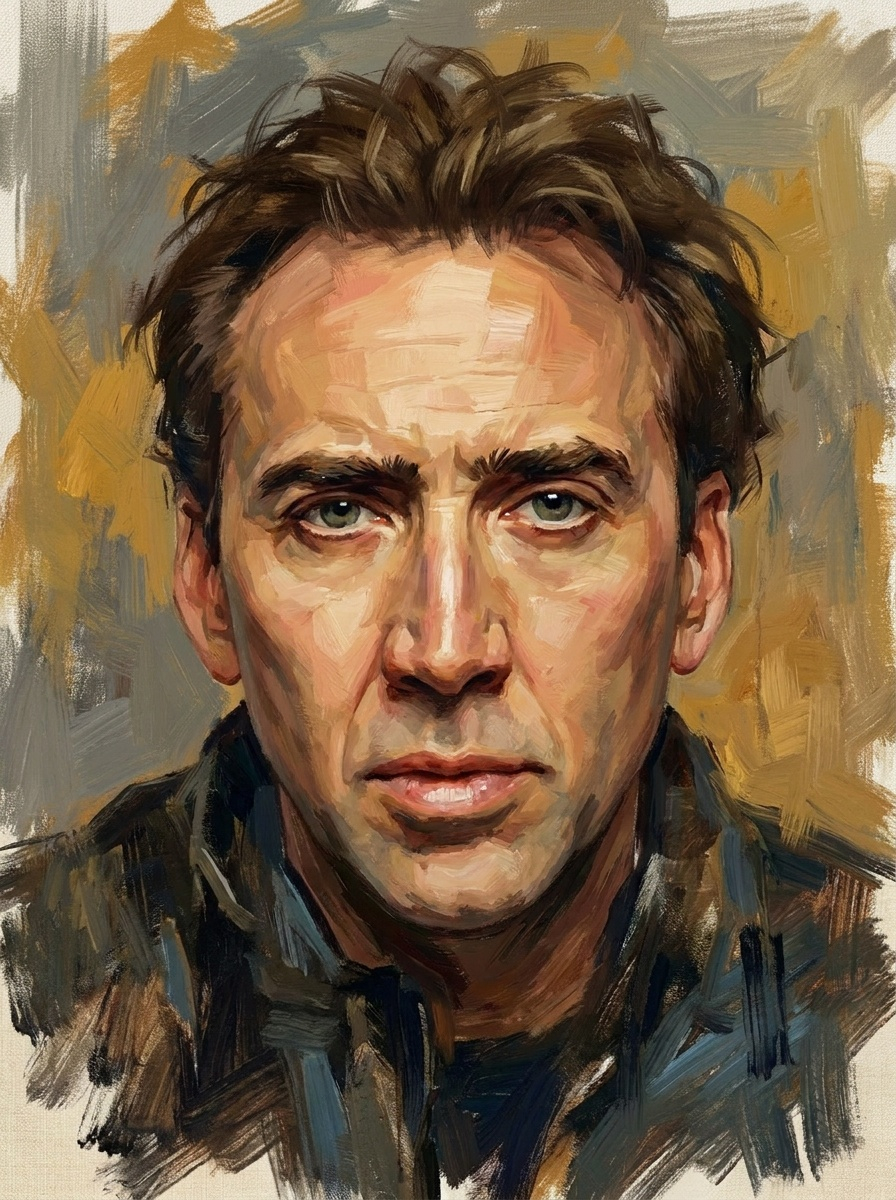
Nicolas CagePortrait · Nicolas Cage

From Coppola's Nephew to Hollywood's Own Genre

Born Nicolas Kim Coppola on January 7, 1964, in Long Beach, California — the nephew of Francis Ford Coppola, which was as much a burden as an advantage, and which he addressed by changing his surname to Cage before his career had begun, choosing the Marvel Comics character Luke Cage and the minimalist composer John Cage as his joint references. The name change was the first declaration of the aesthetic position he would maintain for forty years.

Fast Times at Ridgemont High (1982), Valley Girl (1983), and Birdy (1984) established the range before the mainstream was paying attention. Alan Parker's Birdy — Cage as Al Columbato, the Vietnam veteran trying to reach his catatonic friend — contains the first fully realised version of the expressionist performance style he would develop: the emotion at full intensity, nothing held back, the performance taking the same risks the character's situation describes.

Mike Figgis's Leaving Las Vegas (1995) — Cage as Ben Sanderson, the screenwriter who has decided to drink himself to death in Las Vegas and makes a deal with a prostitute that neither of them will try to save the other — is the performance that won the Academy Award and that remains the clearest statement of what his method can produce when the material matches the instrument. He reportedly immersed himself in alcoholic behaviour for months of preparation; the result is a performance of such specific physical commitment that the screen gravity of a dying man is completely credible.

The subsequent career divides observers — the action films (The Rock, Con Air, Face/Off, all 1996-97), the character films (Snake Eyes, 1998; Birdy, 1984), and the movies that seem to exist in a third category that only he inhabits. His theory of acting — which he calls "Nouveau Shamanic," drawing on German Expressionism and the idea of the actor as vessel rather than technician — is the most coherent aesthetic position in contemporary Hollywood, whether or not any particular film justifies it.
1964
Born Nicolas Coppola in Long Beach; changes name to Cage before debut
1984
Birdy — the expressionist style first fully visible; Parker; the instrument forming
1987
Moonstruck — Ronny Cammareri; the romantic comedy; Golden Globe nom
1995
Leaving Las Vegas — Ben Sanderson; Oscar won; the peak crystallised
1996–97
The Rock, Con Air, Face/Off — the action triptych; at full volume
1998
Snake Eyes — De Palma; the corrupt detective; the tracking shot
1984
Birdy — Parker; the expressionist style first fully visible; teeth removed

From Ben's Las Vegas to Charlie Kaufman's Twin

1995Drama · Mike Figgis · Elisabeth Shue
Leaving Las Vegas
Mike Figgis's Las Vegas drama — Cage as Ben Sanderson, the Hollywood screenwriter who has decided to drink himself to death and arrives in Las Vegas with that single purpose, making a deal with a sex worker that neither will try to save the other. The Academy Award. The most complete demonstration of what his expressionist method can produce when the material has the same commitment level as the instrument.
Oscar Won

Ben's quality — the man who has made peace with his own destruction and whose peace is the most disturbing thing about him — is played by Cage with a physical specificity that communicates the alcoholic's specific experience: the coordination, the cognition, the warmth that is also the dissolution. He spent months studying alcoholics and filming himself drinking to prepare; the preparation produced a performance so specific that the abstraction of dying becomes a concrete physical fact throughout the film's duration.

1998Neo-Noir Thriller · Brian De Palma · Gary Sinise
Snake Eyes
Brian De Palma's Atlantic City thriller — Cage as Rick Santoro, the corrupt Atlantic City detective working the night a heavyweight boxing match doubles as cover for the assassination of the Secretary of Defense. Cage at maximum expressionist volume in a De Palma film designed to exploit it: the crooked cop who talks too much and notices more than he lets on, operating inside the film's single-location real-time structure with the specific energy of someone who thrives under pressure and has something to hide.

Rick's quality — the corruption that is also a form of competence, the showmanship that conceals both the guilt and the intelligence — is played by Cage with the controlled excess that De Palma's baroque visual style requires and rewards. The opening ten-minute tracking shot — following Santoro through the arena in real time as he works the crowd, collects information, and performs himself — is the film's thesis statement: a corrupt man doing his job brilliantly, the job being inseparable from the corruption.

1984Drama · Alan Parker · Matthew Modine
Birdy
Alan Parker's post-Vietnam drama — Cage as Al Columbato, the young South Philadelphia man whose best friend Birdy (Matthew Modine) has retreated into catatonic silence in a military psychiatric ward, believing himself to be a bird. The first fully realised version of what would become the Cage expressionist style: Al's desperation to reach his friend played at full emotional intensity, the instrument taking the same risks the character's situation describes. He had teeth extracted for the role; he wore a bandage on his face for weeks to simulate wounds. The preparation at twenty was already absolute.

Al's quality — the extrovert trying to reach the introvert through the sheer force of presence, the practical man confronting something his practicality cannot resolve — is played by Cage with the specific quality that would define the career: the emotion at full volume, nothing withheld, the performance committed to the character's experience as completely as the experience itself. Parker recognised what he had and gave Cage the space to inhabit Al completely; the result is a performance of genuine tenderness inside an expressionist frame — the combination that Cage would spend the next forty years perfecting.

1987Romantic Comedy · Norman Jewison · Cher
Moonstruck
Norman Jewison's Brooklyn comedy — Cage as Ronny Cammareri, the one-handed baker who falls in love with his brother's fiancée (Cher) and declares it in terms of operatic extravagance. The Golden Globe nomination; the romantic lead performed at full Cage expressionism in a context that could accommodate it; the evidence that the instrument worked in comedy as completely as in tragedy.
Golden Globe Nom

Ronny's quality — the man whose entire existence has the intensity of a man who lost his hand and blames his brother and has been baking bread in grief ever since — is performed by Cage with the complete conviction that prevents the character's extremity from tipping into parody. "Loretta, I love you. Not like they told you love is, and I didn't know this either, but love don't make things nice — it ruins everything. It breaks your heart. It makes things a mess." The speech earns the emotion because the voice giving it has been carrying it the whole film.

"

I'm not a demon. I'm a lizard, a shark, a heat-seeking panther. I want to be Bob Denver on acid playing the accordion.

— Nicolas Cage

The Oscar — The Genre He Declared — Birdy and Snake Eyes

Academy Award — Best Actor
1996
Leaving Las Vegas
Won for Ben Sanderson — the alcoholic in terminal self-destruction, played with a physical specificity that makes abstraction concrete. The Academy Award confirmed what the critical establishment had been circling: that the expressionist method, applied to material of equivalent commitment, produces results that cannot be categorised as anything other than great acting.
Oscar Won
The Nouveau Shamanic Method
1982 – Present
A Declared Aesthetic
His term for his own acting approach — drawing on German Expressionism, the idea of the actor as vessel rather than technician, and a deliberate rejection of psychological naturalism in favour of something he describes as "Nouveau Shamanic." The coherence of the aesthetic position is more evident in retrospect than it appeared while he was building it, which is often how aesthetic positions work.
Nouveau Shamanic
Birdy & Snake Eyes — The Range Confirmed
2021
Al Columbato · Rick Santoro
Birdy (1984) and Snake Eyes (1998) bracket the career's range: the young Cage playing tenderness at full intensity for Alan Parker, and the mature Cage playing corruption as charisma for De Palma. Together they demonstrate that the Nouveau Shamanic method was never a single register but a complete instrument capable of opposite effects — the grief-stricken friend and the talking detective are as far apart as a career can stretch.
Career Reappraisal
The Name Change
1982
From Coppola to Cage
Changing his name from Coppola to Cage before his career began — citing Luke Cage and John Cage as his references — was the first and most consequential aesthetic declaration of his career. The refusal of the inherited advantage; the insistence on building the identity from scratch; and the specific references (a Marvel superhero, a minimalist composer) that encoded the whole career in a single name change.
The Name Declaration

The Full Volume — The Coherent Method — Birdy to Snake Eyes

Nouveau Shamanic
The term he uses for his own method — the actor as vessel rather than technician, the emotion at full intensity by design rather than by excess, the German Expressionist tradition applied to Hollywood product. The method is more coherent than the surrounding career has allowed critics to recognise, and Pig is the film that made the coherence undeniable.
The Full Range
From Leaving Las Vegas to Con Air to Birdy to Snake Eyes — the range is wider than any other actor of his generation attempted, and the consistency of the commitment across the full range is the career's specific achievement. He brings the same investment to Birdy that he brought to Ghost Rider; the results differ; the investment does not.
The Internet's Actor
He became a meme before meme was the term — the expressionism at full volume generating images that circulated outside their original context and became the shorthand for a certain kind of performance intensity. The meme culture simultaneously obscured and preserved his actual work: the GIFs are Cage without the films; the films are the argument that the GIFs were responding to something real.
The Volume as Choice
Pig demonstrated that the volume had always been a choice — that the instrument at minimum could do what it could do at maximum, that the quiet performance and the screaming one came from the same source. The demonstration retroactively reframes the screaming: not excess, but full commitment to the character's specific emotional register, which in Ben Sanderson and in Ghost Rider happen to be different registers requiring different volumes.

Ben's Las Vegas — Rob's Pig — The Most Interesting Actor in Hollywood

Nicolas Cage's legacy is the full commitment — the performance at the same intensity level as the character's situation, whether that situation is dying of alcoholism, losing a truffle pig, or parachuting into a federal penitentiary. One Academy Award, one coherent aesthetic method declared before the career began, and the most bewildering and genuinely interesting body of work produced by any actor in American cinema's last forty years.

Pig recalibrated the critical consensus: the quiet performance and the screaming one come from the same place. The meme culture responded to something real — an actor doing the thing at full volume, on purpose, by design, with a theory — and the theory is more defensible than forty years of surrounding noise had allowed critics to notice while they were busy being distracted by the noise.

Academy Awards Won
Leaving Las Vegas, 1996
1
Film Credits
1982 to present — and counting
100+
Name Changed From
Coppola to Cage, 1982
1
Movies Made in 2021 Alone
The pace has not slowed
7