Southsea, Hampshire · 1925 – 1980

PeterSellers

The Southsea comedian who played three roles simultaneously in Dr. Strangelove — including the President of the United States, a British RAF officer, and the deranged ex-Nazi scientist — who insisted he had no self of his own outside his characters, and whom Stanley Kubrick called the greatest actor in the world and the most frightening person he had ever met.

3
Roles in
Dr. Strangelove
2
Oscar
Nominations
54
Years
of Life
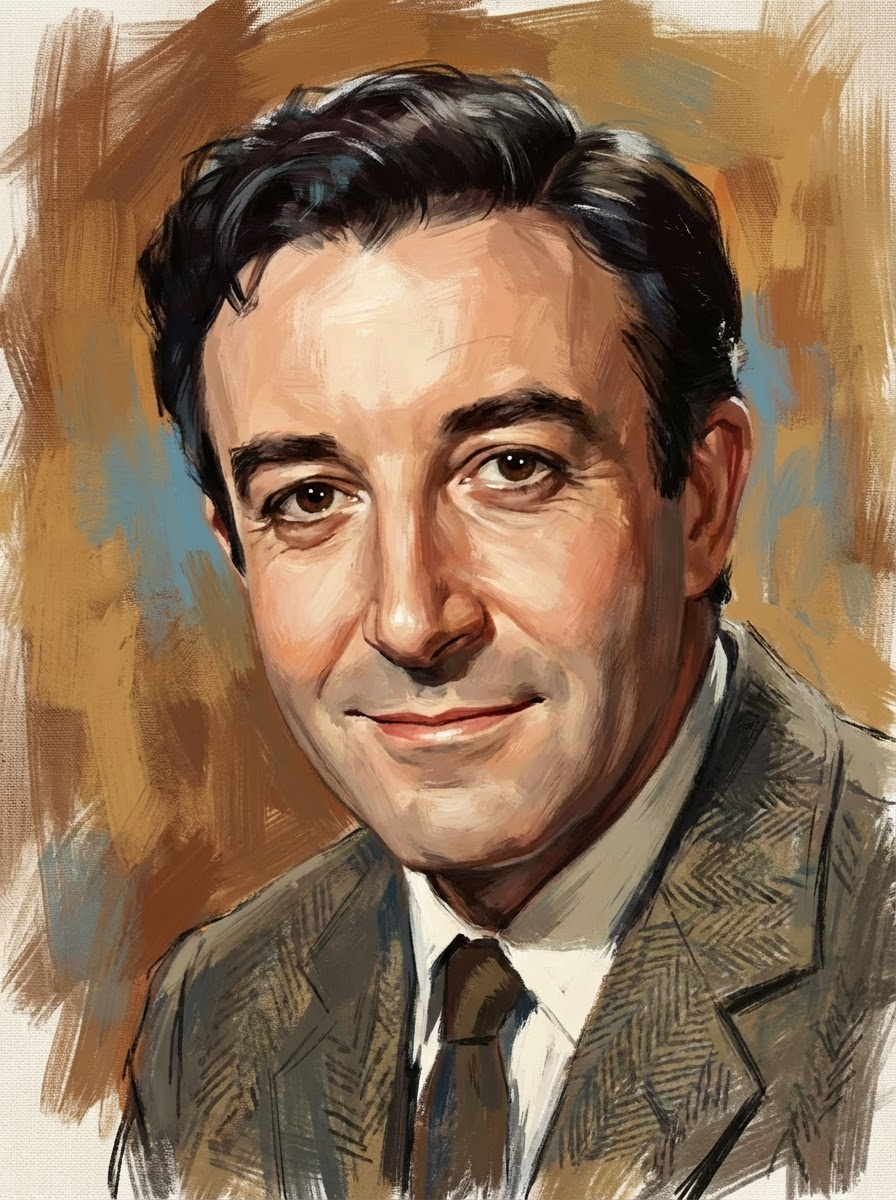
Peter SellersPortrait · Peter Sellers

From Goon to Strangelove's Triple Role

Born Richard Henry Sellers on September 8, 1925, in Southsea, Hampshire — the son of music hall entertainers, raised in the theatrical world, performing from childhood. He established himself in British radio as a member of The Goon Show (1951–1960) alongside Spike Milligan and Harry Secombe — the absurdist comedy programme that was simultaneously the most influential British radio show of the 1950s and the incubator for the kind of character transformation that his film career would exploit.

Stanley Kubrick's Dr. Strangelove or: How I Learned to Stop Worrying and Love the Bomb (1964) — Sellers playing Group Captain Lionel Mandrake (British RAF officer), President Merkin Muffley (American president), and Dr. Strangelove himself (ex-Nazi scientist) simultaneously — is the most sustained demonstration of character multiplication in cinema history. A fourth role, Major T.J. "King" Kong, was abandoned when Sellers broke his ankle; Slim Pickens took it. The Oscar nomination for Strangelove was for all three performances simultaneously — the Academy's acknowledgment that no single category could contain what had been done.

Blake Edwards's The Pink Panther (1963) introduced Inspector Jacques Clouseau — the French police inspector of catastrophic incompetence and granite self-confidence whose comedy depended entirely on Sellers's ability to make Clouseau's self-belief absolute. The character became the most commercially successful of his career and the least technically demanding: Clouseau was a fixed point around which the world arranged its disasters, where Strangelove had required three entirely distinct people.

Hal Ashby's Being There (1979) — Sellers as Chance the gardener, the intellectually simple man whose meaningless utterances are received as profundity — is the final major performance and arguably the most demanding: the character is blank, and Sellers had to fill the blankness with a quality so precisely calibrated that the audience and the characters surrounding him could project anything onto it. He received his second Oscar nomination and died eight months after the film's release, of a heart attack, on July 24, 1980.
1925
Born in Southsea; music hall family; performing from childhood
1951
The Goon Show — Milligan; Secombe; the absurdist foundation for the film career
1963
The Pink Panther — Clouseau; the commercial character; the franchise begins
1964
Dr. Strangelove — three roles; Kubrick; first Oscar nomination; the peak
1968
Heart attacks; near-death; years of recovery; the personal disintegration visible
1979
Being There — Chance; second Oscar nom; the career's final statement
1980
Dies of heart attack; age 54; told Kubrick he had no self outside his characters

From Strangelove's Three Faces to Chance's Garden

1964Political Satire · Stanley Kubrick · Three Roles
Dr. Strangelove
Kubrick's nuclear satire — Sellers playing Group Captain Mandrake (the reasonable British officer), President Muffley (the reasonable American president), and Dr. Strangelove himself (the unreasonable everything else) simultaneously, in the same film, without the seams showing. The Oscar nomination for all three at once. The most concentrated demonstration of character multiplication in cinema history, accomplished in collaboration with a director who understood exactly what he had.
Oscar Nom

The three characters' quality — each distinct from the others in voice, posture, psychology, and relationship to the film's central catastrophe — required Sellers to be three people in the same production without the characters ever bleeding into one another. Kubrick shot the film in sequence and allowed extensive improvisation within the structure; the improvisation produced the arm that Dr. Strangelove cannot control, the specific laugh, the specific terror — all found in the moment, all kept because Kubrick recognised what they were.

1979Drama · Hal Ashby · Jerzy Kosinski
Being There
Hal Ashby's Kosinski adaptation — Sellers as Chance the gardener, the intellectually simple man who has spent his entire life watching television and tending a garden, and who is released into the world where his empty utterances are received as profound wisdom by people desperate to hear wisdom. The second Oscar nomination; the most technically demanding performance of his career; the blank onto which the film's satire is projected.
Oscar Nom

Chance's quality — the absolute absence of inner life that reads as depth to everyone surrounding him — is the most precisely calibrated of his performances: too much and the satire becomes obvious; too little and the character becomes unwatchable. Sellers plays Chance at a temperature so exactly neutral that the film's argument about American politics and the projection of meaning onto emptiness works completely — we understand why everyone sees wisdom in Chance because Sellers never gives us a reason to see anything else.

1963Comedy · Blake Edwards · David Niven
The Pink Panther
Blake Edwards's heist comedy — Sellers as Inspector Jacques Clouseau, the French police inspector of catastrophic incompetence and absolute self-certainty, investigating the theft of the Pink Panther diamond. The most commercially successful character of his career; the one that generated five sequels and a franchise that outlasted his death; and the purest demonstration of his ability to maintain a character's internal logic regardless of what the world was doing around it.

Clouseau's quality — the incompetence so complete it has achieved a kind of grace, the self-belief so absolute it functions as a force field — is played by Sellers with the specific commitment that separates the character from mere buffoonery. Clouseau never knows he has failed; his relationship to his own catastrophes is always one of dignified puzzlement at the world's inexplicable resistance to his genius; and the comedy lives entirely in the gap between his self-perception and the reality that the rest of the film inhabits.

1960Drama · Bryan Forbes · British New Wave
The Optimists of Nine Elms / Only Two Can Play
Bryan Forbes's Welsh comedy-drama — Sellers as John Lewis, the assistant librarian in a Welsh town whose fantasy life is considerably more ambitious than his actual circumstances. The performance that first demonstrated his range to the critical establishment; the Welsh accent and mannerisms built from observation rather than type; and the warmth beneath the comedy that prevented it from becoming condescending.

John Lewis's quality — the ordinary man whose imagination has outrun his circumstances and who has made a specific peace with the gap — is played by Sellers with the warmth that Clouseau and Strangelove, for all their brilliance, would never require. The performance demonstrated that the transformative technique had a register beyond comic exaggeration — that it could produce characters of genuine sympathy who remained recognisably themselves rather than demonstrations of the actor's range.

"

If you ask me to play myself, I will not know what to do. I do not know who or what I am.

— Peter Sellers

Two Nominations — Three Characters Simultaneously — The Man Without a Self

Oscar Nomination — Best Actor
1965
Dr. Strangelove
Nominated for all three roles simultaneously — the Academy's way of acknowledging that what had been done in one film could not be contained in the usual framework of a single nominated performance. The nomination was unprecedented in its scope; the fact that it was for a comedy, in 1965, when the Academy had not yet developed language for what Kubrick and Sellers had done, makes it more remarkable.
Three Roles — One Nomination
Oscar Nomination — Best Actor
1980
Being There
Nominated for Chance — the blank, the absence, the performance of nothing that required more control than any exuberant character he had created. The nomination confirmed that the industry recognised what Being There had done; the film's argument about the projection of wisdom onto emptiness was, by 1980, as timely as it had been when Kosinski wrote the novel.
Oscar Nominated
The Goon Show
1951 – 1960
The Foundation
The Goon Show — nine years of absurdist radio comedy alongside Spike Milligan and Harry Secombe, performing multiple characters per episode, developing the vocal transformation technique that the film career would exploit. The show was simultaneously the most popular radio programme in Britain and the most artistically radical; the two qualities being, in this case, the same quality.
The Foundation
Kubrick's Assessment
1964
The Greatest Actor in the World
Stanley Kubrick called Sellers the greatest actor in the world and the most frightening person he had ever worked with — frightening because of the completeness of the transformation, the absence of a stable self beneath the characters, the sense that what was performing was not a person but something that inhabited persons. The assessment is both a tribute and a diagnosis.
Kubrick's Verdict

The Absent Self — Three Roles at Once — Clouseau's Grace

No Self of His Own
He told interviewers and colleagues repeatedly that he had no self outside his characters — that if asked to play himself, he would not know what to do. The claim was simultaneously the key to the technique and its cost: the total availability that made three Strangeloves possible also made a stable personal life impossible. Four marriages; chronic heart problems; a personal life conducted at the same intensity as the performances.
The Three Roles
Mandrake, Muffley, Strangelove — three entirely distinct characters in one film, played simultaneously by one actor. The technical achievement has no equivalent in cinema. The fourth character, Major Kong, was abandoned when he broke his ankle; the three that remain are sufficient to make the point. Kubrick originally conceived the film as a thriller; Sellers's characters turned it into the comedy it became.
Clouseau's Longevity
Inspector Clouseau — the commercially successful character that Sellers resented even as it funded his career, that outlasted his death in five sequels and a remake, and that represents the most widely distributed version of his genius. The comedy is structurally perfect: a man who cannot fail because he does not recognise failure, surrounded by a world that cannot stop failing around him.
The Heart Attacks
He suffered a series of heart attacks in 1964, aged thirty-eight, from which he recovered over several years — the recovery marked by personal instability, professional difficulty, and the specific anxiety of an actor who has found his technique at the cost of finding himself. Being There, made fifteen years later, is the final statement: Chance's blankness played by a man who had spent his career filling blankness with other people.

Strangelove's Arm — Clouseau's Dignity — Chance's Garden

Peter Sellers's legacy is the absence at the centre of the technique — the man who had no self outside his characters and who made that absence the most productive artistic resource in British comedy. Three roles in Dr. Strangelove; Inspector Clouseau across five films; Chance the gardener at the end; and the specific quality that Kubrick identified as both greatness and terror: the completeness of the transformation, the absence of a stable self beneath it.

He died at fifty-four having never resolved the question of who he was outside the characters. The question was the work; the work was the answer. Strangelove's uncontrollable arm reaching upward; Clouseau's dignified puzzlement at the world's incompetence; Chance watching television with the same equanimity he brings to everything — three images from three films, one actor, no self connecting them except the technique itself.

Roles in Dr. Strangelove
1964 — Kubrick
3
Oscar Nominations
Strangelove · Being There
2
Goon Show Years
1951 to 1960
9
Age at Death
Heart attack, July 24, 1980
54