The New York City actor who gained sixty pounds to play Jake LaMotta, drove a cab for a month to play Travis Bickle, learned the Sicilian dialect of Italian to play the young Vito Corleone, and established a standard of physical and psychological preparation for American screen acting that every subsequent actor has been measured against — whether or not they wanted to be.
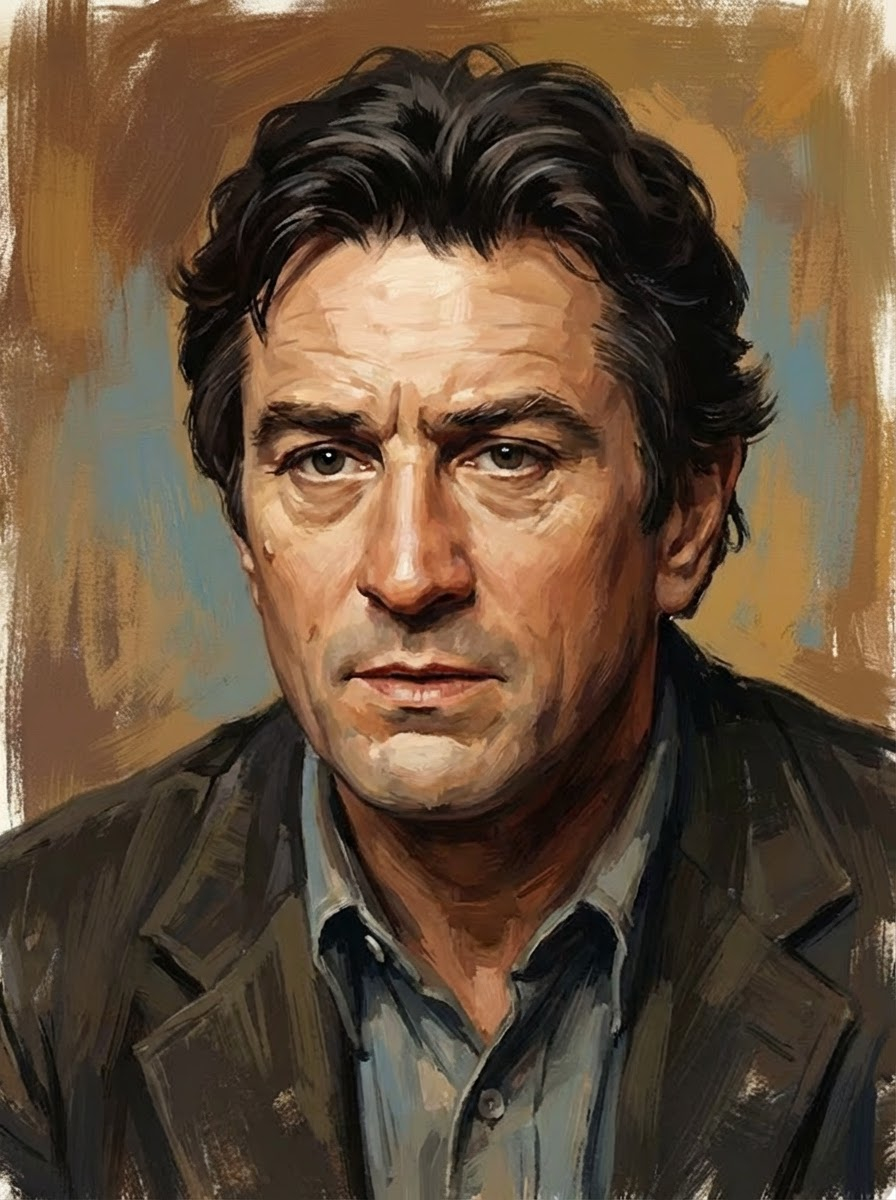
Portrait · Robert De NiroBorn Robert Anthony De Niro Jr. on August 17, 1943, in Greenwich Village, New York — the son of two painters, raised in Little Italy after his parents' divorce, educated in the street environment that would inform every subsequent New York performance. He studied acting under Stella Adler and at the Actors Studio, developing the physical preparation and psychological research methodology that would define his career.
Francis Ford Coppola's The Godfather Part II (1974) — De Niro as the young Vito Corleone, the same character Marlon Brando had played as an old man in the original film — won him his first Oscar and required him to learn the Sicilian dialect of Italian from scratch, since the young Vito had not yet learned English. The performance had to simultaneously be its own thing and be recognisably the same person Brando had played. That it accomplished both is the most complete demonstration of the preparation's value in his filmography.
Martin Scorsese's Taxi Driver (1976) — De Niro as Travis Bickle, the Vietnam veteran turned New York cab driver whose alienation curdles into violence — is the film that established both the Scorsese-De Niro collaboration and the specific performance style: the body inhabited at the molecular level, the psychology built from the outside in and from the inside out simultaneously, the mirror scene improvised.
Scorsese's Raging Bull (1980) — De Niro as Jake LaMotta, the middleweight champion whose self-destructive rage is the film's entire subject — required him to gain sixty pounds after filming the boxing sequences to play LaMotta in middle age. He won his second Oscar. The preparation is the most-cited example of physical commitment in American screen acting; the performance is the most-cited example of what the preparation produces when the material is equal to it.
LaMotta's quality — the man whose rage has no external cause and is therefore total — is played by De Niro with the specific physical reality of a man who has lived in that body for months. The later scenes — the fat LaMotta in the Catskills, the nightclub comedy act, the jail cell — are the performance's fullest expression: the rage with nowhere to go, contained in a body that has lost the form that gave it purpose, and still burning.
Travis's quality — the man whose isolation is so complete it has become its own logic, a world in which he is both audience and hero — is played by De Niro with the specific flatness that makes the character's eventual explosion fully prepared and completely surprising. "You talkin' to me?" — the mirror scene, improvised by De Niro against his own reflection because the script said only "Travis talks to himself in the mirror" — is the most analysed improvisation in American screen acting and the performance's defining moment.
The young Vito's quality — the specific silence of a man who has decided what he will do and is waiting for the right moment — is played by De Niro with the stillness that Brando's older Vito had earned through a lifetime of choices, here being chosen for the first time. His Italian-American audiences in 1974 could hear the Sicilian dialect and recognise it as authentic; the authenticity was the preparation; the preparation was the point.
McCauley's quality — the professional so complete that nothing remains of the person the profession was built on — is played by De Niro with the specific coldness of someone who has resolved all ambivalence in favour of the work. The diner scene with Pacino — two actors who had been compared for twenty years finally sharing a table — is played as a conversation between two equals who recognise each other and know that recognition changes nothing about what they will do when they leave the restaurant.
The talent is in the choices.
Robert De Niro's legacy is the standard — the preparation methodology and what it produced in nine Scorsese films and The Godfather Part II and Heat, and the way those productions redefined what American screen acting was expected to be. Two Oscars, eight nominations, sixty pounds gained for one role, a month in a New York cab for another, a dialect learned from scratch for a third — and "You talkin' to me?" improvised in a mirror when the script ran out of words.
Travis Bickle, Jake LaMotta, the young Vito Corleone, Neil McCauley — four characters from four films, all built by the same methodology, all doing things the preparation made possible and that the performance made necessary. The standard he set is the standard the next generation of American actors trained against: the question every preparation asks is how far you are willing to go, and the answer De Niro gave was: as far as the character requires, and then a little further.