The Santa Monica golden boy who partnered with Newman to define the buddy picture, won Best Director for Ordinary People, and then quietly became something more lasting than a movie star — the founder of Sundance, the man who built a mountain in Utah into the infrastructure for independent American cinema, and who changed the industry more profoundly as an institution-builder than he ever had as a performer.
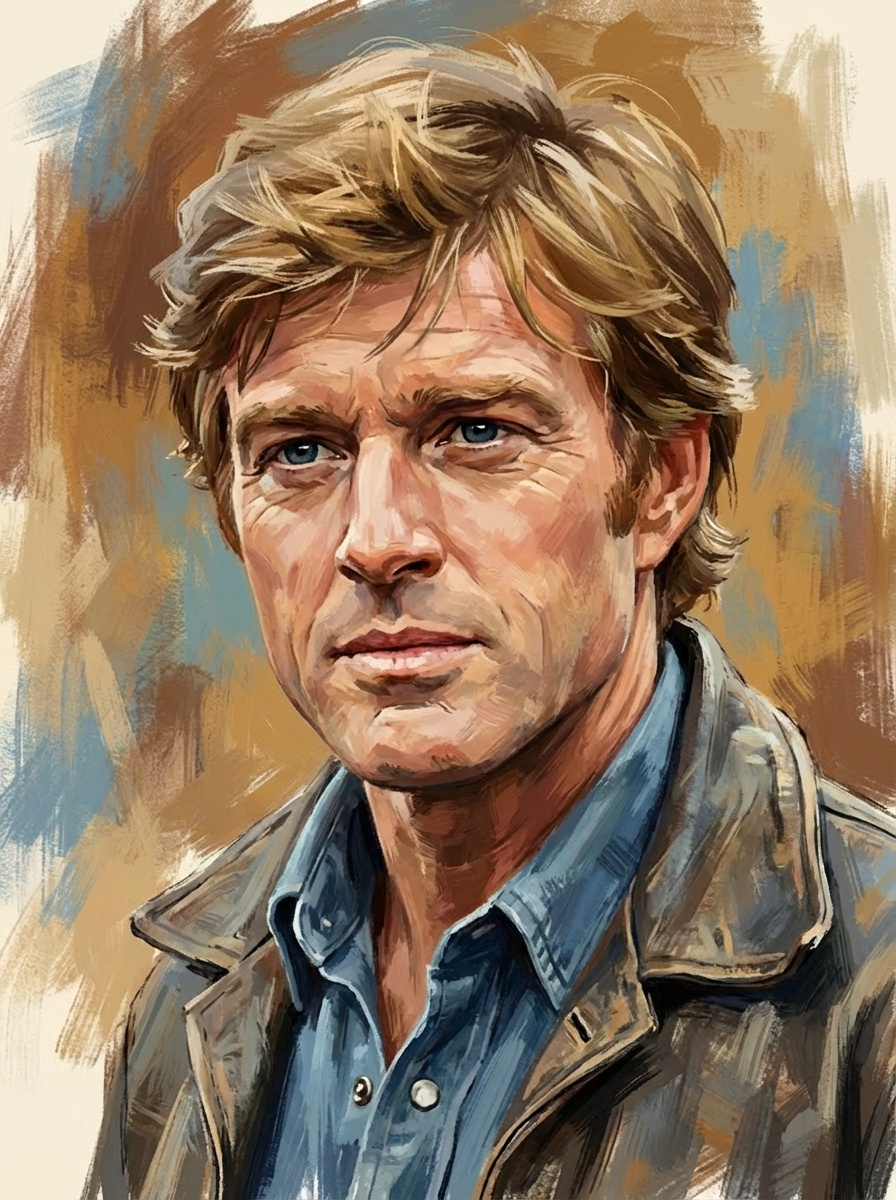
Portrait · Robert RedfordBorn Charles Robert Redford Jr. on August 18, 1936, in Santa Monica, California — the son of an accountant and a mother who died when he was eighteen, a young man who received an art scholarship to the University of Colorado, lost it through indifference, drifted through Europe painting, and eventually found his way to the American Academy of Dramatic Arts in New York. He established himself on Broadway before transitioning to film.
George Roy Hill's Butch Cassidy and the Sundance Kid (1969) — Redford as the Sundance Kid, opposite Paul Newman's Butch Cassidy — made him a star and established the specific quality that would define the actor career: the ease and the competence, the man who is good at things without needing you to know he is good at them. The Newman-Redford chemistry generated one of the most commercially successful films of the year; Newman and Redford would reunite for Hill's The Sting (1973).
Sydney Pollack's All the President's Men (1976) — Redford as Bob Woodward, opposite Dustin Hoffman's Carl Bernstein, the two Washington Post journalists who broke Watergate — is the most politically significant film of his acting career and the clearest demonstration of the quality beneath the golden exterior: the specific intelligence of a man doing a job carefully, without drama, because the job matters.
His directorial debut, Ordinary People (1980) — the Judith Guest adaptation about a suburban family's disintegration after the death of one son — won him the Academy Award for Best Director over Martin Scorsese's Raging Bull. The Sundance Institute, which he had founded in 1978 on his Utah property, grew into the Sundance Film Festival — the most important platform for independent American cinema and the launch site for dozens of careers including Steven Soderbergh, Quentin Tarantino, and Park Chan-wook's American distribution.
Sundance's quality — the man whose skills are genuine and whose modesty about them is equally genuine — is played by Redford with the ease that would define the acting career. The opening card game, in which Sundance's reputation does all the work and Sundance watches it work without false modesty, establishes the character completely: the competence is real; the reputation is accurate; and the man behind both is simply waiting to see what the situation requires.
Woodward's quality — the reporter whose persistence is not dramatic but procedural, who keeps knocking on doors because that is what the job requires — is played by Redford with the specific steadiness that the political thriller demands: the man who understands that the story is larger than the storyteller and who proceeds accordingly. The parking garage scenes — Woodward meeting Deep Throat — are the film's set pieces, played by Redford as the professional receiving intelligence, not the hero having an adventure.
The direction's quality — the restraint that matches the subject's restraint, the refusal to show the pain more clearly than the characters would show it to each other — is the film's central argument. Mary Tyler Moore's performance as the mother who cannot grieve, allowed and guided by Redford's direction, is the finest work of both their careers: the woman whose control is indistinguishable from coldness, playing a real distinction that the film refuses to resolve into either.
Hooker's quality — the intelligence that works best when it is not noticed — is played by Redford with the lightness that the comedy requires and the precision that the thriller demands. The film is constructed as a series of reveals, each of which reframes what the audience thought it understood; Redford's performance is built the same way — you think you have understood Hooker, and then you discover you have understood only what he chose to show you.
It's not who I am underneath, but what I do that defines me. No wait — that's Batman.
Robert Redford's legacy is Sundance — the institution that changed American cinema more profoundly than any individual film he made as actor or director. One Academy Award for directing, an honorary Oscar for the institution, a Presidential Medal of Freedom, and the specific achievement of building a platform for independent cinema on a Utah mountain that had no infrastructure and becoming, over forty years, the industry's most important alternative pathway to production and distribution.
The Newman partnership, the Pakula political thriller, the directorial career that began with one of the decade's most debated Oscar wins — all of it is real and all of it matters. But the films will be shown at Sundance long after the arguments about Ordinary People versus Raging Bull have stopped being interesting, and the careers launched by the institution will generate films long after the last print of Butch Cassidy has worn through. The mountain is the legacy; the institution is the mountain.