Chicago, Illinois · 1951 – 2014

RobinWilliams

The Chicago-born comedian who grew up in San Francisco, studied at Juilliard alongside John Lithgow and Christopher Reeve, improvised his way through Mork & Mindy into film stardom, won an Oscar for sitting on a park bench in Good Will Hunting, and gave a generation of teachers the phrase "O Captain, My Captain" — gone at sixty-three, his speed and warmth unmatchable, his loss still felt.

1
Academy Award
Won
5
Grammy
Awards
63
Years
of Life
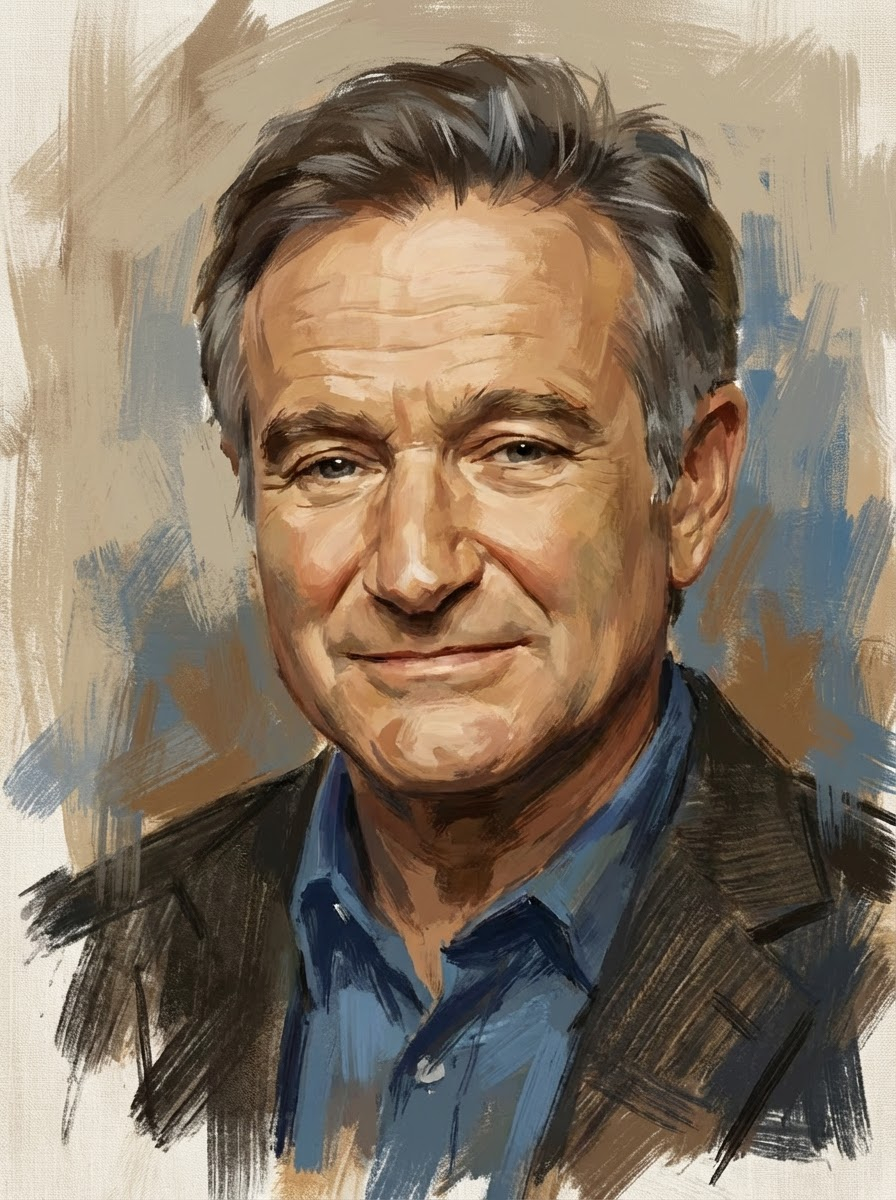
Robin WilliamsPortrait · Robin Williams

From Mork to the Park Bench in Good Will Hunting

Born Robin McLaurin Williams on July 21, 1951, in Chicago, Illinois — the son of a Ford Motor executive and a model, raised in a large house in Bloomfield Hills, Michigan, a shy child who found his voice in comedy. He attended Julliard on a full scholarship (one of twenty students accepted that year, alongside John Lithgow and Christopher Reeve) before dropping out when his teacher told him he had nothing more to learn there, and heading to San Francisco's comedy scene.

Mork & Mindy (1978–1982) — Williams improvising sixty percent of each episode as the alien Mork from Ork — established a television stardom based entirely on the improvisational speed that would become his signature: the ability to produce associations faster than a writer could plan them, sustain the production for hours, and find the exact right gear ratio between genuine wit and performed chaos. John Belushi had discovered him at a comedy club and recommended him to Garry Marshall; the show ran four seasons.

Gus Van Sant's Good Will Hunting (1997) — Williams as Sean Maguire, the therapist who reaches a damaged genius (Matt Damon) by refusing to be impressive and by being genuinely present — won him the Academy Award for Best Supporting Actor. The park bench monologue; the "it's not your fault" scene; and the specific quality of warmth that the comedic career had always contained but that the dramatic roles required it to be the whole instrument.

He died on August 11, 2014, in Paradise Cay, California, by suicide. He was sixty-three. The career he left behind is the fullest evidence of what the speed and the warmth, sustained together across thirty-five years, can produce.
1951
Born Chicago; shy child; Juilliard; San Francisco comedy scene
1978
Mork & Mindy — sixty percent improvised; four seasons; the speed established
1987
Good Morning, Vietnam — first Oscar nomination; the comedy-drama range revealed
1989
Dead Poets Society — O Captain; Keating; second nomination
1993
Mrs. Doubtfire — the comedy peak; the warmth at full power
1997
Good Will Hunting — park bench; Oscar won; the dramatic range confirmed
2014
Dies age 63; August 11, 2014; the warmth and speed that the world had come to rely on

From Keating's Desk to Maguire's Park Bench

1997Drama · Gus Van Sant · Matt Damon · Ben Affleck
Good Will Hunting
Gus Van Sant's Boston drama — Williams as Sean Maguire, the therapist whose own damage makes him the only person capable of reaching a self-destructive genius (Damon) who has used his intelligence as a weapon against anyone who gets close. The Academy Award; the park bench monologue; and the performance that demonstrated the warmth that had always been present in the comedy was, deployed in a dramatic context, one of the most powerful instruments in American film.
Oscar Won

Sean's quality — the therapist who reaches the genius not by being smarter but by being genuinely present, who refuses to be impressed because he has done his own work — is played by Williams with the specific stillness that the comedic career had never required and that revealed how much more of the instrument existed beneath the speed. "It's not your fault" — repeated six times, sustained by Williams without sentimentality or manipulation, until it becomes the scene the film has been building toward — is the Oscar moment and the career's most fully realised dramatic beat.

1989Drama · Peter Weir · Dead Poets Society
Dead Poets Society
Peter Weir's prep school drama — Williams as John Keating, the English teacher who uses poetry to teach boys how to think for themselves in an institution designed to prevent it. The second Oscar nomination; the "O Captain, My Captain" moment; and the specific quality of inspired teaching played by the man best qualified to understand what it means to find an audience and refuse to lose them.
Oscar Nom

Keating's quality — the teacher whose love of poetry is genuine and whose pedagogical method is designed to transmit the genuineness rather than the knowledge — is played by Williams with the warmth and the speed simultaneously: the comedy teacher who actually knows the poems and who needs the students to know that knowing the poems matters. "O Captain, My Captain" — the students standing on their desks as Keating is expelled — is one of American cinema's most reproduced final images, and it works because Williams has spent the film making Keating worth standing for.

1987War Comedy-Drama · Barry Levinson · Adrian Cronauer
Good Morning, Vietnam
Barry Levinson's Vietnam War comedy-drama — Williams as Adrian Cronauer, the Air Force DJ whose improvisational broadcasts on Armed Forces Radio brought real comedy and real music to soldiers in Saigon, and whose refusal to broadcast approved content put him in conflict with the military establishment. The first Oscar nomination; the most direct use of the improvisational speed in a dramatic context; and the performance that introduced film audiences to what the stand-up audiences already knew.
Oscar Nom

The radio broadcasts — fully improvised by Williams within the structure of the script — are the film's justification: the comedy that the soldiers needed and that the military feared, delivered at the speed that only Williams could sustain. The film's argument — about the relationship between comedy and truth, about the military's fear of both, about what a voice on a radio can do for people who need to laugh — runs entirely through the broadcasts, which are the performance's most concentrated expression of what the instrument could do at full power.

1993Comedy · Chris Columbus · Sally Field
Mrs. Doubtfire
Chris Columbus's family comedy — Williams as Daniel Hillard, the divorced father who disguises himself as a Scottish nanny to remain in his children's lives. The most commercially successful film of his career and the comedy that demonstrated the warmth at full power: the father whose love for his children is so complete that he is willing to spend twelve hours a day in latex and a Scottish accent rather than see them less.

Daniel/Mrs. Doubtfire's quality — the father whose love has not been disciplined into wisdom but remains generous and overwhelming, the man who has failed at everything except knowing what matters — is played by Williams without the speed as the primary register; the comedy is warm rather than fast, the character's central impulse protective rather than performative. The transformation sequences — the forty-five minutes it took to apply the makeup each day, filmed as Williams improvised through them — are the comedy's technical foundation: the effort that the character makes willingly, because the effort is what love looks like when it has nowhere else to go.

"

You're only given a little spark of madness. You mustn't lose it.

— Robin Williams

One Oscar — Five Grammys — O Captain My Captain

Academy Award — Best Supporting Actor
1998
Good Will Hunting
Won for Sean Maguire — the park bench, "it's not your fault," the specific stillness that the comedic career had never required. The Academy's recognition that the instrument was larger than the speed, that the warmth that had made the comedy work was also capable of making a dramatic performance the most affecting in the year. He thanked his three nominations and everyone who had already given up on him.
Oscar Won
Five Grammy Awards
1979 – 2003
Best Comedy Recording
Five Grammy Awards for Best Comedy Recording across twenty-five years — the industry's sustained recognition of the stand-up career that was the foundation of everything. The Grammy audiences heard what the television audiences saw and what the film audiences benefited from: the speed, the associations, the specific quality of a mind that moved faster than any writer could plan and landed every time on something real.
Five Grammys
Four Oscar Nominations
1987 – 1998
Good Morning Vietnam · Dead Poets · Fisher King · Good Will
Four nominations across eleven years — Good Morning, Vietnam (1988); Dead Poets Society (1990); The Fisher King (1992); Good Will Hunting (1998). The range of the nominations reflects the range of the dramatic career: the comedian doing drama, doing drama about teaching, doing drama about grief and madness, and finally winning for the drama about being genuinely present for someone who needed it.
Four Nominations
The USO and Humanitarian Work
1990s – 2014
Decades of Service
Throughout his career Williams performed dozens of USO tours for American troops overseas, bringing the improvisational speed and warmth to audiences in combat zones who had the greatest need for it. He was consistently among the most requested performers in USO history. He also donated extensively to St. Jude's Children's Research Hospital and other charitable causes, the generosity as unconditional as the comedy that funded it.
USO · St. Jude's

The Speed — The Warmth — The Darkness Beneath Both

The Speed
The improvisational speed was the career's public face — the associations produced faster than a writer could plan them, the voices and the references and the connections sustained for hours on stage, sixty percent of Mork & Mindy improvised per episode. The speed was real; it was also the instrument's most visible surface. The warmth was underneath it, and more durable.
The Warmth
The warmth — the quality that made the comedy feel like a gift rather than a performance, that made the dramatic roles feel like the same person who had been making you laugh — was the instrument's centre. Keating teaching poetry; Maguire refusing to be impressive; Doubtfire applying latex for twelve hours a day: the warmth is the same in all three, expressed in three different registers.
The Darkness
The substance abuse, the depression, the three marriages — the darkness was as real as the speed and the warmth, and generated the same intensity. The comedians who knew him spoke consistently of the specific quality of his suffering: as fast and as total as his joy, and impossible to separate from it. He carried it alongside everything else, and the carrying was part of what produced the work.
The Juilliard Foundation
One of twenty students accepted to Juilliard in 1973 — alongside John Lithgow and Christopher Reeve. He left when his teacher told him he had nothing more to learn there, and headed to San Francisco's comedy scene. The training was real; it was the foundation on which the improvisational career was built; and it is the explanation for why the dramatic roles worked as well as they did — the speed was built on a classical instrument.

The Park Bench — O Captain — The Spark of Madness

Robin Williams's legacy is the warmth that the speed delivered — the specific quality that made the comedy feel like a gift and the drama feel like the same gift in a different register. One Oscar, five Grammys, four nominations, Good Morning Vietnam and Dead Poets Society and Good Will Hunting and Mrs. Doubtfire, and the stand-up recordings that remain the best evidence of what the speed sounded like when it had a stage and an audience and nowhere to go but forward.

He was sixty-three when he died. The man who gave teachers "O Captain, My Captain" and gave a generation of children the Genie and gave Matt Damon the park bench — his absence is the career's final argument for what the warmth was worth. The speed and the warmth together, for thirty-five years: the gift was real and it was given completely.

Academy Award
Good Will Hunting, 1998
Won
Grammy Awards
Best Comedy Recording
5
Oscar Nominations
1988 to 1998
4
Age at Death
August 11, 2014
63