The Bahamian-born son of tomato farmers who arrived in New York City barely literate, learned to read from a Jewish waiter who helped him study scripts aloud, and became the first Black actor to win the Academy Award for Best Actor — changing what American cinema was permitted to say about race, dignity, and possibility across three decades of work that had no precedent and no ceiling.
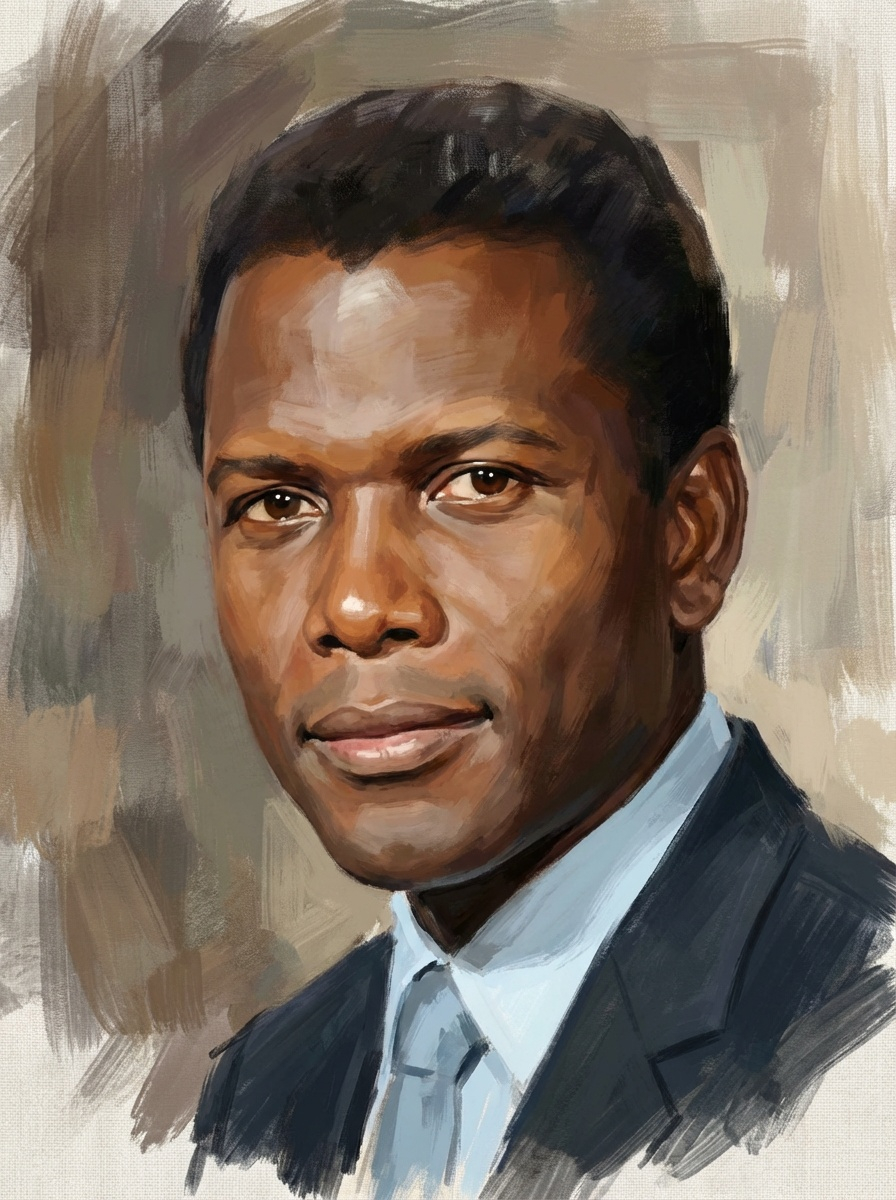
Portrait · Sidney PoitierBorn on February 20, 1927, in Miami, Florida — two months premature during a visit by his Bahamian parents — and raised in the Cat Island and Nassau communities of the Bahamas, the youngest of seven children of tomato farmers. He arrived in New York City at fifteen largely without formal education, found work as a dishwasher, and auditioned for the American Negro Theatre. When the director dismissed him for his Bahamian accent and his near-illiteracy, a Jewish waiter named Nathan offered to help him practice reading scripts aloud. He returned to the audition and was accepted.
His breakthrough came with Joseph L. Mankiewicz's No Way Out (1950), playing Dr. Luther Brooks, a Black physician treating a white racist patient — a role that established the template for the Poitier career: the Black man of absolute dignity, competence, and moral authority in situations designed by racism to deny him all three. The template was politically necessary in 1950 and politically complicated in retrospect; what is indisputable is that it worked, that the audiences who saw the films were changed by them, and that he carried the template with a commitment and an intelligence that never allowed it to become a type.
Ralph Nelson's Lilies of the Field (1963) — Poitier as Homer Smith, the itinerant handyman who is persuaded by a group of German immigrant nuns to build them a chapel — won him the Academy Award for Best Actor, making him the first Black actor to receive the honour. In 1967, the same year, he appeared in three of the most commercially and critically significant films of the decade: In the Heat of the Night, Guess Who's Coming to Dinner, and To Sir, with Love. The three films collectively constituted the most sustained cultural intervention in American cinema's engagement with race.
He died on January 6, 2022, in Los Angeles, aged ninety-four. He had served as the Bahamian Ambassador to Japan and to UNESCO. He received the Presidential Medal of Freedom from President Obama in 2009.
Tibbs's quality — the professional dignity that is also a political act in a state that has legislated against it — is played by Poitier with the specific control of someone who has spent a career measuring exactly how much of the anger is permitted to show. The slap — Tibbs striking the white plantation owner who has struck him first, in 1967 Mississippi, on American cinema screens — is the decade's most political single gesture in film: the Black character who does not absorb the violence but returns it, and who is right to do so.
Homer's quality — the man whose generosity is also stubbornness, whose competence is also a form of grace — is played by Poitier with the lightness that the film's comedy required and the seriousness that the film's subject deserved. The chapel built by one man's hands across the course of the film — the physical labour made visible in every shot of the construction — is the argument the film makes about what a person can give when the project is worthy of the giving.
John's quality — the man whose excellence must be absolute to be permitted to be ordinary — is played by Poitier with the specific awareness of what the role was doing and what it cost. The film's argument — that the liberal parents' liberalism is tested by a situation their liberalism had not prepared them for — is carried by Hepburn and Tracy; the film's political impact is carried by Poitier, who had understood that the role required him to make a certain kind of demand on the audience's sympathy, and who made it.
Noah's quality — the man whose justified rage at his situation must be redirected into the shared project of survival — is played by Poitier as the more complex of the two characters: Curtis's racist has a trajectory from hatred to respect; Noah's has a more difficult arc, which is the journey from legitimate contempt to a recognition that the chain is also a kind of bond. The film's final image — Poitier leaving the train to stay with the injured Curtis — is the most debated ending in the Poitier filmography: sacrifice or solidarity, the audience decides.
I always wanted to be someone better the next day than I was the day before.
Sidney Poitier's legacy is the first — the first Black actor to win Best Actor, in 1964, thirty-seven years after the first Academy Awards — and what the first produced: a generation of Black performers who existed in an industry his work had helped make possible, in films his template had helped make permissible. One Oscar, one Honorary Oscar, a Presidential Medal of Freedom, and the specific achievement of a career conducted under conditions that no subsequent actor has had to navigate in the same way.
The slap in In the Heat of the Night — Tibbs returning the plantation owner's blow — is the career's most concentrated political image: the Black character who does not absorb the violence of racism but responds to it, in 1967 Mississippi, on American cinema screens nationwide. It is a gesture in a film, and it changed what American cinema was permitted to say. The man who made it spent thirty years earning the right to be in the room, and he used that right the moment it mattered most.