Naples, Italy · Born 1934

SophiaLoren

The Naples-born daughter of an unmarried mother who arrived in Rome with nothing, entered beauty contests, caught Vittorio De Sica's eye, and became the only actress to win the Academy Award for a foreign-language performance — Cesira in La Ciociara — demonstrating that the neorealist tradition of wartime Italy could produce drama as complete as anything Hollywood had ever made.

1
Oscar Won
(Foreign Language)
2
Honorary
Oscars
90
Years
of Life & Counting
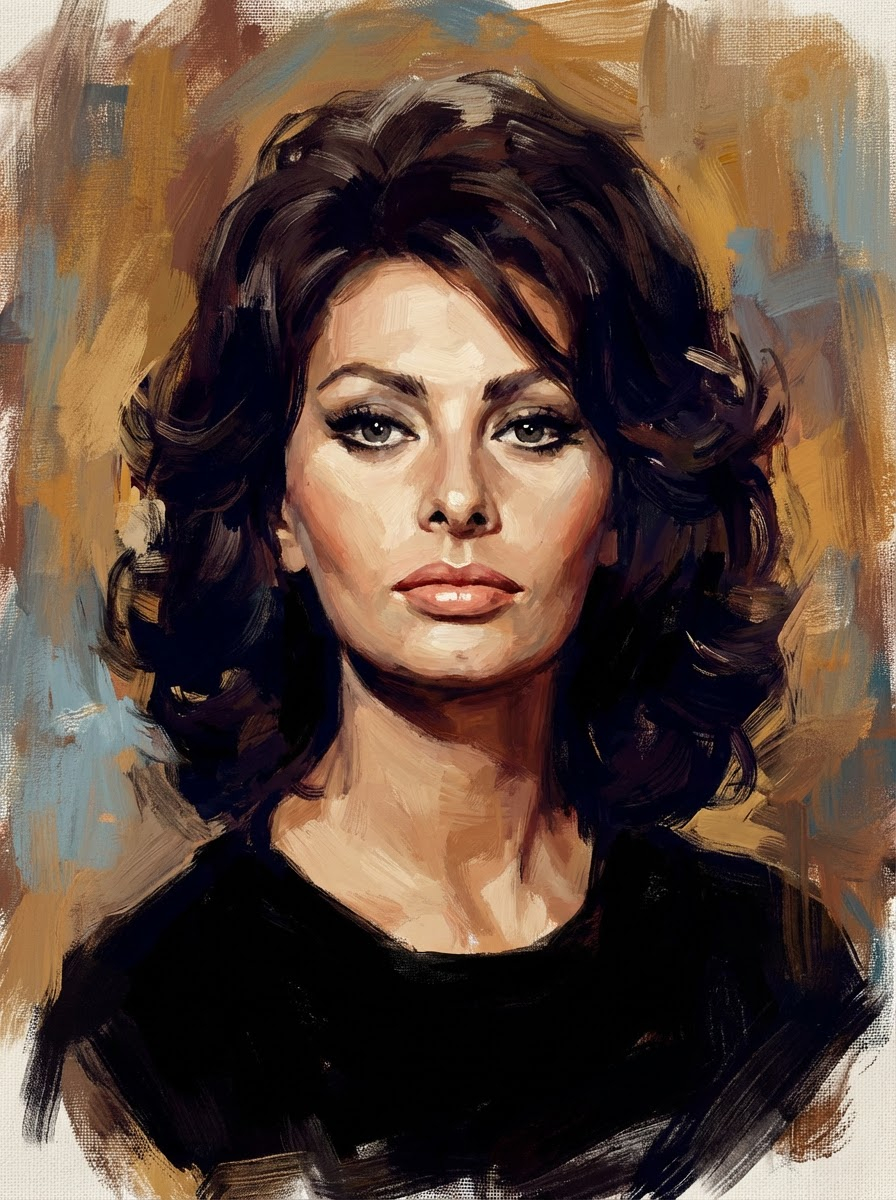
Sophia LorenPortrait · Sophia Loren

From the Pozzuoli Bombings to Cesira's War

Born Sofia Villani Scicolone on September 20, 1934, in Rome, to an unmarried mother from Pozzuoli near Naples — raised in poverty during the Second World War, living through the Allied bombing of Pozzuoli in 1943, an experience that would later provide the emotional foundation for La Ciociara. She arrived in Rome in her teens, entered beauty contests, appeared as an extra in films, and was discovered by producer Carlo Ponti, whom she eventually married despite the extraordinary legal difficulties Italian law placed in the way of their union.

Vittorio De Sica's La Ciociara (1961, released internationally as Two Women) — Loren as Cesira, the Roman shopkeeper who flees with her teenage daughter to the countryside during the German occupation of Italy, and who survives the war's horrors including a devastating assault — won her the Academy Award for Best Actress: the first time the award had been given for a performance in a foreign language, in a foreign film. The performance is one of the most completely realised in cinema history: the survival instinct and the grief at the same scale, the mother's love that cannot protect what it loves most.

Her Hollywood career — Houseboat (1958), El Cid (1961), The Fall of the Roman Empire (1964) — demonstrated that the instrument worked in English as well as Italian, though it was always the Italian films with De Sica, Ettore Scola, and Edoardo Ponti that produced the most complete work. The De Sica collaboration — nine films across three decades — is the centre of the career: a director who understood exactly what she contained and a series of films designed to demonstrate it. Equally defining is her partnership with Marcello Mastroianni, the Italian cinema's other great personality of the era: they appeared together in Ieri, oggi, domani (1963), Matrimonio all'italiana (1964), Una giornata particolare (1977), and Prêt-à-Porter (1994), among others — a pairing so natural and so frequently revisited that their chemistry became its own genre, encompassing broad comedy, political allegory, and intimate chamber drama with equal ease.

She received an Honorary Academy Award in 1991 for her career achievement, the Jean Hersholt Humanitarian Award in 2021 at age eighty-six, and returned to leading roles in her son Edoardo Ponti's La vita davanti a sé (2020), winning the David di Donatello Award for Best Actress at eighty-six. She is still working.
1934
Born Rome; raised Pozzuoli; poverty; wartime bombing; beauty contests; Ponti
1954
De Sica discovers the instrument; the Italian career established
1958
Hollywood: Houseboat with Cary Grant; El Cid with Heston; the range confirmed
1961
La Ciociara — Cesira; Oscar won; first foreign-language Best Actress
1991
Honorary Oscar for career achievement; the Academy corrects an oversight
2020
La vita davanti a sé — directed by her son; David di Donatello at age 86
2021
Jean Hersholt Humanitarian Award; age 86; still working; still Naples

From Cesira's Flight to Filumena's Decades

1960War Drama · Vittorio De Sica · Jean-Paul Belmondo
La Ciociara (Two Women)
De Sica's wartime drama — Loren as Cesira, the Roman widow who flees with her daughter Rosetta to the countryside during the German occupation, and who cannot protect her daughter from the violence that arrives when the German retreat exposes them to Moroccan irregulars in a bombed-out church. The Academy Award; the first foreign-language Best Actress win; and the performance that settled any remaining question about the range of the instrument: the survival instinct and the grief at equal scale, the mother who survives what she cannot forgive herself for surviving.
Oscar Won

Cesira's quality — the survivor whose survival is also a form of loss, the mother whose love could not protect what it loved — is played by Loren with the specific authority of a woman who had spent the actual wartime in Pozzuoli, who had been bombed, and who did not need to imagine what the fear felt like. The church scene — the assault, Cesira's screaming, Rosetta's silence afterward — is the most devastating sequence in the Loren filmography and one of the most devastating in Italian cinema: the violence not shown but its aftermath played with the completeness of someone who understood what it meant.

1964Comedy · Vittorio De Sica · Marcello Mastroianni
Ieri, oggi, domani (Yesterday, Today and Tomorrow)
De Sica's anthology comedy — Loren in three entirely different characters across three stories, each opposite Marcello Mastroianni: the Naples black-market cigarette seller who evades prison by staying perpetually pregnant; the bored Milan socialite who begins an affair to relieve the tedium; and the Rome call girl whose charge falls for the seminarian next door. Best Foreign Language Film Oscar; and the proof that the range encompassed high comedy as completely as it encompassed grief.
Best Foreign Film

The three characters' quality — each distinct, each comic, each using a different instrument — is the demonstration that De Sica understood what he had found. The striptease in the third episode — Loren slowly removing her stockings for Mastroianni's Renzo while the seminarian next door tries and fails not to watch — is the film's most famous sequence and Loren's most complete demonstration of comic timing: the awareness of the effect, the control of the pace, the specific pleasure of someone who knows exactly what they are doing and why it is funny.

1977Drama · Ettore Scola · Marcello Mastroianni
Una giornata particolare (A Special Day)
Ettore Scola's two-character chamber piece — Loren as Antonietta, the exhausted Fascist housewife who meets and forms a tentative bond with the gay journalist Gabriele (Mastroianni) on the day Hitler visits Rome in 1938. No makeup; the glamour deliberately stripped away; the De Sica neorealist inheritance applied to an intimate domestic drama of two people briefly making each other's lives possible. César Award; the most stripped-back and arguably the finest performance of her career.

Antonietta's quality — the woman whose life has been entirely shaped by Fascist domesticity and who has one day in which to recognise what that domesticity has cost her — is played by Loren without the instrument's usual glamour, which is the performance's central argument: the beauty is a role, not the person, and the person beneath it has a specific dignity that the beauty had obscured. The film is a rebuke to every earlier performance that had used the beauty as the instrument's primary register — and the rebuke works because Loren understood exactly what she was rebuking.

1979Drama · Eduardo De Filippo · Mastroianni · Neapolitan Theatre
Filumena Marturano
Eduardo De Filippo's adaptation of his own play — Loren as Filumena, the Naples woman who spent twenty-five years as the mistress of a wealthy merchant and who forces him to marry her by pretending to be dying, then reveals she has three sons by different fathers, one of whom is his. The Neapolitan theatrical tradition fully inhabited; the Naples identity the career had always contained but rarely foregrounded; and the performance of a woman whose entire life has been strategy in service of love.

Filumena's quality — the woman whose intelligence has been deployed entirely in the service of a love she has never been permitted to name as such — is played by Loren with the specific Naples knowledge that the role required: the cadences, the logic, the specific combination of warmth and cunning that the city had always produced and that the career had always contained. The film returns Loren to the Naples tradition that De Sica had drawn on from the beginning, and the return is complete: the instrument and the material finally at the same temperature.

"

Everything you see, I owe to spaghetti.

— Sophia Loren

The First Foreign-Language Win — The Career They Finally Recognised

Academy Award — Best Actress
1962
La Ciociara (Two Women)
The first actress to win the Academy Award for a performance in a foreign language — the Academy's recognition, sixty years before the practice of subtitled films became mainstream in American cinemas, that the instrument was complete regardless of what language it performed in. The Oscar was received in absentia; Loren was told the result by De Sica and wept in her hotel room in Rome, unable to believe it.
First Foreign-Language Win
Honorary Academy Award
1991
Career Achievement
Honorary Oscar for one of the genuine treasures of world cinema — the Academy's acknowledgment that a career conducted largely outside Hollywood had produced work of equivalent seriousness to anything the American industry had generated. The award corrected the oversight of the preceding thirty years, during which Loren had continued to make films of the highest quality in the Italian tradition without the recognition the Hollywood system typically provides.
Honorary Oscar
Jean Hersholt Humanitarian Award
2021
Lifetime Humanitarian Service
Jean Hersholt Humanitarian Award at eighty-six — the Academy's recognition of decades of charitable work for children's welfare, UNICEF advocacy, and humanitarian causes. The award was announced the same year as the Netflix release of La vita davanti a sé, directed by her son Edoardo Ponti, confirming that the humanitarian and creative careers were simultaneously active at an age when most careers are entirely retrospective.
Humanitarian Award, Age 86
David di Donatello — Best Actress
2021
La vita davanti a sé
Italy's highest film award for Best Actress — given for her performance in La vita davanti a sé, directed by her son, at age eighty-six. The award confirmed what the Honorary Oscar and the Hersholt Award had gestured toward: that the instrument had not diminished with age, that the Naples quality was still present, and that a career that had begun in beauty contests in 1950 was still producing work of the highest standard seventy years later.
Age 86 — Still Active

Naples — De Sica — The Beauty That Was Not the Instrument

The Naples Identity
The Naples childhood — the poverty, the wartime bombing, the Pozzuoli community — is the foundation of the instrument and the source of its specific quality: the survival instinct, the comedy as a form of resilience, and the grief that comes from knowing what real loss looks like. La Ciociara worked because Cesira's experience was not invented; the instrument had the raw material already.
The De Sica Partnership
Nine films with Vittorio De Sica — the Italian neorealist director who understood what Loren contained and built a series of films designed to demonstrate it. The collaboration produced La Ciociara, Ieri, oggi, domani, Matrimonio all'italiana, and I girasoli — the body of work that defines the career and that the Academy recognised, belatedly, with the Honorary Oscar. De Sica knew what he had; he spent twenty years proving it.
The Beauty and the Instrument
Una giornata particolare — the no-makeup, stripped-back performance — is the clearest argument that the beauty was never the instrument; it was the surface the instrument operated from. The performance works because Loren understood this distinction and was willing to demonstrate it publicly in a film that deliberately denied her the resource that the industry had always used as the primary argument for her value.
The Still Working
David di Donatello at eighty-six, for a film directed by her son — the career that ended, returned, ended again, and returned again, always to Italian material, always to the Naples tradition. The longevity is not merely survival; it is continued creative engagement with the material that produced the best work, in collaboration with the family that produced the life. The continuity is the argument.

Cesira's Church — Filumena's Patience — The Award They Had Not Given Before

Sophia Loren's legacy is La Ciociara and the first — the first foreign-language performance to win Best Actress, the Academy's acknowledgment that the neorealist tradition of postwar Italy could produce drama as complete as anything Hollywood made. Two Oscars, the Jean Hersholt Award, the David di Donatello at eighty-six, nine films with De Sica, and the specific quality that Una giornata particolare demonstrated when all the usual resources were stripped away: the instrument beneath the beauty, the Naples woman beneath the glamour.

She is still working. The La vita davanti a sé performance in 2020, at eighty-six, directed by her son Edoardo Ponti, is not a retrospective gesture but a piece of active creative work — the proof that the instrument, developed from a beauty contest entry in 1950 through six decades of Italian and international cinema, remains capable of the fullness the best work has always required. The spaghetti she mentioned is the joke; the survival is the subject; and the Naples childhood is still the foundation.

Oscar Won
La Ciociara — first foreign-language Best Actress
1962
Films with De Sica
The defining collaboration
9
David di Donatello — Age
La vita davanti a sé, 2021
86
Honorary Oscars
1991 Career · 2021 Humanitarian
2