O'Fallon, Illinois · 1918 – 1981

William Holden

The golden-faced cynic of the studio era — handsome enough to be a conventional star and talented enough to subvert it. From Sunset Boulevard to Network, he made world-weariness look like wisdom.

1
Academy Award
Won
3
Oscar
Nominations
75+
Film
Credits
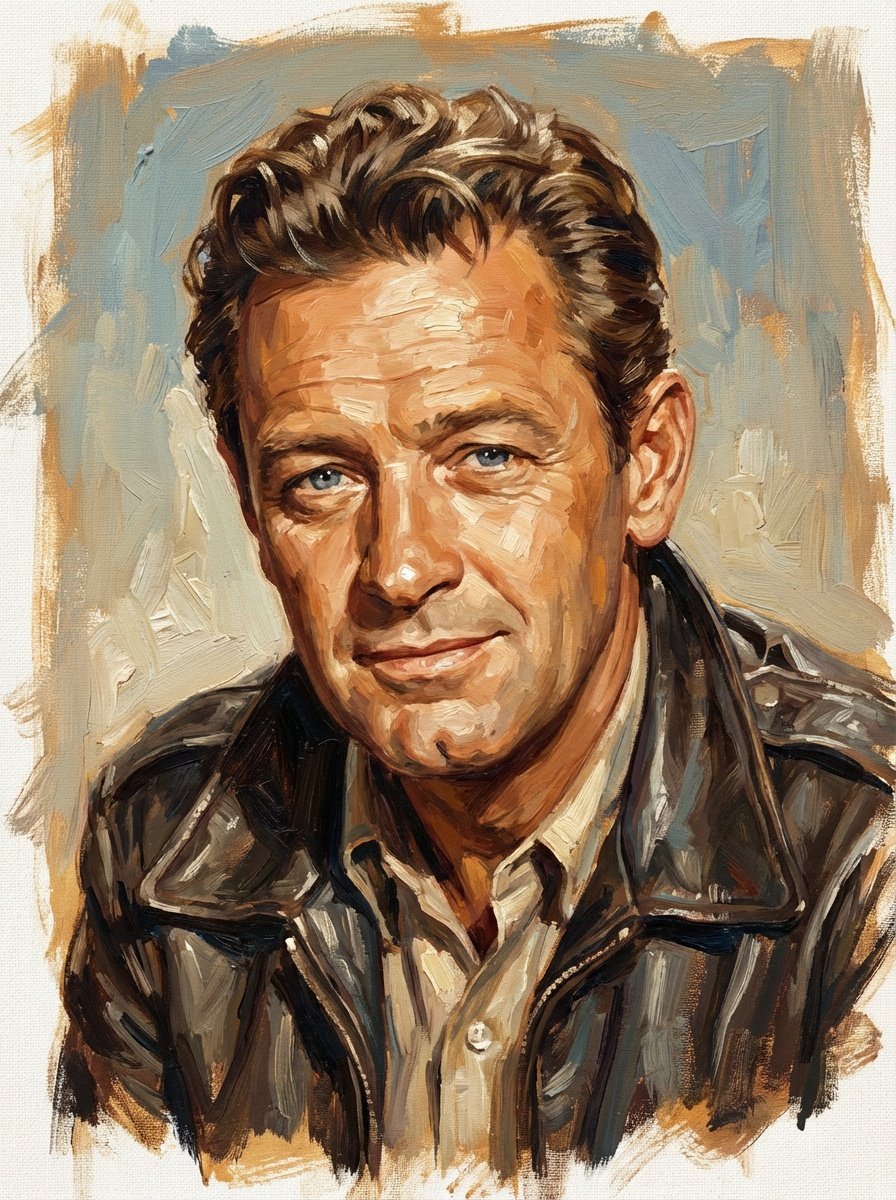
William Holden — painted portrait Portrait · William Holden

The Golden Boy Who Learned to See Through It All

Born William Franklin Beedle Jr. on April 17, 1918, in O'Fallon, Illinois — raised in Pasadena, California — he was discovered by a Paramount talent scout while performing in a radio class at Pasadena Junior College. He was twenty. The studio changed his name and immediately cast him opposite Barbara Stanwyck in Golden Boy (1939), and a career was launched before he understood what that meant.

He spent the war years in the Air Force making training films and returned to find Hollywood had moved on. It was Billy Wilder's Sunset Boulevard (1950) that transformed him — playing Joe Gillis, the kept screenwriter floating dead in a swimming pool, whose cynical narration became one of Hollywood's sharpest acts of self-examination. The role required Holden to be handsome, weak, compromised, and ultimately tragic. He nailed all four simultaneously.

His Academy Award came for Stalag 17 (1953), Wilder's prisoner-of-war dark comedy — a performance of carefully constructed ambiguity in which you never fully know whether Sefton is heroic or simply shrewd. He was the perfect Wilder hero: smart enough to survive, too cynical to pretend it was more than that.

His later career included the defining Western valediction The Wild Bunch (1969), Sam Peckinpah's blood-soaked elegy for the outlaw life, and Network (1976), in which his measured performance as Max Schumacher anchors a film of furious, prophetic satirical energy. He died alone in his Santa Monica apartment in 1981, a fall and a hemorrhage ending a life that had by then been seriously damaged by alcoholism.
1918
Born William Beedle Jr., O'Fallon, Illinois
1939
Golden Boy — studio debut, renamed by Paramount
1950
Sunset Boulevard — Joe Gillis; career-defining role
1954
Oscar win — Best Actor, Stalag 17
1954
Sabrina — Wilder, Audrey Hepburn; romantic peak
1969
The Wild Bunch — Peckinpah's outlaw elegy
1976
Network — Oscar nomination; Paddy Chayefsky's prophecy
1981
Dies alone in Santa Monica, California, age 63

From Sunset Boulevard to Network

1950Noir · Drama
Sunset Boulevard
Billy Wilder's merciless dissection of Hollywood — Holden as Joe Gillis, an opportunistic screenwriter who takes up with the deranged former star Norma Desmond, and narrates his own story from beyond death.
Oscar Nom

Holden plays weakness with uncommon grace — Joe Gillis is compromised in every scene and sympathetic in every scene simultaneously. The role required a kind of moral ambiguity that most leading men of the era would have refused, or been unable to sustain.

1953War · Dark Comedy
Stalag 17
Wilder's German POW camp film — Holden as Sefton, the camp's cynical entrepreneur, suspected of being an informer. The performance that won him the Academy Award for Best Actor.
Oscar Win

Sefton is never fully vindicated or condemned by the film — he is simply efficient, which Holden plays as a form of dignity in an undignified situation. The ambiguity is the performance.

1969Western · Elegy
The Wild Bunch
Sam Peckinpah's blood-soaked masterwork — Holden as Pike Bishop, leader of an aging outlaw gang making one last score in a world that has no use for them. The film that changed the Western forever.

Holden's weathered face carries the weight of a genre's mortality — he is not just a man getting old but an entire way of life that is already over. One of cinema's great farewell performances, though he was only 51.

1976Satire · Drama
Network
Sidney Lumet's prophetic media satire — Holden as Max Schumacher, the news division president watching his world consumed by showbiz spectacle. The conscience of Paddy Chayefsky's furious masterwork.
Oscar Nom

Against Peter Finch's magnificent madness and Faye Dunaway's icy ambition, Holden's Max is the film's moral anchor — exhausted, clear-eyed, and ultimately powerless. A performance of controlled devastation.

1954Romance · Comedy
Sabrina
Wilder's romantic comedy — Holden as the rakish younger Larrabee brother, pursued by the chauffeur's daughter Sabrina. A lighter register that showed the full range of a star comfortable in any mode.

Opposite Audrey Hepburn, Holden demonstrates the ease of a genuine leading man — he makes charm look effortless because for him it largely was. The charming surface of the man that hid everything the darker films revealed.

"

I used to be in the business of acting. Now I'm in the business of surviving. They're not the same business.

— William Holden

An Oscar, a Wilder Career, and a Prophet's Eye

Academy Awards — Best Actor
Stalag 17
Academy Award for Best Actor
1954
Oscar Won
Academy Awards — Nominations
Sunset Blvd · Network
Best Actor nominations — his finest bookends
1951 · 1977
2 Oscar Nominations
Hollywood Walk of Fame
Star on the Walk
Inducted to Hollywood's Walk of Fame
1960
Walk of Fame
Cecil B. DeMille Award
Golden Globe · Lifetime Achievement
For outstanding contributions to entertainment
1979
Lifetime Honor

The Handsome Man Who Refused to Be Just That

Moral Ambiguity
Holden specialized in men you couldn't fully trust and couldn't fully dismiss — Joe Gillis, Sefton, Pike Bishop, Max Schumacher. He made compromise feel like a form of honesty rather than a failure of character.
The Wilder Partnership
Four films with Billy Wilder — Sunset Boulevard, Stalag 17, Sabrina, Fedora — gave Holden the material he needed to move beyond the golden-boy image. Wilder saw in him a fatalism that conventional casting concealed.
Weathered Masculinity
By the late 1960s, Holden's face had acquired a texture that young-Hollywood handsomeness couldn't supply. Peckinpah and Lumet understood this and used it — his later performances have an authority rooted in lived experience, not technique.
The World Off-Screen
Holden co-founded a wildlife conservancy in Kenya, was deeply committed to African wildlife preservation, and spent years on the continent. The environmental adventurer and the cynical screen persona were, in his case, different faces of the same restlessness.

The Star Who Was Better Than the Star System

William Holden is one of those stars whose true stature only becomes clear when you look at the range of what he did — not just the hits, but the texture of the choices. From Joe Gillis to Pike Bishop to Max Schumacher, he consistently chose roles that required him to be inadequate in some fundamental way, which is precisely what made him more interesting than most of his contemporaries.

The alcoholism that shadowed his later years and ultimately killed him at 63 was, like everything else about him, visible in the work. The films of his final decade have a tragic weight that belongs both to the characters and to the man playing them. He was aware of it, and he kept working anyway — which is, in its way, another form of the movie star's particular courage.

Academy Award
Best Actor, Stalag 17, 1954
Won
Oscar Nominations
Sunset Blvd · Stalag 17 · Network
3
Films with Wilder
The defining Hollywood partnership
4
Film Credits
Features across four decades
75+